Inside Son Doong, Vietnam's Massive Record-Breaking Cave Passage
Son Doong's caverns soar taller than 65 stories and host their own jungle; only 1,000 visitors a year may enter, reshaping one Vietnamese community's livelihood.
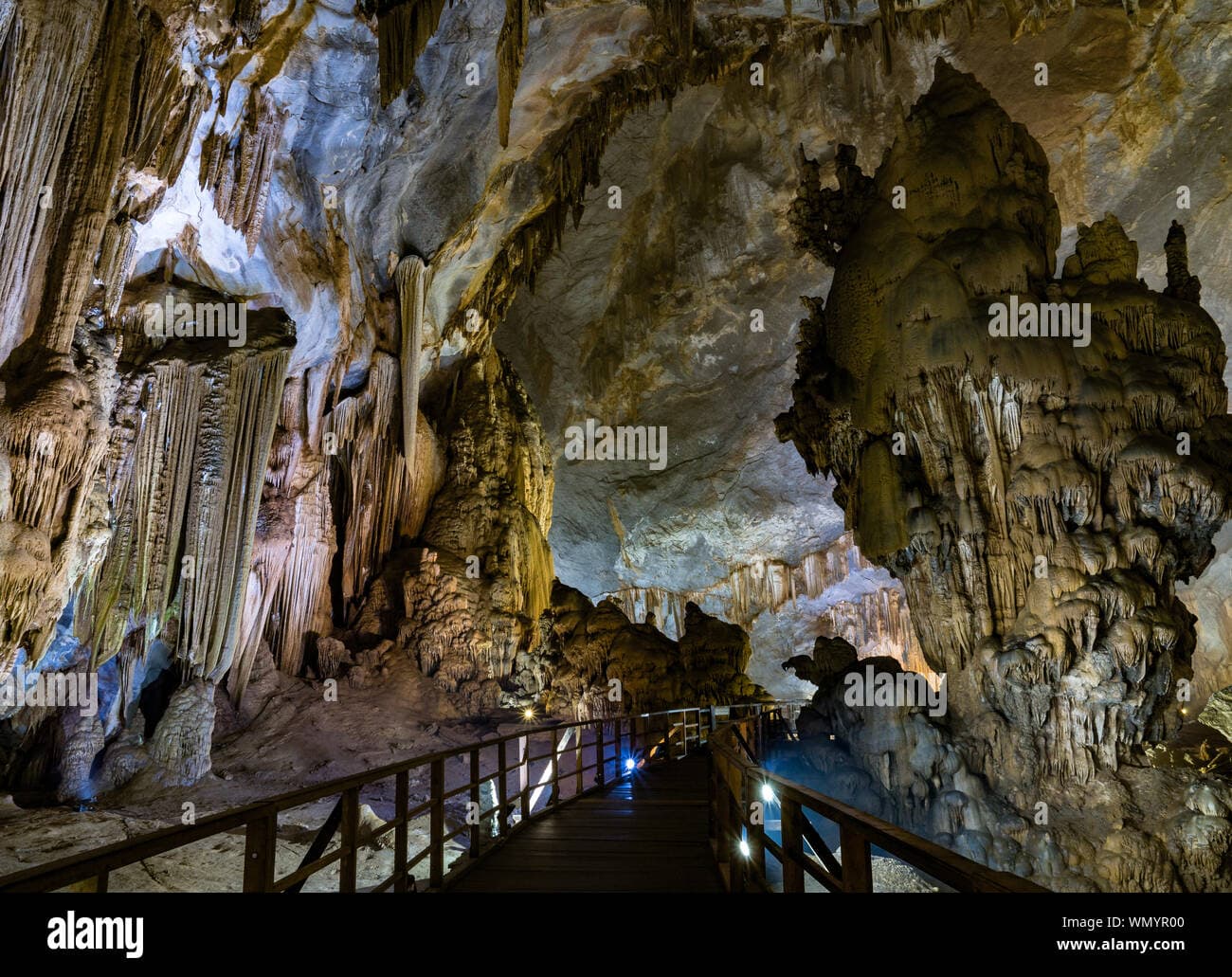
In December 1990, a forager named Ho Khanh was pushing through the jungles of Phong Nha-Ke Bang National Park in central Vietnam when a rainstorm forced him toward a limestone cliff for shelter. He found a dark opening in the rock, felt a freezing wind pouring out of it, watched clouds billow from the entrance, and heard a river raging somewhere far below. Unsettled, he walked away. By the time he reached home, he had forgotten its exact location. That forgotten hole turned out to be Son Doong: a cave so vast its largest passage can accommodate a Boeing 747 in flight.
What Ho Khanh stumbled away from is now confirmed by National Geographic as the largest cave in the world by volume, measuring 38.5 million cubic meters. According to CBS News, its caverns reach higher than 65 stories and stretch as wide as one and a half football fields, large enough to contain the Great Pyramid of Giza inside a single chamber. The cave that started its life, in the words of one report, "millions of years ago as a crack the width of a piece of hair," has grown into something that defies ordinary architectural comparison.
The wonder is real. So is the tension over what access costs.
A Scale That Reorders the Imagination
Son Doong's dimensions don't translate easily into language, which is why every attempt to describe it reaches for borrowed monuments. Scientists say the cave was formed over two million years ago through the erosion of limestone by an underground river; the passage that river carved is nearly nine kilometers long and, at certain points, more than 200 meters high. Collapse events over hundreds of thousands of years opened massive skylights in the cave ceiling, called dolines, which now allow sunlight to penetrate deep underground and support a living ecosystem: biologists have documented more than 200 plant species growing inside Son Doong, including trees exceeding 40 meters in height, alongside blind fish that have adapted entirely to the cave's permanent darkness.
The Hope and Vision Passage, one of the largest chambers, contains an 80-meter-tall stalagmite recognized as the tallest in the world, rising alongside the uniquely shaped Hand of Dog formation. Deeper in, a newly discovered side passage holds fossils dating back an estimated 300 million years, an astonishing figure given that the cave passage itself is geologically recent by comparison. In the wet season, clouds form inside the cave near the dolines, creating an internal weather system that produces mist, wind, and the visual surrealism of weather occurring underground.
The Man Who Found It Twice
Ho Khanh returned to Son Doong in 2009, this time intentionally, guiding a joint expedition organized by the British Cave Research Association and the British-Vietnamese Cave Expedition Team. That expedition, led by caver Howard Limbert, spent 2009 and 2010 surveying the cave's immense passages and confirmed Son Doong as the largest natural limestone cave in the world. National Geographic Magazine independently verified the finding in 2011. In November 2023, the BBC's Planet Earth III brought Son Doong to a global television audience when Episode 6, titled EXTREMES, featured the cave alongside neighboring Hang En and Hang Va.
CBS News correspondent Scott Pelley described his 60 Minutes assignment to the cave as one of "the most physically demanding and visually stunning" of his career. "This was completely unique," Pelley said. His team's initial skepticism was captured in a line producer Nicole Young later recalled: "It's a hole in the ground. What are we going to take pictures of?" The footage that answered that question required trekking through dense jungle for a day and a half, navigating roughly 20 river crossings, constant wet conditions, and leeches that demanded frequent stops to clean out boots.
Ho Khanh, who spent his childhood foraging for agarwood in these same jungles because his family could not reliably grow enough food, now works as a guide for expeditions that charge upward of VND 79,500,000 per person, roughly equivalent to several thousand US dollars. The cave he once walked away from has become the economic engine of his entire region.
The Hard Cap on Wonder
Son Doong is not freely open. Oxalis Adventure, the sole operator authorized by Vietnamese authorities to organize expeditions to the cave, restricts entry to just 1,000 visitors per year. Tours run only between January and August; the remaining months are closed to allow the cave's ecosystem and weather cycles to reset without human interference. Each individual expedition is capped at ten participants, meaning the number of people who experience Son Doong in a given year is smaller than the capacity of a single commercial aircraft.
That cap is both a conservation tool and a market mechanism. At VND 79,500,000 per person, the expedition is priced to reflect genuine scarcity. The itinerary, which runs across four days and three nights inside the cave itself, demands physical fitness alongside financial commitment: the approach alone includes a 262-foot vertical descent into the cave's first huge passage, river crossings that may require a boat depending on water levels, and a support team of 16 porters, safety specialists, and guides whose livelihoods depend entirely on those 1,000 annual permits.
The exclusivity creates a cascading economic impact in Phong Nha, the small town that serves as the base for all Son Doong expeditions. Longer itineraries, such as the seven-day mini-expedition offered by some operators, include two nights at a local hotel in the village, two nights camping in the national park, and three nights camping inside Hang Son Doong, multiplying the number of local businesses and workers touched by each visit. Deep in the park's strictly protected core zone, the isolated village of Ban Doong, home to the Bru-Van Kieu ethnic minority, now receives visitors who would otherwise have no reason to travel there at all.
What Three Nights Inside Actually Looks Like
The itinerary inside Son Doong is unlike anything offered elsewhere. On the first full day underground, explorers descend that 262-foot vertical drop into the cave's main tunnel, cross the underground river, and set up camp near the first doline. The Hand of Dog formation, an aptly named stalactite structure, marks the boundary of the first camp zone. Further in, the Great Wall of Vietnam, a massive calcite formation stretching across the cave, marks the boundary between the surveyed and the barely explored.
Oxalis describes the campsites as settling down on pristine sandy beaches, where natural light and moonlight stream through the overhead dolines and transform the cavern ceiling into what the company calls "a breathtaking, sparkling starry sky." It is a description that sounds promotional until the geology confirms it: those dolines, open to the sky above, do genuinely channel moonlight 200 meters down through humid cave air onto pale sand. The effect is documented by every photographer who has camped there, including the Planet Earth III crew.
The cave's alternate name, the Cave of Teeth, comes from the stalagmite formations that once stood at its entrance like a row of jutting incisors. Many are now gone, worn by time and the passage of explorers, but the name persists in the memory of every guide who leads tourists past where they once stood.
The Equation That Doesn't Fully Balance
Limiting Son Doong to 1,000 visitors per year protects the cave. It also raises a harder question about who gets to stand inside a natural wonder that belongs, in any meaningful sense, to everyone. The permit structure currently routes most of that economic benefit through a single operator, which concentrates control alongside conservation responsibility. For the communities around Phong Nha, whose poverty was once as stark as Ho Khanh's foraging childhood, the cave represents something more than a spectacle: it is the reason roads have been built, hotels have opened, and porters can earn a steady wage.
Whether 1,000 visitors a year is the right number, or whether climate change will eventually alter the cave's internal weather system and force further restrictions, are questions scientists and park authorities are still actively working through. What is not in question is the cave itself: a formation born from a hair-thin crack, hollowed over two million years by an underground river, ignored by one man on a rainy afternoon in 1990, and now confirmed as the largest void of its kind on Earth.
This article was produced by Prism’s automated news system from verified source data, official records, and press releases, then run through automated quality and moderation checks before publishing. The system is built and supervised by the people who set the standards it runs under. Read our full AI policy.
Did this article answer your question?