Investors Flood Struggling Wall Street Lender With Record Withdrawal Requests
Blue Owl Capital disclosed record withdrawal requests of 41% from one fund and 22% from another, far surpassing any comparable firm in the $1.8 trillion private credit market.

Blue Owl Capital disclosed on Thursday that investors in two of its private credit funds submitted record-breaking requests to exit, a stark sign of how quickly confidence has eroded in what was once Wall Street's most coveted lending sector.
Shareholders in Blue Owl's flagship Blue Owl Credit Income Corp., a $36 billion fund, asked to pull 21.9% of shares in the three months ended March 31, up sharply from 5.2% in the prior quarter. The deterioration was even more severe at the smaller Blue Owl Technology Income Corp., a $6 billion vehicle focused on software loans, where investors sought to redeem 40.7% of shares, compared with 15.4% three months earlier. No major asset manager in the $1.8 trillion private credit market had previously disclosed withdrawal requests approaching those percentages.
Blue Owl said it would honor only 5% of redemption requests at each fund, the standard industry cap, meaning the remainder of investor exits could take years to fulfill. In total, investors sought to redeem roughly one-quarter of the $23 billion held across the two funds, excluding debt, representing an extraordinary vote of no confidence in a firm that spent years marketing itself as the premier private lender.
In letters to investors, Blue Owl executives attributed the surge to "heightened negative sentiment toward direct lending and software" rather than any weakness in the funds' actual performance. The firm pointed specifically to "concerns around A.I.-related disruption to software companies" as a drag on investor perception. OCIC noted that 90% of its shareholders chose not to tender, suggesting the pressure was concentrated among a smaller group of investors. OTIC said its redemption pressure was "amplified by the fund's more concentrated shareholder base, particularly within certain wealth channels and regions."
Both funds have returned roughly 9% annualized since inception, and Blue Owl said each fund remains in a "strong position" to meet the capped requests. OCIC held $11.3 billion across cash, available borrowing, and liquid assets as of the end of February, while OTIC held $1.3 billion.
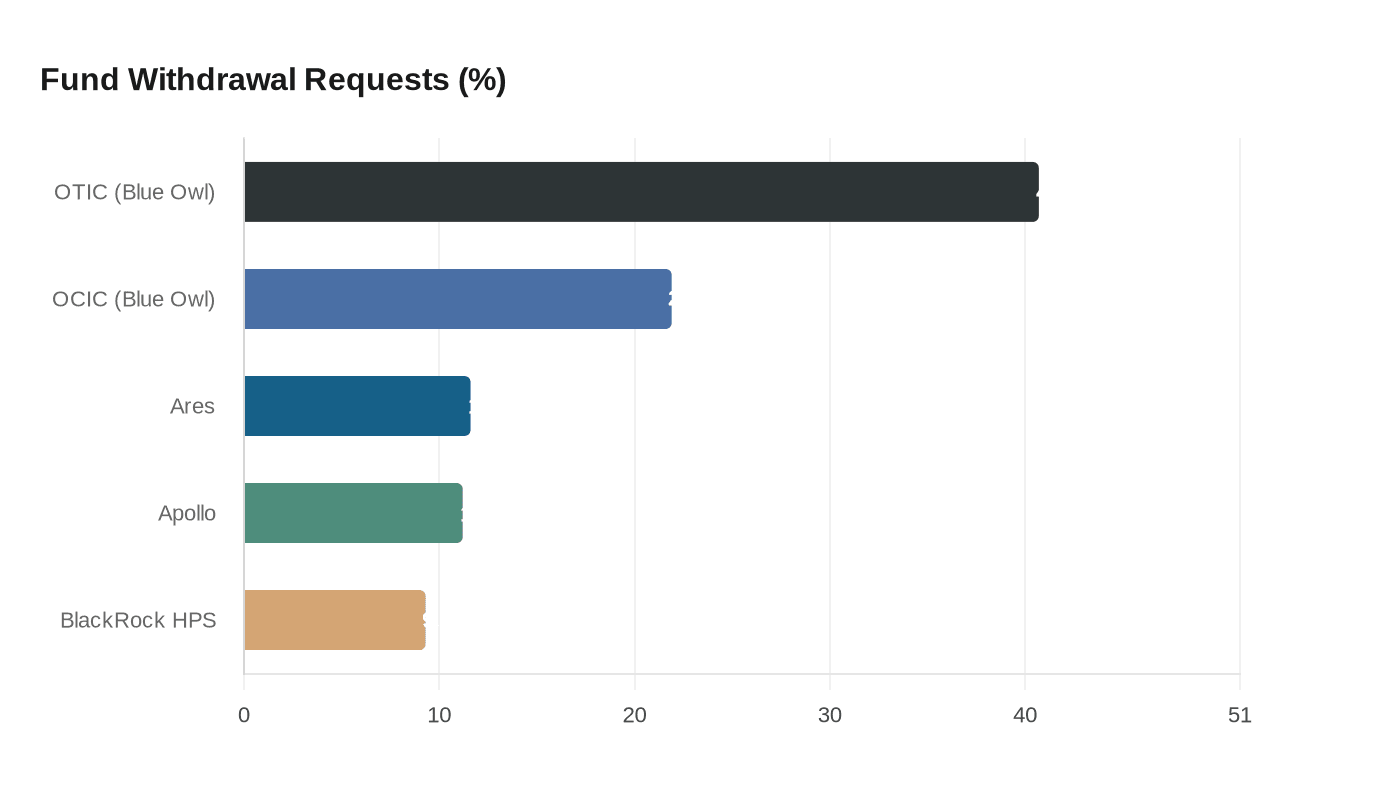
The disclosures arrive amid a broader reckoning across the private credit industry. Peer firms have faced their own redemption pressures in recent months: Ares saw 11.6% withdrawal requests at its flagship credit fund, Apollo fielded 11.2%, and BlackRock's HPS unit received requests totaling about 9.3% of assets. Blue Owl's figures dwarf those comparisons by a wide margin.
The roots of the turmoil trace back to high-profile collapses including First Brands, an auto parts manufacturer, and Tricolor, a subprime auto lender, both of which had taken on heavy loads of private credit debt. Those failures prompted JPMorgan Chase CEO Jamie Dimon to warn that problems in private credit are rarely isolated. For Blue Owl specifically, the fallout began accelerating in November after a scrapped merger between two of its funds, followed by outsized withdrawal requests from its tech-focused vehicle in January and a decision in February to sell $1.4 billion in assets while halting quarterly withdrawals from one retail-focused fund entirely.
Know something we missed? Have a correction or additional information?
Submit a Tip