Iran’s 1989 Khomeini funeral drew millions in historic chaos
Millions jammed Tehran for Khomeini’s burial, delaying the ceremony and crushing mourners, a display of revolutionary loyalty that turned funeral day into a political test.
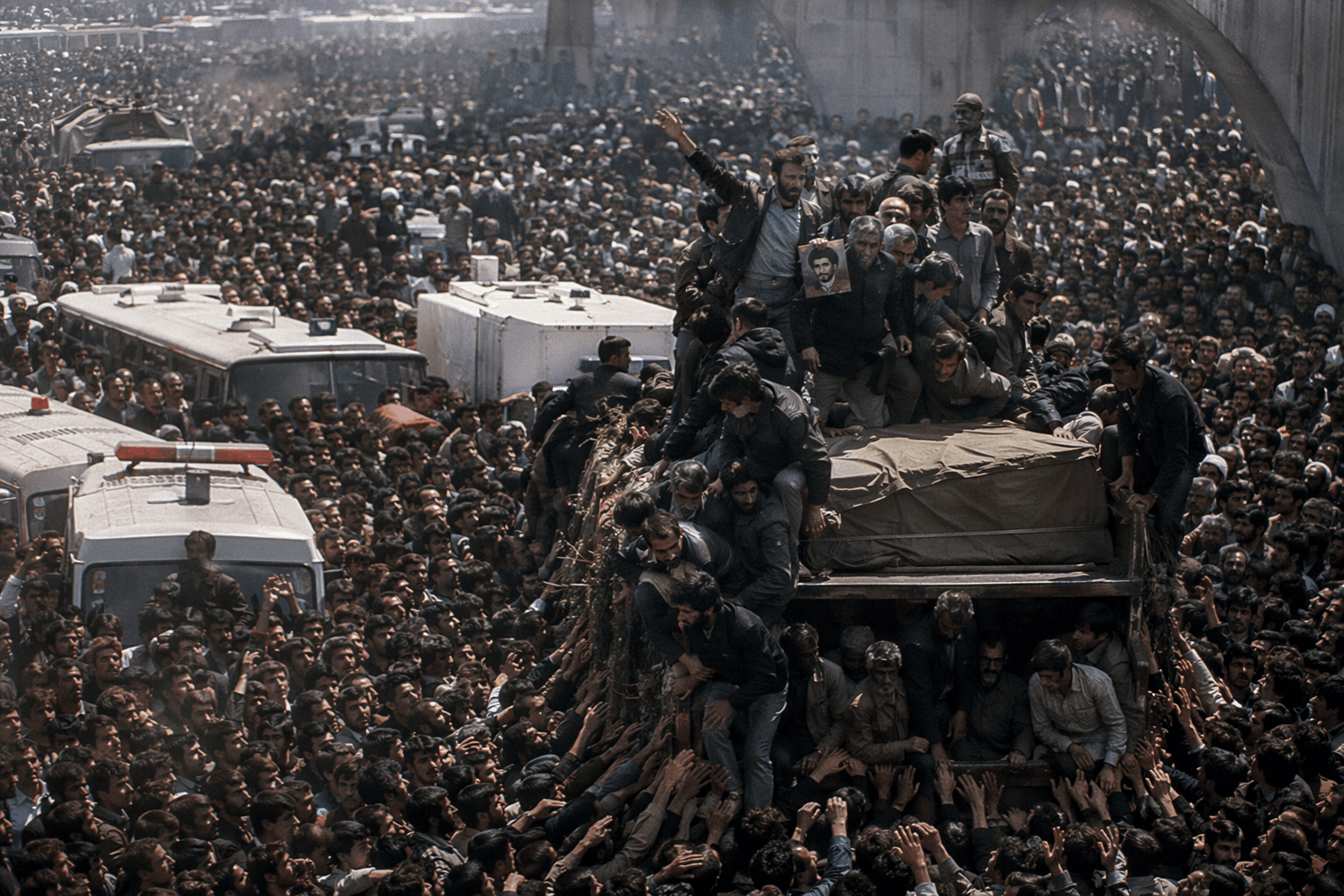
Ayatollah Ruhollah Khomeini’s burial in Tehran became a scene of such force and disorder that a reporter in Iran said it “surpassed anything I’ve ever witnessed.” Khomeini died on June 3, 1989, and when millions of Iranians came into the streets on June 6 to bury the founder of the Islamic Republic, the crowd overwhelmed the funeral organizers and pushed the ceremony off schedule.
The burial at Beheshte Zahra Cemetery was delayed as mourners surged toward the body in the intense summer heat. Contemporary accounts described people beating their chests, then being crushed as the mass pressed forward. Among those caught in the chaos was Khomeini’s son. The funeral was not only a moment of grief, but also a measure of how deeply the revolutionary state had fused itself with public ritual and political legitimacy.
Khomeini had led the 1979 Iranian Revolution, overthrew the shah, and became the first supreme leader of the Islamic Republic. Encyclopaedia Britannica describes how he declared Iran an Islamic republic and helped shape a new constitution built around his vision of velayat-e faqih, the system of clerical rule that placed religious authority at the center of the state. By the time of his death, he had governed through the hostage crisis at the U.S. embassy and the 1980-88 Iran-Iraq War, both of which had hardened the politics of the new republic.
That history helps explain why the funeral drew not just mourners but a political demonstration of enormous scale. Later widely cited estimates put the crowd at about 10.2 million people, roughly one-sixth of Iran’s population at the time, making it one of the largest funerals ever recorded. The sheer size of the turnout showed the reach of Khomeini’s revolutionary symbolism and the state’s ability to mobilize devotion in public.
The comparison with 1989 still matters because any funeral for a supreme leader in Iran is never only religious. It is also a test of elite cohesion, a display of regime confidence, and a reading on public mood at a volatile moment. In Khomeini’s case, the funeral crowds answered with numbers so vast that the ceremony itself nearly collapsed under the weight of the state he had created.
This article was produced by Prism’s automated news system from verified source data, official records, and press releases, then run through automated quality and moderation checks before publishing. The system is built and supervised by the people who set the standards it runs under. Read our full AI policy.
Did this article answer your question?