Iran’s security chief arrives in Oman to deliver nuclear response
Ali Larijani flew to Muscat to meet Omani mediators amid renewed indirect talks with the United States, signalling Tehran’s formal reply and testing a path back to negotiations.
Ali Larijani, secretary of Iran’s Supreme National Security Council and a close adviser to the supreme leader, arrived in Muscat on Feb. 10, 2026, for a sequence of high-level meetings that officials and regional media cast as central to restarting indirect nuclear talks with Washington. Iranian state photographs released by the SNSC show Larijani disembarking in Oman, and Iranian media said he would deliver an “important” message, AP reported.
Larijani met with Omani foreign minister Badr al‑Busaidi, whom multiple outlets describe as the chief intermediary in the U.S.-Iran negotiations, and photographs shared by Larijani’s entourage show the two men together with what appeared to be a letter sheathed in plastic sitting alongside the Omani diplomat, WRAL and AP reported. Iran’s state news agency IRNA told AP that Larijani also held a nearly three‑hour audience with Sultan Haitham bin Tariq, underscoring Oman’s role as host and facilitator for the stalled diplomatic channel.
The visit was widely presented as the likely delivery mechanism for Tehran’s response to an initial round of indirect talks in Muscat held last week. AP and WRAL said Larijani “likely” carried Iran’s reply to U.S. counterparts; Hindustan Times and other outlets similarly characterized the trip as conveying an indirect response. TRTWorld framed the arrival as intensified behind-the-scenes diplomacy after nearly eight months of stalemate, saying Larijani was expected to coordinate closely with Omani mediators on the structure, timing and location of any next round.
Tehran’s public negotiating posture remains firm. AP reported Iran’s foreign minister, Abbas Araghchi, told diplomats in Tehran that Iran would “stick to its position that it must be able to enrich uranium,” a central point of contention with U.S. negotiators. Neither Iran nor Oman has provided detailed public readouts of Larijani’s meetings, and IRNA’s terse description offered no specifics beyond calling the talks important, AP noted.
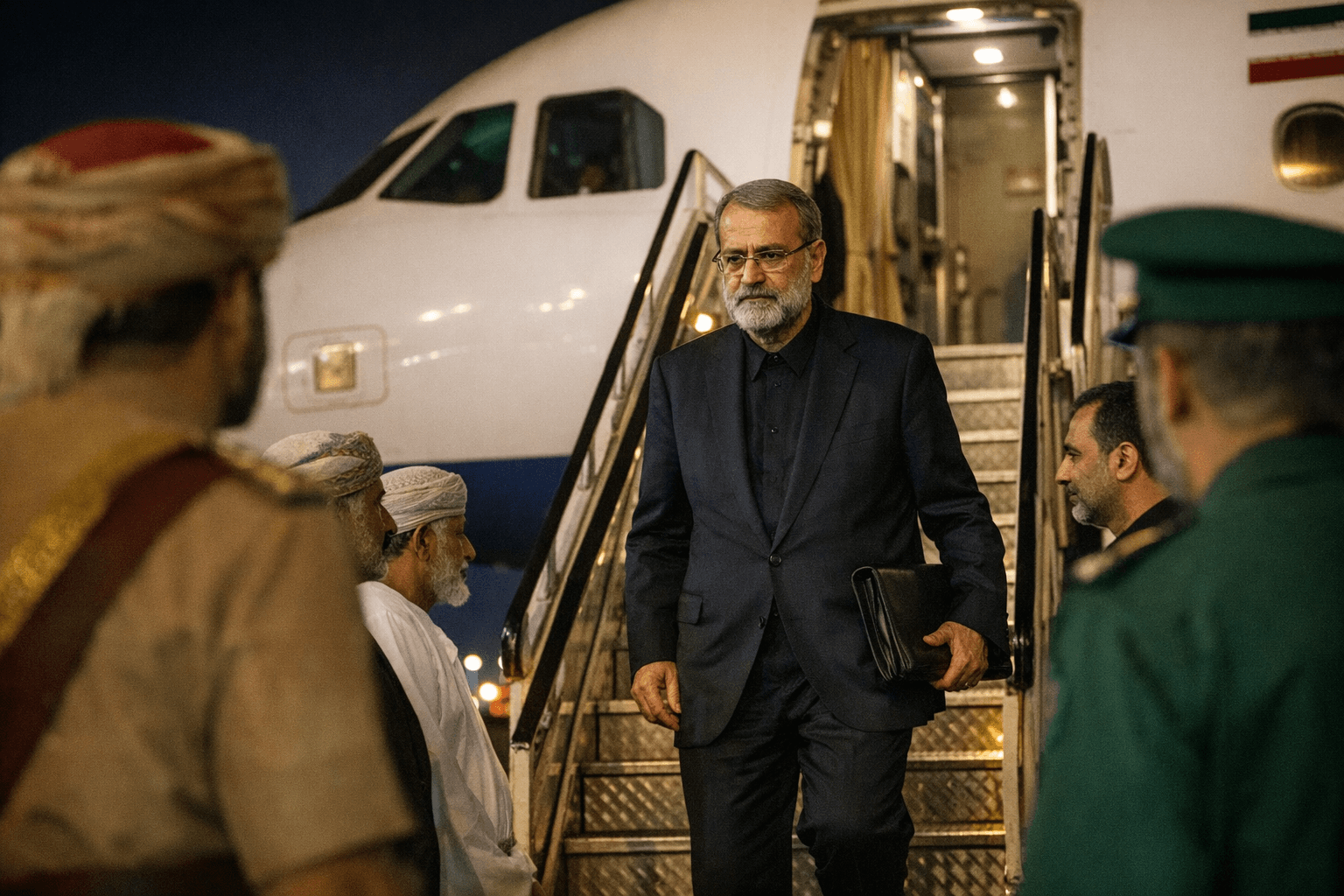
Omani media and Iran’s Mehr News Agency, cited by Shafaqna, added that Larijani met Sultan bin Mohammed Al Nu’amani, the minister of the royal office, and that further details would be released in due course. WRAL and AP reported that Larijani was later due to travel to Qatar, a move framed by those outlets against a fraught security backdrop: Qatar hosts a major U.S. military installation that Iran attacked in June after U.S. strikes hit Iranian nuclear sites during a 12‑day Iran‑Israel war, according to the same reporting.
The optics of written communications and palace-level audiences reflect a cautious, state‑to‑state choreography: Oman has long provided discreet channels between Tehran and Western capitals, and the presence of a sealed document alongside the foreign minister reinforces the expectation of a formalized response rather than public negotiating statements. Analysts and diplomats will watch whether the Omani meetings produce a U.S. reply and whether the parties commit to dates and formats for a next session.
For now, reporting leaves open basic confirmations: which officials saw any delivered message, the contents of any document shown in photos, and whether Washington formally received Iran’s response. Journalists noted these are key follow-ups; Iran, Oman and U.S. authorities have yet to publish substantive readouts.
This article was produced by Prism’s automated news system from verified source data, official records, and press releases, then run through automated quality and moderation checks before publishing. The system is built and supervised by the people who set the standards it runs under. Read our full AI policy.
Did this article answer your question?


