Irish police break up Dublin fuel blockade as shortages spread nationwide
Police moved tractors off O'Connell Street, but blockades at Whitegate and Galway had already left about 600 fuel stations dry and stretched emergency planning.
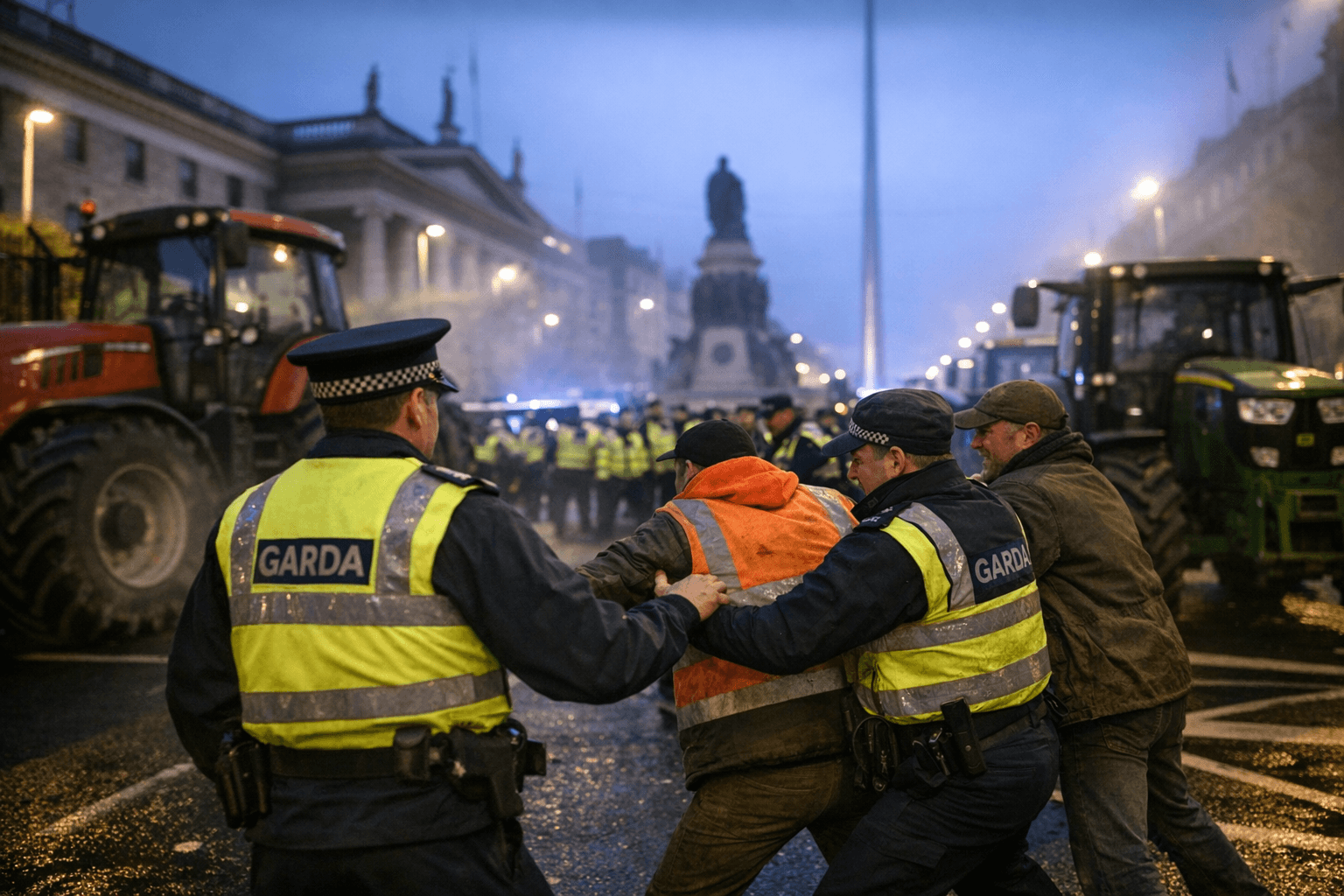
Police in Dublin broke up a fuel blockade on O'Connell Street Sunday, but the bigger crisis had already moved beyond the capital, turning a protest over soaring prices into a nationwide supply emergency.
Tractors and heavy goods vehicles that had clogged central Dublin were rolling out as authorities pushed to restore order, yet shortages were spreading from the country’s only oil refinery at Whitegate in County Cork to fuel depots in Galway city and Foynes in County Limerick. Those sites together supply roughly half of Ireland’s fuel, and the disruption quickly went from a political stunt to a logistics problem that touched commuters, hauliers and emergency planners alike.
In Galway, about 50 protesters remained at the docks while a tanker carrying 6 million litres of fuel sat moored in Galway Bay because storage tanks at the depot were full. Elsewhere, at least 60 tractors and heavy goods vehicles were parked on O'Connell Street, with sections of the M50, M1 and N7 also blocked. By the time police moved on the Dublin blockade, about 600 of Ireland’s 1,500 gas stations had already run out of fuel.
The sharpest confrontation came at Whitegate, where police used pepper spray to clear demonstrators after tankers were blocked from entering or leaving the refinery since Wednesday. The Justice Minister, Jim O'Callaghan, had ordered army assistance two days earlier, and soldiers were deployed with heavy-lifting equipment to remove trucks and tractors. Police said they were acting to protect public safety because fuel shortages could hamper emergency services.
The protesters say they are being forced into escalation by the cost of keeping vehicles and farms running. A farmer serving as a spokesman in Dublin said the group had been ambushed by police overnight and had little choice but to move expensive heavy vehicles rather than risk damaging their transmissions if they were towed. The demonstrations began Tuesday and spread by word of mouth and social media, drawing truckers, farmers and taxi and bus operators calling for price caps or tax cuts to blunt fuel inflation.
The government had already announced a 250 million euro package in March, including cuts to excise duty on diesel and petrol, but the backlash has only widened. Taoiseach Micheál Martin called the protests an "act of national sabotage," while police commissioner Justin Kelly rejected the tactics and said the blockades were not a legitimate form of protest. With organized farm and haulage groups staying out of the movement, the unrest now sits at a difficult intersection of household anger, transport disruption and a state trying to contain a blockade that is still testing the limits of public patience.
This article was produced by Prism’s automated news system from verified source data, official records, and press releases, then run through automated quality and moderation checks before publishing. The system is built and supervised by the people who set the standards it runs under. Read our full AI policy.
Did this article answer your question?