Japan factory sentiment edges up, but recovery stays fragile
Japan’s factory mood improved only slightly in May, with chemicals and metals recovering while autos, food processors and services stayed weak.

Japanese factory managers found some relief in May, but the rebound was too uneven to support any broad recovery narrative. The Reuters Tankan survey showed manufacturers’ sentiment rising to plus 8 from plus 7 in April, a modest gain that still left confidence far below March’s plus 18, a four-year high.
The improvement came mainly from commodity-linked industries. Materials sentiment turned positive again, with the index climbing to plus 5 from minus 3. Chemicals recovered to plus 6 from minus 8, while steel and nonferrous metals moved to zero from minus 25. Managers at a chemicals company and a ceramics firm pointed to front-loaded demand tied to the Middle East situation, underscoring how geopolitical shocks can briefly lift parts of Japan’s industrial base even as they rattle others.
The stronger numbers, however, masked deeper weakness in Japan’s export engine. Transport machinery confidence fell to plus 10 from plus 20, extending a slide from plus 36 in March. That category includes Japan’s automakers and their supplier networks, industries that sit at the center of global manufacturing and are closely watched by U.S. buyers, competitors and supply-chain managers. A transport machinery manager said the sector was beginning to feel production effects from supply constraints apparently linked to the blocking of the Strait of Hormuz.
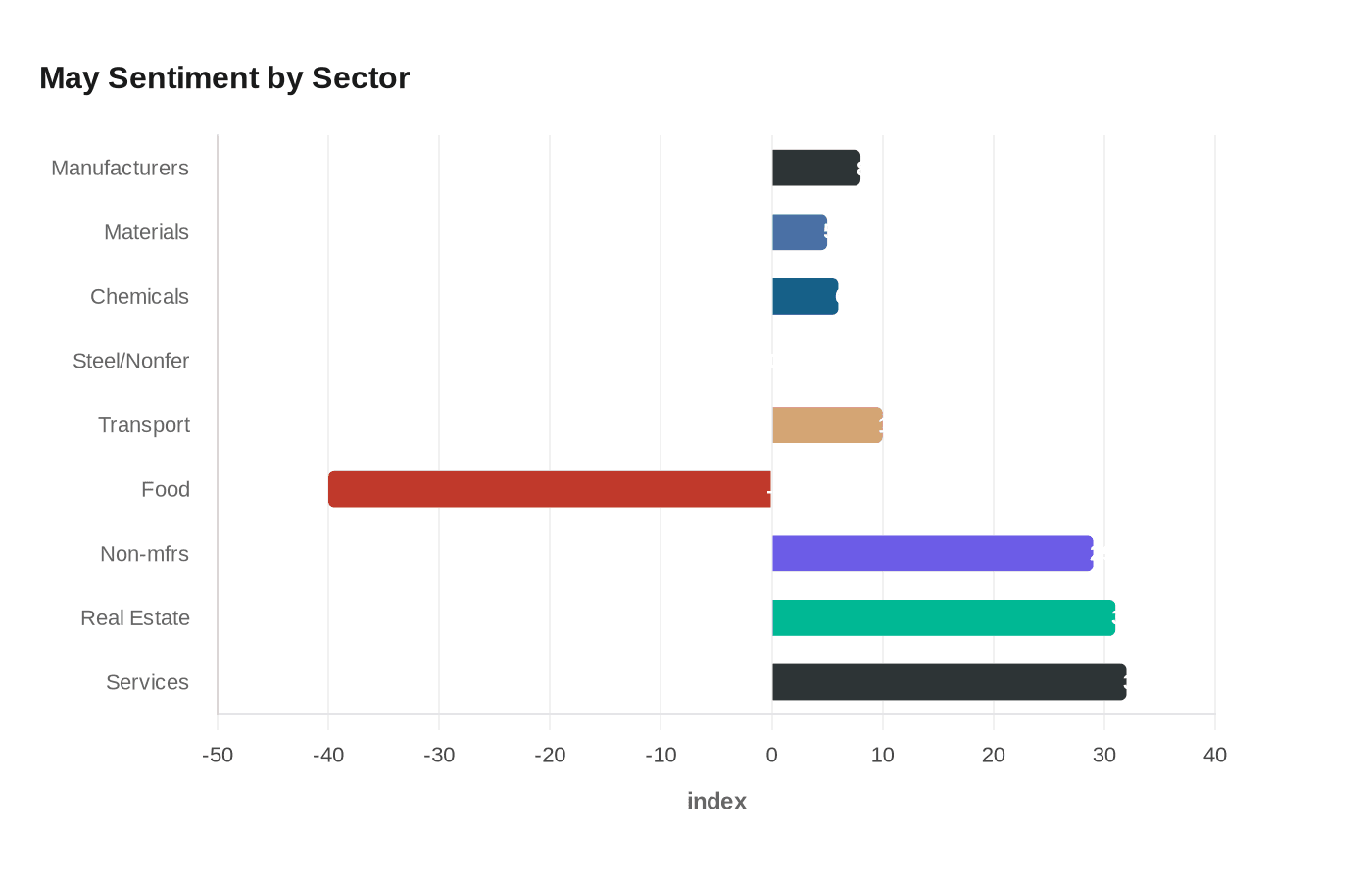
Other pockets of industry remained under clear pressure. Food processors dropped to minus 40, a six-year low, while textile-related industries stayed deeply pessimistic because of rising raw material costs and the weak yen. Even outside manufacturing, the picture softened: non-manufacturers slipped to plus 29 from plus 31, with real estate and construction falling to plus 31 from plus 41 and general services easing to plus 32 from plus 38. Wholesalers turned less upbeat, even as retailers became more optimistic.
The poll covered 220 major Japanese non-financial firms and was conducted from May 1 to May 15, 2026. It carries weight because it is a leading indicator for the Bank of Japan’s quarterly Tankan business survey, and the latest reading suggests policymakers are still looking at a patchwork economy rather than a clean turn upward. Respondents expected manufacturers’ sentiment to slip to plus 5 by August and non-manufacturers to ease to plus 18, a sign that caution still dominates corporate planning. For U.S. readers, that matters because Japan’s factory mood is often a proxy for demand in autos, machinery, materials and shipping-intensive supply chains that feed directly into global trade.
Know something we missed? Have a correction or additional information?
Submit a Tip