Keir Starmer’s landslide win fades as public support collapses
Labour won 411 seats on 33.7% of the vote, then saw support slide to 25% and Starmer’s approval sink to 13%.

Keir Starmer inherited a Commons supermajority, but not the kind of political mandate that can survive disappointment. Labour’s 2024 victory delivered 411 seats on just 33.7% of the vote, while the Conservatives crashed to 121 seats and 23.7%, a result built as much on Tory collapse as on a sweeping Labour surge.
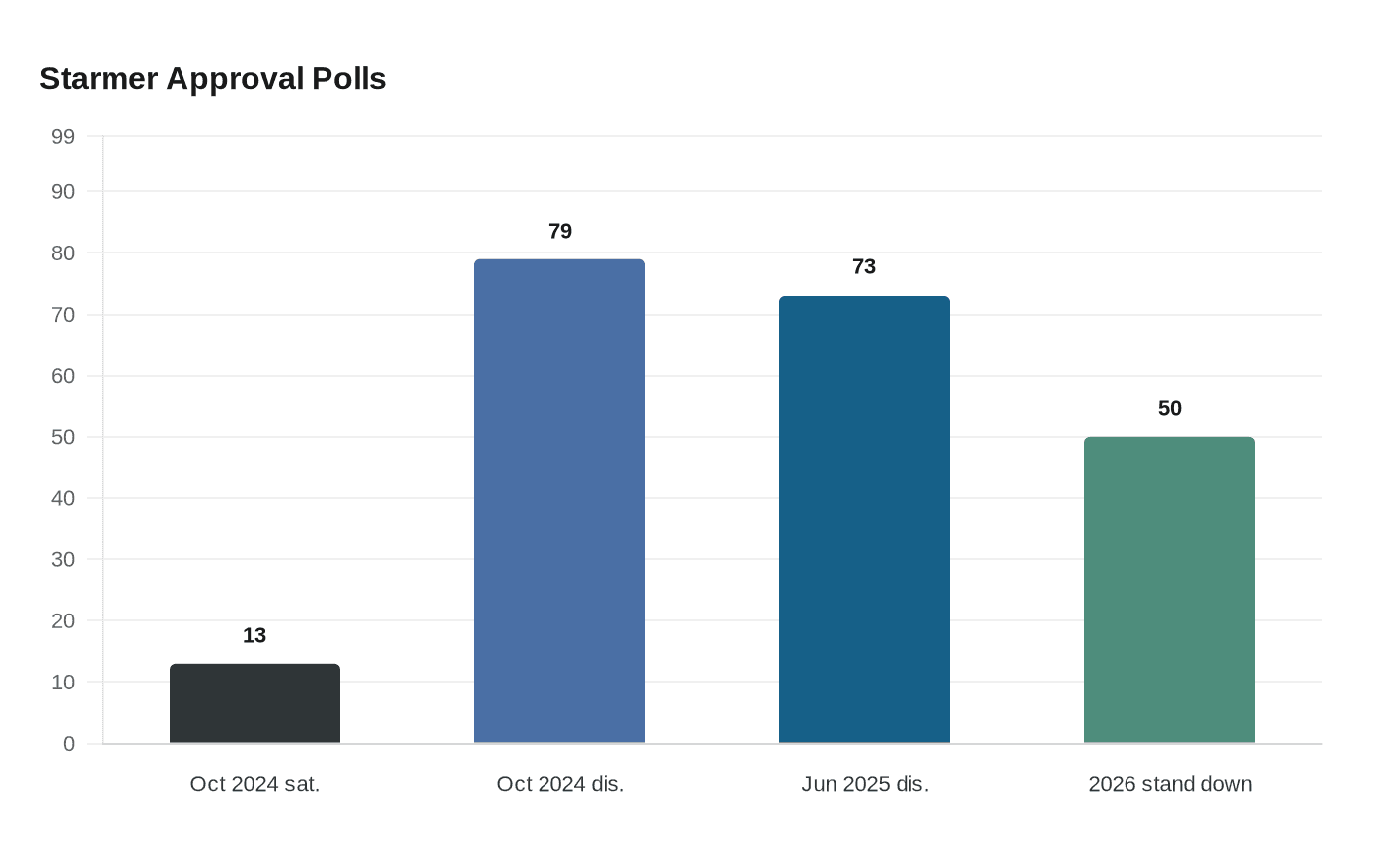
That gap matters because the first year in power exposed how thin the public coalition behind Starmer really was. By October 2024, Ipsos found only 13% were satisfied with the way he was doing his job as prime minister, while 79% were dissatisfied, the worst satisfaction score it had recorded for any prime minister since 1977. By February 2025, 56% of the public said they were disappointed in what Labour had done so far.

The slide continued into June 2025, when Ipsos said Labour’s voting intention had fallen to 25%, its lowest reading since October 2019. At the same point, 73% said they were dissatisfied with Starmer and 76% were dissatisfied with the government. By 2026, Ipsos found that 50% of Britons thought Starmer should stand down as prime minister and Labour leader. A landslide in seats had turned into a hard lesson in how quickly a shallow victory can be squandered.
The warning is sharper when measured against Labour’s own history. BBC coverage noted that Starmer’s win fell short of Tony Blair’s 1997 majority in popular-strength terms, and that Labour’s national vote share had risen by only 2 percentage points. The party did not so much storm the country as inherit the wreckage of a collapsed Conservative machine. That left Starmer with power in Westminster, but far less durable authority in the country.
For Democrats and other center-left parties watching across the Atlantic, the lesson is plain. A lopsided electoral map can disguise a fragile mandate if the opposition implodes and the winner enters office without a broad, enthusiastic base. Starmer’s trajectory shows how quickly a huge parliamentary majority can look like an empty one if voters do not feel immediate improvement and if the original frustration that drove the opposition’s collapse is left untouched.
This article was produced by Prism’s automated news system from verified source data, official records, and press releases, then run through automated quality and moderation checks before publishing. The system is built and supervised by the people who set the standards it runs under. Read our full AI policy.
Did this article answer your question?


