Kim Jong Un Oversees North Korea's High-Thrust Solid-Fuel Rocket Engine Test
Kim Jong Un personally oversaw North Korea's test of a 2,500-kilonewton solid-fuel rocket engine, advancing a five-year plan to expand the country's ICBM arsenal.

Kim Jong Un personally oversaw the ground test of a solid-fuel rocket engine capable of generating 2,500 kilonewtons of thrust, built with composite carbon fiber material, with the Korean Central News Agency reporting the milestone on March 29 without disclosing the date or location of the test itself. KCNA stated that the ground test formed part of a new five-year defense development plan aimed at upgrading North Korea's strategic strike capabilities.
The test likely indicates Kim is intent on enlarging and modernizing an arsenal of missiles capable of reaching the United States mainland. The 2,500-kilonewton output represents a marked jump beyond the 1,971-kilonewton solid-fuel engine that North Korea completed testing in previous rounds, indicating accelerating progress in the propulsion technology that underpins Pyongyang's intercontinental ballistic missile program.
KCNA reported that Kim presented "major tasks for further stepping up the development of the state strategic forces both in quality and quantity." The announcement came days after Kim delivered a speech at North Korea's Parliament pledging to irreversibly cement his country's status as a nuclear power and accusing the United States of global "state terrorism and aggression," in an apparent reference to the war in the Middle East.
The strategic weight of solid-fuel propulsion is considerable. Unlike liquid-fuel missiles, which require time-consuming and detectable fueling operations, solid-fuel systems fire with near-immediate readiness. They suit mobile launchers, resist satellite tracking, and carry a far simpler logistical footprint. Analysts say that North Korea's efforts to build more efficient rocket engines could also be aimed at developing smaller ICBMs that can be launched from a wider range of vehicles or submarines, a capability Kim is also pursuing. The composite carbon fiber construction reduces structural weight, which translates directly into extended range or increased payload capacity.
KCNA also reported that Kim inspected a separate test organized by the Armored Weapons Institute of the Academy of Defence Sciences, evaluating the combat effectiveness of new main battle tank protection systems against anti-tank weapons attacking from different directions. The dual inspection reflected a simultaneous push across both conventional and strategic military programs.
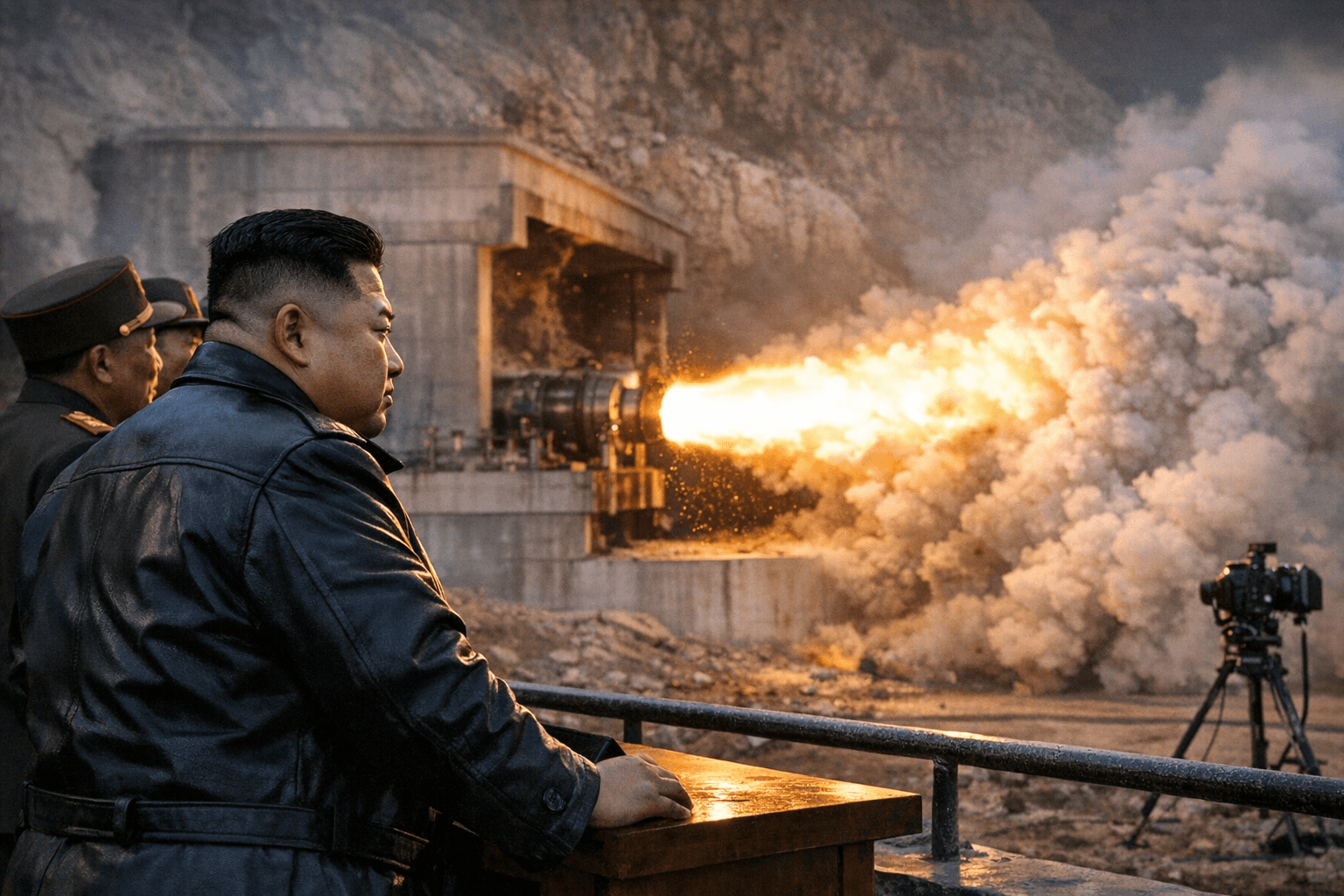
All of North Korea's ICBM tests so far have been conducted at steeper-than-normal trajectories to avoid neighboring territories, and experts say the country may not yet have perfected the technology needed to ensure its warheads survive reentry. Those gaps notwithstanding, a 2,500-kilonewton solid-fuel engine would meaningfully shorten warning windows for missile defense systems in Seoul, Tokyo, and across U.S. Indo-Pacific commands.
Independent analysts consistently caution that KCNA statements alone cannot confirm performance. Validating claims of thrust, burn duration, and reliability requires satellite imagery, telemetry intercepts, or debris recovery, none of which are accessible at undisclosed North Korean test sites where foreign journalists have no access. The imagery and declarations released March 29 are therefore as much a political signal as a technical one: Pyongyang publicizes test milestones to project deterrent credibility and to reshape diplomatic leverage with each announcement.
Hong Min, a senior analyst at the Korea Institute for National Unification, noted that by securing both light weight and thermal durability through carbon fiber technology, North Korea demonstrates domestic development of essential materials for extended missile range. Whether every benchmark was met internally will remain unclear until intelligence agencies complete their technical assessments, but the direction of travel is unambiguous: Kim has publicly bound his regime's strategic credibility to a propulsion program advancing faster than outside analysts had projected just two years ago.
Know something we missed? Have a correction or additional information?
Submit a Tip