Man Arrested After Setting Off Pyrotechnics, Threatening Passengers on German Train
Passengers locked a pyrotechnic-wielding man in a train restroom after he injured 12 aboard a German ICE, forcing a hard look at open-access rail security.
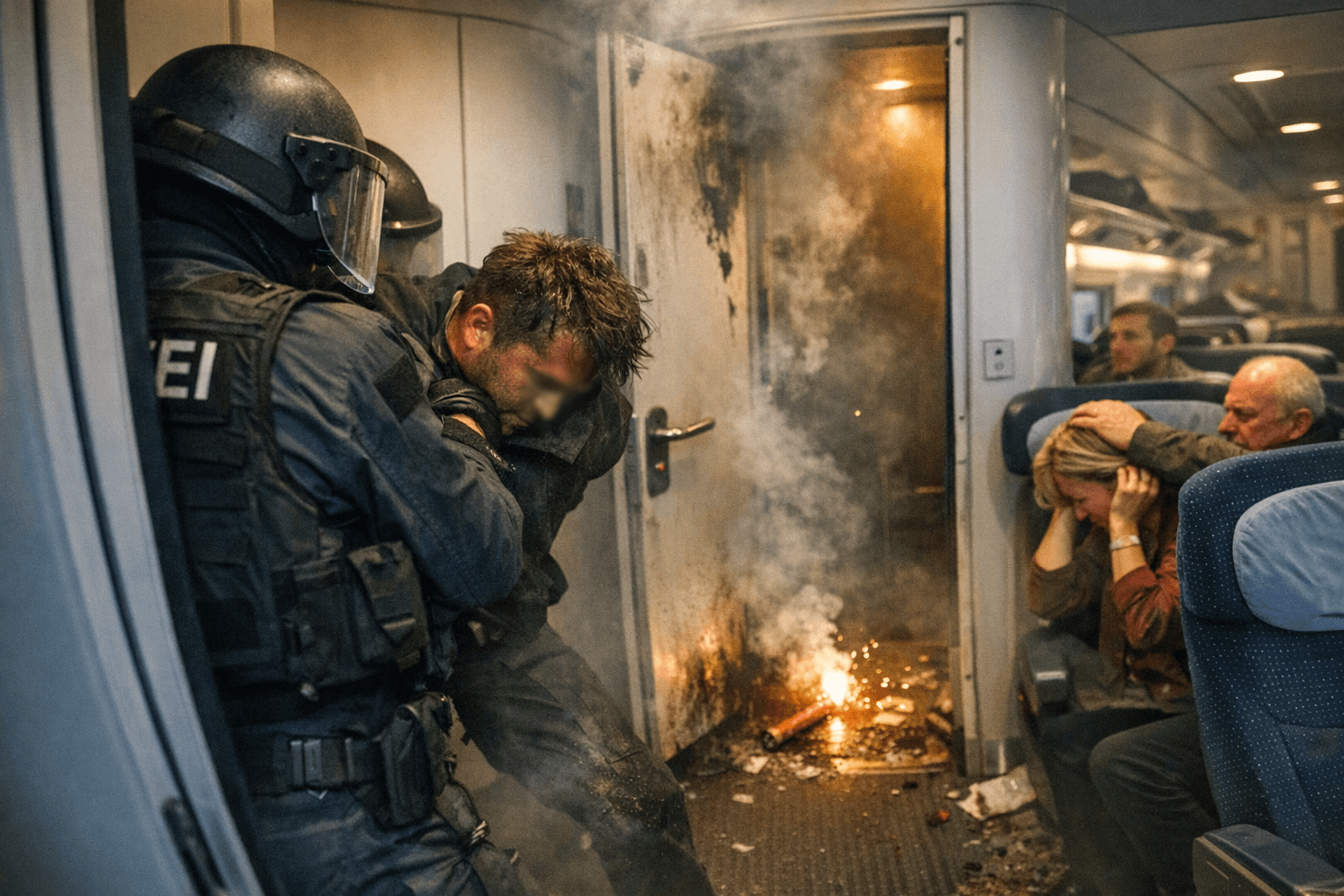
Passengers on ICE 19, traveling from Cologne to Frankfurt on the night of April 2, contained what could have been a far more violent incident through a rapid, improvised act: after a 20-year-old man began igniting pyrotechnic devices in a carriage, other passengers forced him into a restroom and locked the door until federal police boarded at Siegburg-Bonn station.
The man had thrown pyrotechnic devices loaded with plastic pellets into the train's aisles, according to police statements. Twelve passengers were injured, some sustaining acoustic trauma from the blasts and others suffering minor skin injuries from the pellets. One was taken to a hospital and later released. Among items recovered from the suspect: two knives, a mask, and two commercially available smoke devices. The train was carrying approximately 180 passengers.
Deutsche Bahn's initial alert reported possible gunshots aboard ICE 19 at Siegburg station at 8:55 p.m. local time. The language reflected the confusion of a fast-moving incident in a sealed carriage, where loud bangs and smoke made the threat level impossible to assess from the outside. After the arrest, police searched the train and found no additional dangerous objects.
The episode illustrates a structural vulnerability common to high-speed rail systems on both sides of the Atlantic: open access. Unlike aviation, most European and American rail systems do not conduct pre-boarding passenger screening. Travelers on most routes simply walk up and board. Germany's federal rail police, the Bundespolizei, are responsible for rail security but are not stationed inside every carriage on every service.
Amtrak's model on high-volume corridors like the Northeast Corridor relies on visible deterrence: onboard police patrols, K9 units, and CCTV at major stations, coordinated through the Amtrak Police Department's partnerships with the Transportation Security Administration and FBI Joint Terrorism Task Forces. But on long-distance and lower-frequency routes, Amtrak's security footprint thins considerably, with crews and local law enforcement handling most incidents, a framework structurally similar to what Germany's regional services use.
What worked at Siegburg-Bonn was not a scanner or a checkpoint; it was passenger initiative. Emergency responders credited the rapid action of those onboard with preventing further harm. Federal investigators and local prosecutors opened an inquiry to determine whether the episode constituted a terror threat or an act of mass violence; the motive remained under investigation as of Friday.
Deutsche Bahn temporarily halted service through Siegburg while police processed the scene. The suspect remained in federal custody pending formal charges, which prosecutors said could range from violent assault to attempted mass-casualty offenses, depending on evidence and motive reviews.
The Siegburg-Bonn incident reinforces what security analysts have long argued about confined, open-access transit: in high-speed rail, the gap between a threat and serious injury collapses to seconds. Equipping passengers and crew to recognize, report, and contain threats closes that gap more reliably than infrastructure built around the assumption that danger will be stopped at the gate.
This article was produced by Prism’s automated news system from verified source data, official records, and press releases, then run through automated quality and moderation checks before publishing. The system is built and supervised by the people who set the standards it runs under. Read our full AI policy.
Did this article answer your question?


