McGill review maps mindfulness, breathwork and yoga for cognitively impaired older adults
McGill published a scoping review March 4, 2026, screening five databases and analyzing 98 studies to produce a visual map and public guidance on mindfulness, breathwork and yoga for older adults with cognitive impairment.
McGill University released a scoping review and public guidance March 4, 2026 that screened five databases and analyzed 98 studies worldwide to clarify how mindfulness, breathing practices and yoga can support older adults with mild cognitive impairment and dementia. The team from the McGill Mindfulness Research Lab, led by Professor Bassam Khoury, packaged results into a visual map and a logic model designed to translate evidence into practical clinical steps.
The peer-reviewed article appears under the title “Mind-body interventions to promote the mental health of older adults with cognitive impairment and dementia: a scoping review and logic model,” authored by Isabel Sadowski (McGill), Kabisan Vilvaratnam (Université de Montréal), Martine Bordeleau (Université de Sherbrooke), Mael Gagnon-Mailhot (Université de Montréal), Marianne Meilleur-Bédard (McGill), Soham Rej (McGill) and Bassam Khoury (McGill), and published in Aging and Mental Health. The research was supported by the Social Sciences and Humanities Research Council of Canada (SSHRC), and the review team cites collaborators across McGill, Université de Montréal and Université de Sherbrooke.
The review groups “mind-body interventions” to include mindfulness, meditation, yoga, tai chi and breathing practices and directly confronts a prior uncertainty: non-pharmacological interventions have shown promise in reducing some mental health symptoms in people with cognitive decline, but which modalities work best, for whom and under what conditions remained unclear. The McGill team organized study findings into a visual map that highlights intervention types, dementia-specific adaptations and implementation barriers and facilitators, and presented that logic model to guide clinicians and program planners.
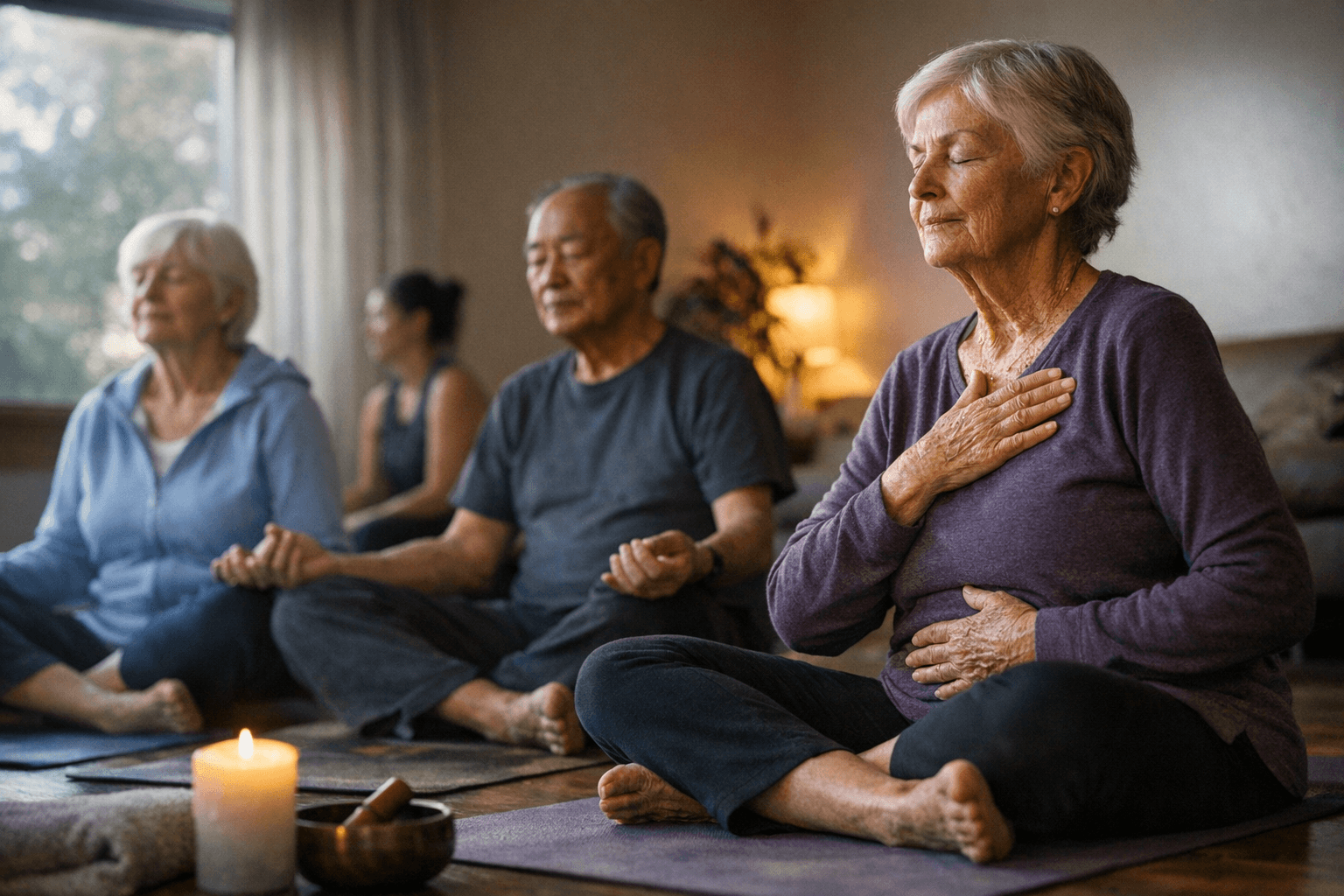
Practical, implementable recommendations appear in the public guidance: keep sessions under an hour; recruit family members or staff to reinforce program participation; use flexible scheduling and clear routines; and favor group sessions where appropriate. McGill’s press materials include imagery captioned “group of seniors doing chair yoga,” underlining that adaptations such as chair-based practice were visible in the corpus the authors screened.
For breathwork specifically, a separate PLOS scoping review protocol cited in the background material frames breathwork as interventions that deliberately manipulate the breath and notes that isolated breathing techniques - for example prāṇāyāma - should be treated differently than multi-component programs that include yoga asana. That PLOS protocol argues that “Breathwork has great potential for supporting connections to self, others, and nature, laying the foundations for individual, collective, and planetary wellbeing,” and cautions that “Current reviews of breathing interventions reinforce an individualistic outlook, overlooking their potential to foster connection across multiple domains.” Those statements come from a distinct project and were retained as context for how breathwork is being defined in parallel literature.
McGill’s review delivers an evidence map and logic model intended to move clinicians and caregivers beyond theory to specific program choices, but the release stops short of enumerating every implementation barrier and facilitator in the public excerpt. The full Aging and Mental Health article, high-resolution visual map and logic model will be necessary for clinicians to see the list of the 98 included studies, the five databases searched by name, and the precise adaptations the authors cite for dementia care; until then, the McGill product provides a concise set of tactical steps clinicians can apply now while the field continues to sort which mind-body practices work best for which patients.
Know something we missed? Have a correction or additional information?
Submit a Tip