Mexico's World Cup Security Spending Draws Criticism From Families of the Disappeared
Mexico deployed 100,000 security personnel for the World Cup while 133,500 remain officially disappeared. Families say the state is erasing their faces from city streets.
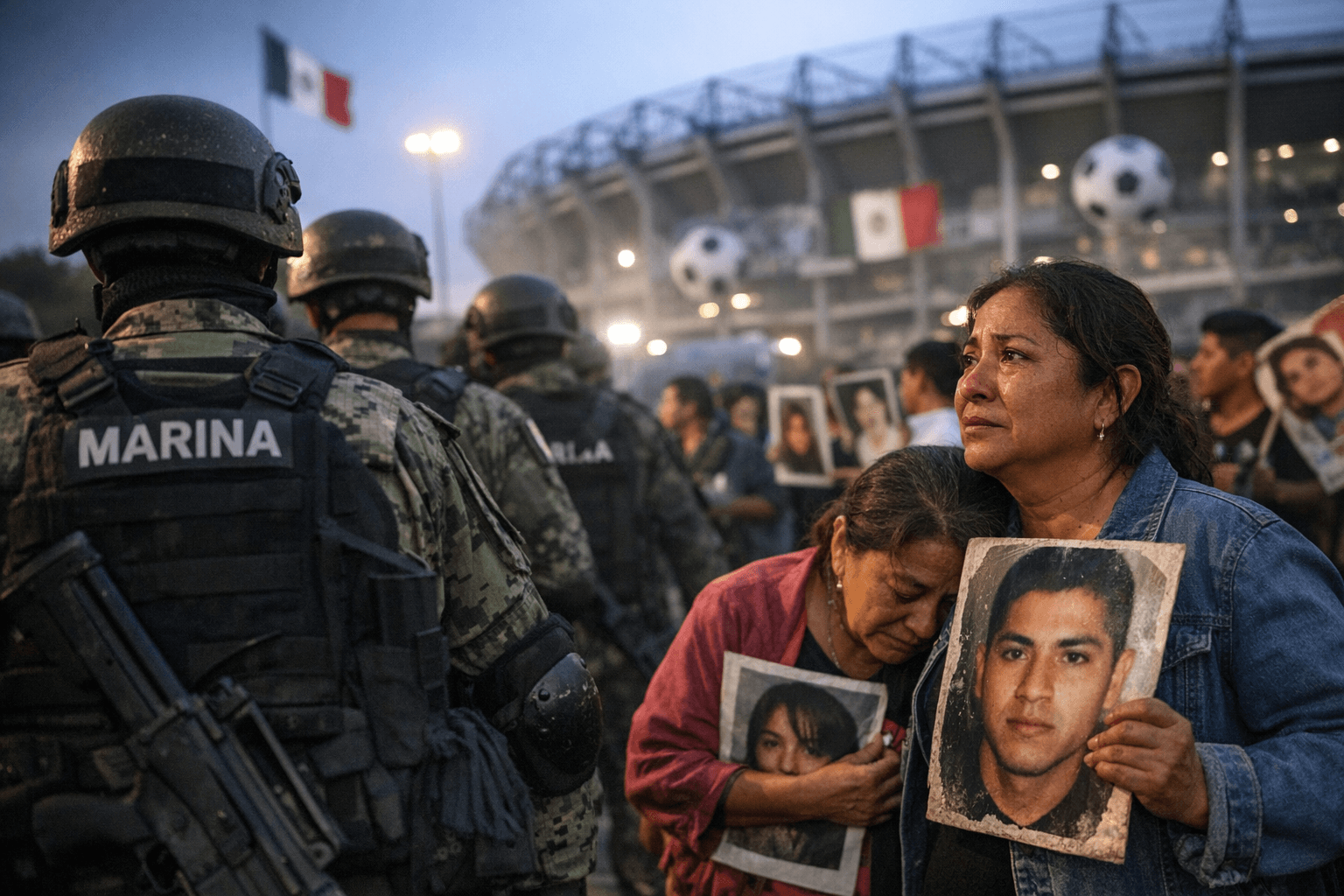
Carmen López papered Guadalajara's walls with her brother's face. Then her nephew's. Then she watched local lawmakers draft legislation to make it easier to tear those faces down, timed to the arrival of the World Cup.
"They don't want people coming to the World Cup, people coming from abroad, to see" the fliers, López said. "It's not in their interest, because they would get their hands dirty. It makes the government look bad in front of the entire world."
Mexico has mobilized roughly 100,000 security personnel, including 20,000 military and National Guard troops and 55,000 police officers, to protect players, fans, and officials at a tournament that kicks off June 11 in Mexico City. Jalisco's secretary of security, whose state will host four matches at the Akron Stadium, showed journalists $55 million in new security equipment. Black Hawks from the Mexican police now patrol the skies above the venue. What that apparatus has not been directed toward is finding the 133,500 people officially recorded as disappeared, a figure Amnesty International cited in its March 2026 report on the tournament.
Jalisco alone accounts for close to 16,000 of those disappearances, the highest official tally of any state in Mexico. Families and activists say the true number is almost certainly higher; roughly one in four cases goes unreported out of fear of cartel reprisals.
The contrast between those two mobilizations, one calibrated to the arrival of cameras and foreign tourists, the other chronically neglected, is what families are determined to force into the international frame. Four of Ana Hatsumi Muñoz's family members have disappeared or been killed. Her sister Virginia, a police officer, vanished in 2021 after witnesses saw armed men take her. Muñoz is part of a citizen search collective that has continued operating largely without state support.
What those searchers have uncovered near the tournament's own venues makes the resource disparity difficult to dismiss. Search groups have found at least 500 bags of human remains across four clandestine grave sites within 20 kilometers of the Akron Stadium. In March 2025, the Guerreros Buscadores de Jalisco entered a ranch near Teuchitlán, roughly an hour from Guadalajara, and discovered what their leader, Indira Navarro, called an "extermination camp": bullet casings, makeshift ovens, 154 pairs of shoes, and charred human remains.
Jose Raul Servin has been searching for his son Raul since April 2018. His fear runs almost parallel to López's. "We don't want anything to happen," he said, "like what's happened to us."
Whether the international spotlight produces meaningful pressure or merely cosmetic calm is the central question. A movement of mothers seeking justice for the disappeared has announced plans to protest outside the opening match at Mexico City's Estadio Azteca. Amnesty International warned in its March report that Mexico's very militarization for the tournament carries risk, including the potential suppression of exactly those protests.
President Claudia Sheinbaum pledged robust security during a March visit to Jalisco, and FIFA president Gianni Infantino declared "complete confidence" in Mexico's preparations. But as one family member, whose brother Jose Gil Cedeno Rosales disappeared in Tlajomulco de Zuniga in September 2021, demanded: "Where is our security? Where is the security for our family members, or for those of us whose lives are at risk because we are searching for the missing?"
If the tournament passes without incident for the 48 nations competing, the security apparatus will be declared a success. López's fliers, if the proposed legislation advances, may not be on the walls long enough to tell the other story.
This article was produced by Prism’s automated news system from verified source data, official records, and press releases, then run through automated quality and moderation checks before publishing. The system is built and supervised by the people who set the standards it runs under. Read our full AI policy.
Did this article answer your question?