Microsoft hunts AI startups to reduce reliance on OpenAI
Microsoft is seeking AI startups to own more of its model stack, after OpenAI capped revenue sharing at $38 billion through 2030 and exclusivity ended.
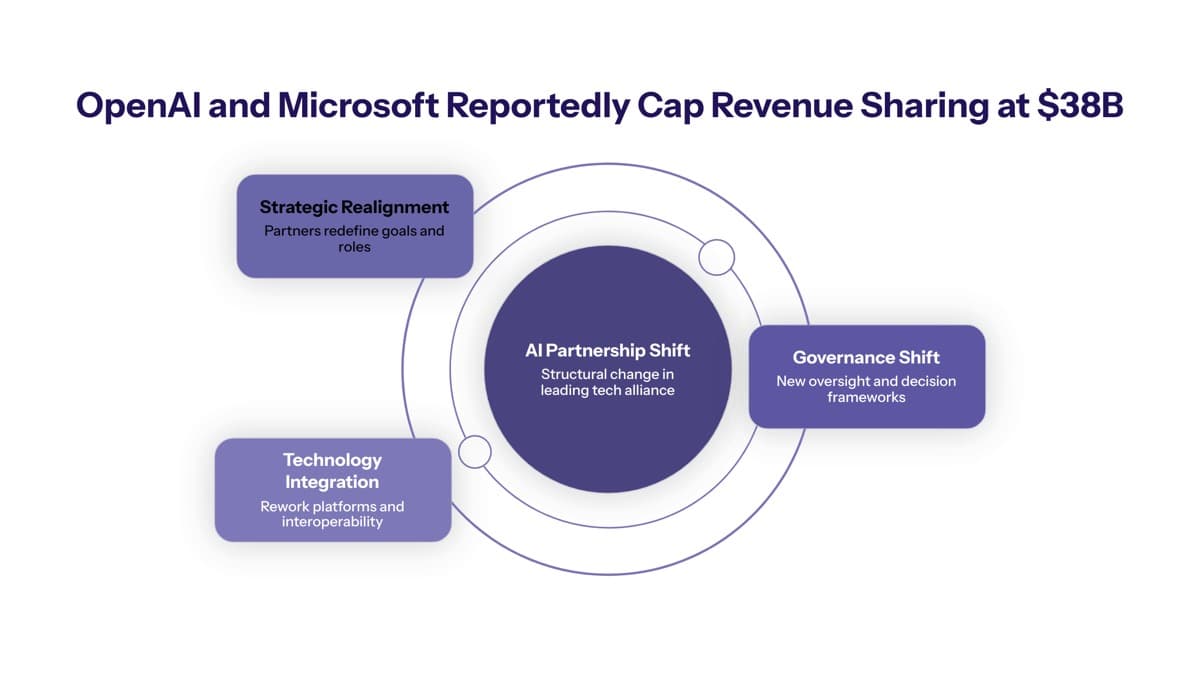
Microsoft is moving to buy more of the artificial-intelligence stack it once expected OpenAI to supply, a sign that the software giant wants a credible path to frontier models even if its most important AI partnership keeps loosening. Five people familiar with the matter said Microsoft has been shopping for AI startups as it tries to strengthen its ability to build a frontier model by next year and reduce its dependence on OpenAI.
The shift comes after years of heavy investment. Microsoft has put roughly $13 billion into OpenAI since 2019, but the economics of the relationship have changed. OpenAI agreed in April to cap the total revenue it shares with Microsoft at $38 billion through 2030, far below the $135 billion in cumulative payments the earlier arrangement could have produced. The end of exclusivity also left Microsoft with more reason to build leverage of its own, especially as the two companies compete for control over product timing, model access and the commercial upside of generative AI.

One target under discussion was Cursor, the code-generation startup built by Anysphere as a standalone AI-native editor. Microsoft weighed an acquisition of Cursor this spring before backing away over internal concerns that the deal could draw regulatory scrutiny because Microsoft already owns GitHub Copilot, one of the most important AI coding products in the market. That hesitation shows the company is not just buying growth for its own sake. It is trying to avoid piling new assets on top of an already powerful position in developer tools.
Microsoft is also in discussions with Inception, a startup founded by a Stanford University team that is pursuing a different way to build large language models. Inception raised $50 million in seed funding in November 2025, with Microsoft’s M12 venture fund among the participants, alongside Menlo Ventures, Mayfield, Innovation Endeavors, NVentures, Snowflake Ventures and Databricks Investment. The company is developing diffusion-based large language models, a bet on faster and more efficient AI systems that could give Microsoft another route to model ownership if traditional scaling becomes harder or more expensive.
Together, the searches point to a broader strategic turn inside Microsoft. The company is not merely collecting tools or making opportunistic startup bets. It is trying to secure technical talent, optionality and more control over its model roadmap before the AI market settles into a smaller group of vertically integrated winners. If Microsoft succeeds, the next phase of competition with Google, Meta and independent AI labs may be shaped as much by acquisitions and capability-building as by model benchmarks.
This article was produced by Prism’s automated news system from verified source data, official records, and press releases, then run through automated quality and moderation checks before publishing. The system is built and supervised by the people who set the standards it runs under. Read our full AI policy.
Did this article answer your question?

