Middle East Nations Face Reckoning After War Exposes Deep Vulnerabilities
Iran struck all six Gulf states for the first time in history, draining Bahrain's Patriot interceptor stocks by 87% and forcing a regional reckoning no ceasefire can reverse.
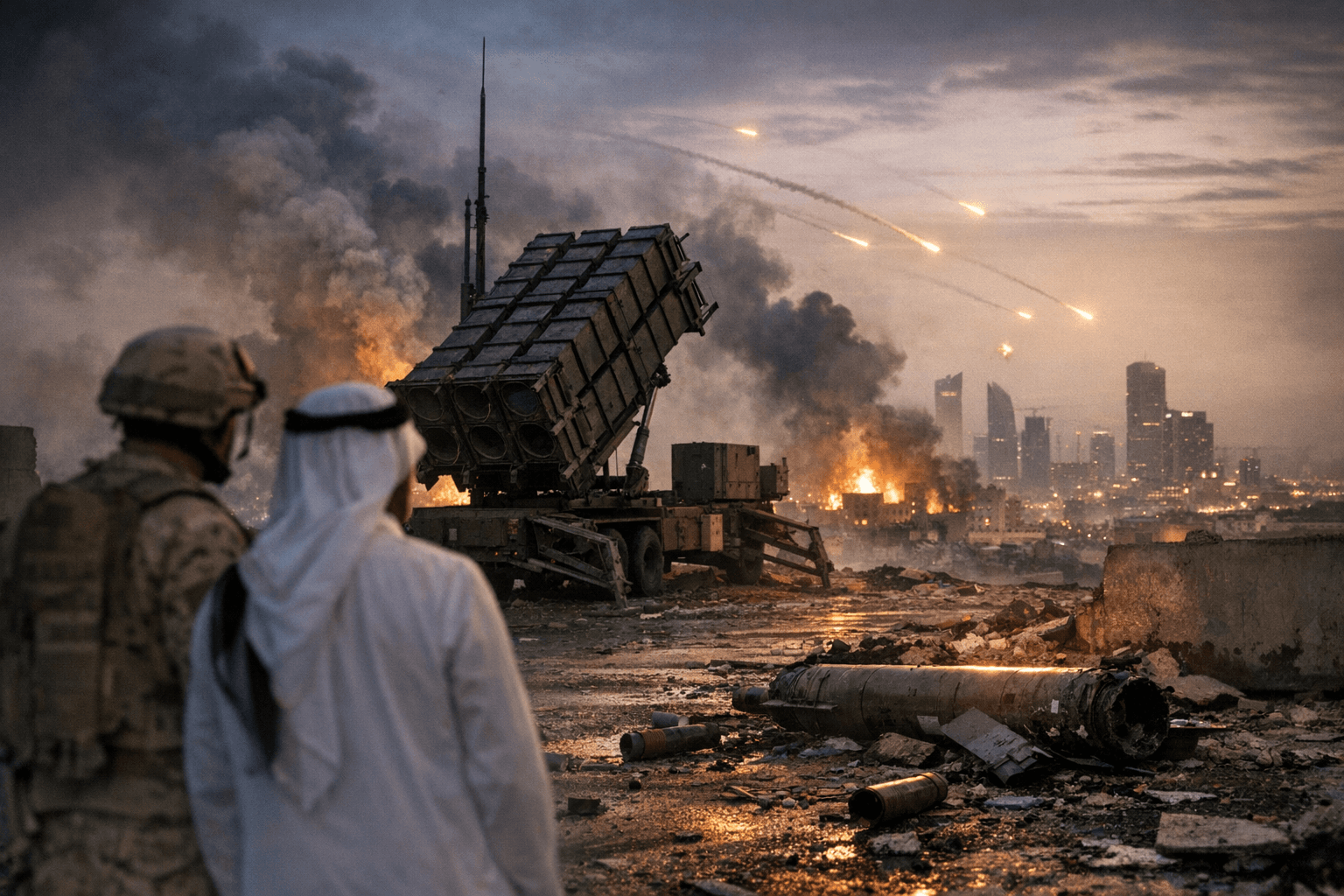
A two-week ceasefire brokered between the United States and Iran on April 7-8 has done little to settle the deeper crisis now consuming the Gulf. Within hours of the announcement, the UAE reported its air defenses intercepting 17 ballistic missiles and 35 drones. Saudi Arabia, Kuwait, Bahrain, and Qatar activated their own systems. The U.S. and Israel have launched more than 3,000 strikes on Iran since the conflict erupted on February 28, and Iran has retaliated with a total of 1,511 strikes against targets in Israel and neighboring Gulf countries, according to ACLED. The math of that exchange has exposed a structural problem that no ceasefire agreement resolves.
For the first time in history, Iran attacked all Gulf Cooperation Council states: Bahrain, Kuwait, Oman, Qatar, Saudi Arabia, and the UAE. Few Gulf monarchies had anticipated this escalation. For decades, the Gulf territory had remained largely insulated from direct Iranian fire; since the Tanker War of the late 1980s, Tehran had avoided openly targeting the region. The precedent, once broken, cannot be unbroken.
By late March, the UAE and Kuwait had spent roughly 75% of their Patriot missile interceptor stocks, while Bahrain was estimated to have depleted as much as 87%, according to the Jewish Institute for National Security of America. The Pentagon has since announced a seven-year agreement to triple production capacity for Patriot PAC-3 MSE missiles, but restocking inventories takes years, not weeks. The war's economic impact has been described as the world's largest supply disruption since the 1970s energy crisis, with surges in oil and gas prices and wide disruptions in aviation, tourism, and financial markets. By March 31, the cost to Arab countries was estimated at over $120 billion.
US bases in Qatar, Bahrain, Kuwait, and the UAE were meant to deter Iran and guarantee regime security. Instead, they became priority targets once the war began. Iran explicitly framed strikes on those facilities as retaliation against Washington, placing Gulf hosts in an impossible position: absorbing attacks on their soil for a war they publicly opposed. Saudi Arabia, the UAE, Qatar, and others quietly urged Washington to avoid a full-scale assault on Iran before the campaign launched, fearing direct blowback on their territory and energy infrastructure. Nevertheless, the US-Israeli air campaign began February 28 without a clearly defined political endgame beyond "crippling" Iran's capabilities.
Qatar shut down its liquid natural gas exports, representing 20 percent of the global LNG market, after Iranian drones targeted key facilities. ADNOC chief executive Sultan Al Jaber called the targeting of energy infrastructure across the region "global economic warfare." UAE presidential adviser Anwar Gargash said the conflict must end with a long-term solution for Gulf security, not a ceasefire that leaves the underlying architecture unchanged.
Gulf Arab states are now hearing competing visions for regional security: Iran's longstanding pitch to expel US bases and coordinate on a regional security framework; Israel's push for normalization and economic integration, with Israeli Prime Minister Benjamin Netanyahu recently suggesting pipelines across the Arabian Peninsula to Israeli ports to circumvent the Strait of Hormuz; and Turkey as a potential Sunni counterbalance. None satisfies the full range of Gulf security requirements, and the divergence between individual states is widening. Saudi Arabia's position on normalization with Israel, already conditioned on a credible path toward Palestinian statehood, has been further complicated by Israel's direct involvement in the war.
The debate is no longer confined to the traditional notion of a protective umbrella that guarantees the security of oil supplies in exchange for a substantial American military presence. It has evolved into a deeper inquiry: who ultimately holds the authority to decide matters of war and peace, and who bears the security, economic, and social costs of those decisions. Iran's ambassador to Pakistan offered Gulf states a blunter formulation, warning them publicly to "pay attention to their conditions and relations with Iran." Whether a two-week pause in the fighting creates space for that reckoning, or merely defers it, is the question now hanging over every capital from Riyadh to Doha.
This article was produced by Prism’s automated news system from verified source data, official records, and press releases, then run through automated quality and moderation checks before publishing. The system is built and supervised by the people who set the standards it runs under. Read our full AI policy.
Did this article answer your question?