Trump Announces Two-Week Pause on Bombing and Attacks Against Iran
Defense Secretary Hegseth vowed U.S. forces would "be hanging around" after Trump suspended strikes on Iran for two weeks, contingent on the Strait of Hormuz reopening.

Hours before his own 8 p.m. deadline expired Tuesday night, President Donald Trump announced on Truth Social that he had agreed to "suspend the bombing and attack of Iran for a period of two weeks," stepping back from a threat earlier that day that "a whole civilization will die tonight" if Tehran did not comply with his demands. The two-week pause was conditioned on Iran reopening the Strait of Hormuz, through which roughly a fifth of the world's seaborne oil trade passes.
The ceasefire, which Trump called a "double sided CEASEFIRE," came together in part through the intervention of Pakistani Prime Minister Shehbaz Sharif and Pakistani Army Chief Gen. Asim Munir, whom Trump credited directly in his Truth Social post. Vice President JD Vance and special envoy Steve Witkoff had also advised Trump to take a deal if one could be secured, and financial markets reacted with immediate relief: S&P 500 futures rose more than 1 percent while oil futures sank roughly 6 percent.
The morning after brought what proved to be the most consequential press conference of the pause. At the Pentagon on Wednesday, Defense Secretary Pete Hegseth and Joint Chiefs Chairman Gen. Dan Caine claimed sweeping success and issued a carefully calibrated warning that the U.S. military had not left the theater. Hegseth declared a decisive military victory over Iran and said Tehran's missile program had been functionally destroyed. Caine confirmed that the joint force had struck more than 13,000 targets inside Iran over 39 days, significantly destroying its defense industrial base and capacity to rebuild. Hegseth listed three completed military objectives: destruction of Iran's missile and drone stockpiles, destruction of its navy, and the shattering of its defense industrial base. Notably, Hegseth did not include securing Iran's nuclear material or reopening the Strait of Hormuz among those completed objectives.
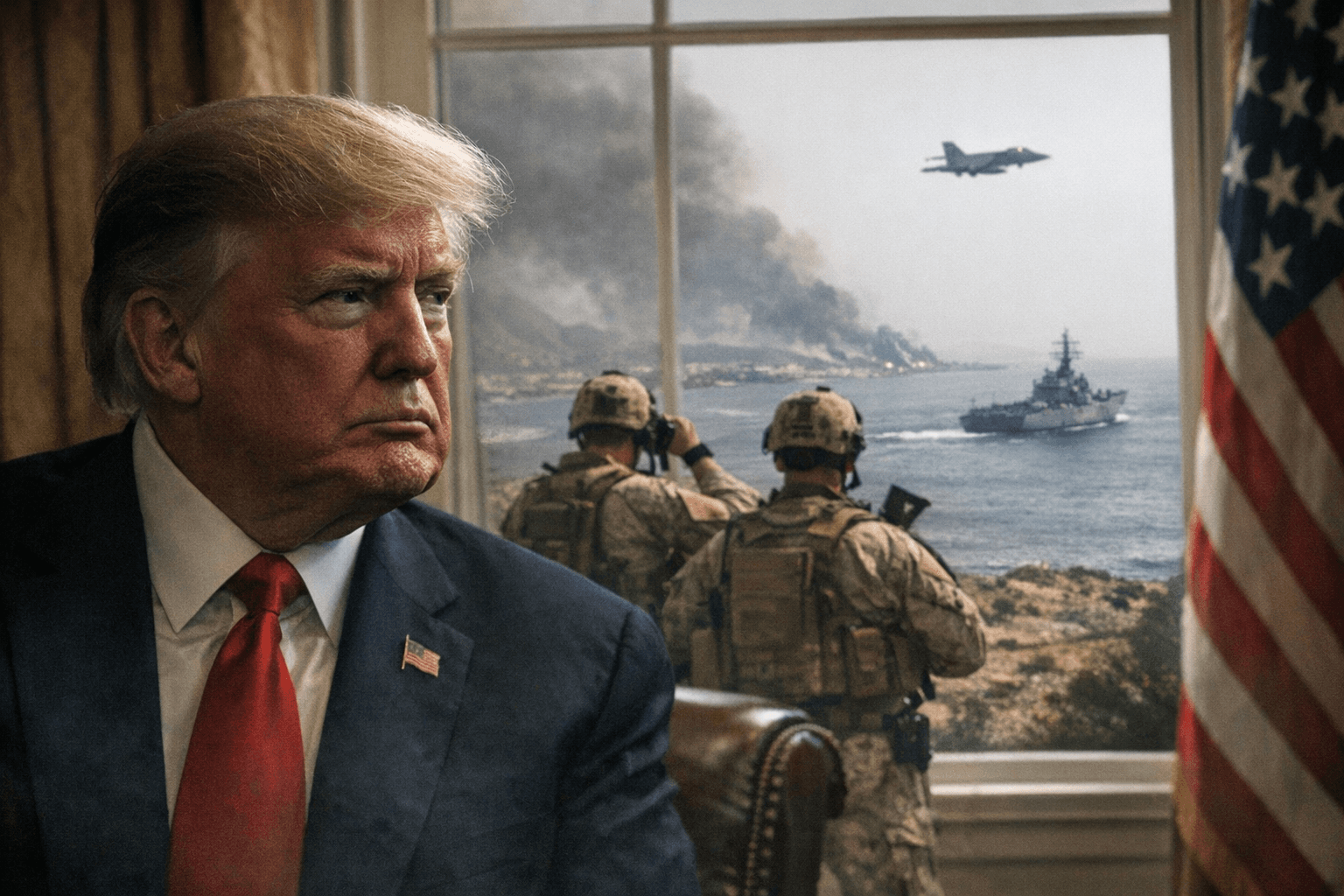
It was Hegseth's description of the military posture going forward that raised the most questions. "We will be hanging around to make sure Iran complies," Hegseth said Wednesday. "We are prepared to restart in a moment's notice." The phrase "hanging around" amounted to deliberate strategic ambiguity: U.S. carrier strike groups, long-range air defenses, intelligence assets, and strike aircraft that conducted the 39-day campaign remain in range of Iran. What Hegseth declined to specify was which specific Iranian actions would trigger a resumption of strikes, how quickly Washington would make that determination, and through what channel Tehran would be notified before bombs fell again.
The nuclear question dominated the second half of the briefing. Hegseth said the U.S. was tracking Iran's enriched uranium stockpile and declared its handover to be non-negotiable. "We know exactly what they have, and they know that, and they will either give it to us voluntarily ... or if we have to do something else ourselves, like we did in Midnight Hammer or something like that, we reserve that opportunity," Hegseth said. He added, "What the new Iranian regime knows is they'll never have a nuclear weapon or the capability to get a path to one."
Iran's Supreme National Security Council formally accepted the ceasefire on Wednesday and said it would begin direct negotiations with the United States in Islamabad on Friday. Iranian Foreign Minister Abbas Araghchi framed the Strait of Hormuz reopening in conditional language, saying "safe passage will be possible via coordination with Iran's Armed Forces and with due consideration of technical limitations," wording that left room for Iran to dispute whether any particular transit met its conditions.
The fragility of the arrangement was evident within hours of the announcement: Iran claimed that its missile and drone attacks on Israel and oil facilities in the UAE, Kuwait, and Saudi Arabia after the ceasefire was announced were retaliation for earlier U.S. and Israeli strikes, including on an Iranian oil refinery. A U.S. defense official disputed that the refinery strike was conducted by American or Israeli forces. Uncertainty also persisted over whether the ceasefire covered Lebanon: Israeli Prime Minister Benjamin Netanyahu's office said it supported Trump's two-week suspension of Iran strikes, but stated that the ceasefire did not include Lebanon, despite Pakistan's prime minister having suggested otherwise.
Gen. Caine honored the 13 U.S. service members killed during the operation and said the military remained ready to resume combat "if called upon." With direct talks scheduled to open in Islamabad and Iran's nuclear material unresolved, the next two weeks will test whether "hanging around" functions as deterrence or simply defers the next decision point.
This article was produced by Prism’s automated news system from verified source data, official records, and press releases, then run through automated quality and moderation checks before publishing. The system is built and supervised by the people who set the standards it runs under. Read our full AI policy.
Did this article answer your question?


