Trump Backs Down From Iran Threats as Markets Surge on Hormuz News
Oil tumbled 17% and the Dow surged 1,200 points after Trump pulled back from threats to destroy Iranian civilization, but the ceasefire frayed within hours.
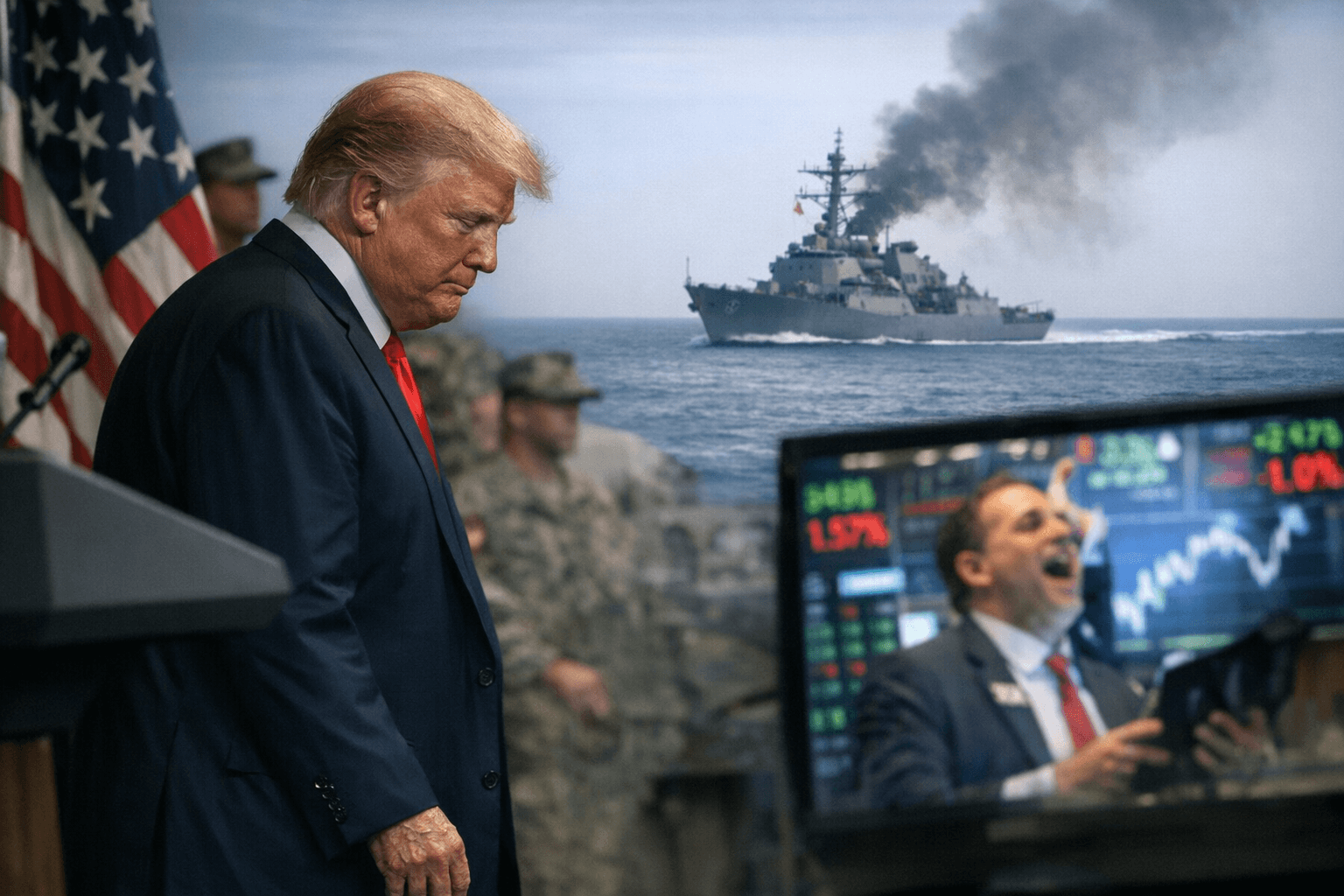
Less than two hours before his self-imposed 8 p.m. ET deadline on Tuesday, President Donald Trump stood down from threats he had framed that very morning as civilization-ending, announcing a two-week ceasefire with Iran contingent on the "COMPLETE, IMMEDIATE, and SAFE OPENING" of the Strait of Hormuz. The deal, brokered by Pakistani Prime Minister Shehbaz Sharif and Field Marshal Asim Munir, the country's military chief, sent markets into a sharp relief rally and crude oil into freefall before its terms began unraveling within hours of taking effect.
The mechanics of the agreement are deceptively simple. The United States and Israel agreed to suspend military strikes on Iran. Iran, for its part, agreed to allow safe passage through the strait, which carries roughly a fifth of the world's seaborne oil supply, and presented Washington with a 10-point peace proposal that Trump called "a workable basis on which to negotiate." But Iranian Foreign Minister Abbas Araghchi's language carried a critical caveat: safe transit would be possible "via coordination with Iran's Armed Forces and with due consideration of technical limitations." No monitoring body, no third-party verification mechanism, and no defined penalty for breach were announced. What happens on day 15 if Iran's Armed Forces decide the technical limitations are too great, or if a tanker captain declines to coordinate with Tehran, remains entirely unresolved.
The enforcement problem became visible almost immediately. Within hours of the 8 p.m. deadline, missiles were still launched from Iran toward Israel, and Israeli strikes continued across southern Lebanon. Israel's position that Lebanon was excluded from the agreement directly contradicts Pakistan's claim that the ceasefire covered "everywhere." Iran has since warned it will resume fighting and close the Strait entirely if Israeli operations in Lebanon do not stop. The Lebanese state media reported airstrikes in Tyre and Israeli artillery attacks on villages across the south, while Israeli soldiers remain entrenched as deep as six miles inside Lebanese territory.
That backdrop mattered little to traders in the immediate term. The Dow Jones Industrial Average surged 1,200 points, or 2.6%. The S&P 500 climbed 2.4% and the Nasdaq Composite gained 2.8%. West Texas Intermediate crude futures collapsed more than 17%, settling around $93.42 a barrel, having traded as high as $117 earlier that same day. Even so, oil remains well above the roughly $70-per-barrel level that prevailed before the war began on February 28, when Israel assassinated Supreme Leader Ayatollah Ali Khamenei. Geoff Yu, senior market strategist at BNY, told CNBC that investors would be watching for "something more durable than a two-week pause."
The ceasefire is the first significant pause in a conflict that has killed at least 1,497 people in more than five weeks of fighting. It closely parallels the Lebanon ceasefire of November 2024, which Israel has consistently violated, providing a template for how quickly a pause negotiated under American pressure can erode. The most plausible spoilers this time are identical: Israel's refusal to halt operations in Lebanon, and Iran's conditional reading of what "open" actually means in the strait.
Delegations from Washington and Tehran are expected to meet in Islamabad on Friday, April 10, under Pakistani mediation, with the goal of converting the two-week pause into a durable agreement. Vice President JD Vance described the situation as a "fragile truce." The 14-day clock, with no enforcement architecture behind it, will test whether that frailty becomes permanent.
This article was produced by Prism’s automated news system from verified source data, official records, and press releases, then run through automated quality and moderation checks before publishing. The system is built and supervised by the people who set the standards it runs under. Read our full AI policy.
Did this article answer your question?


