Milburn urges welfare reform to tackle rising youth inactivity
Nearly one million young people were out of work or study as Milburn’s review opened, exposing a system that spends far more on benefit support than on getting them back into work.

Alan Milburn’s welfare review has put the state’s response to youth disengagement under a hard test: whether Britain is paying to manage inactivity, or investing enough to prevent it.
The numbers driving the investigation are stark. The government said 946,000 young people were not in education, employment or training in December 2025, a figure large enough to fill Wembley Stadium ten times over and more than 200,000 higher than in 2022. Officials have framed the problem as a “crisis of opportunity”, with Milburn’s team arguing that the government spends 25 times more on benefits for young people than on supporting them into work.

The review began after the Department for Work and Pensions launched Milburn’s independent investigation on 10 November 2025. A call for evidence followed from 16 December 2025 to 30 January 2026, and the final report is intended to take a holistic view of welfare, health, skills and employment policy rather than treat the issue as a single-issue labour market problem.
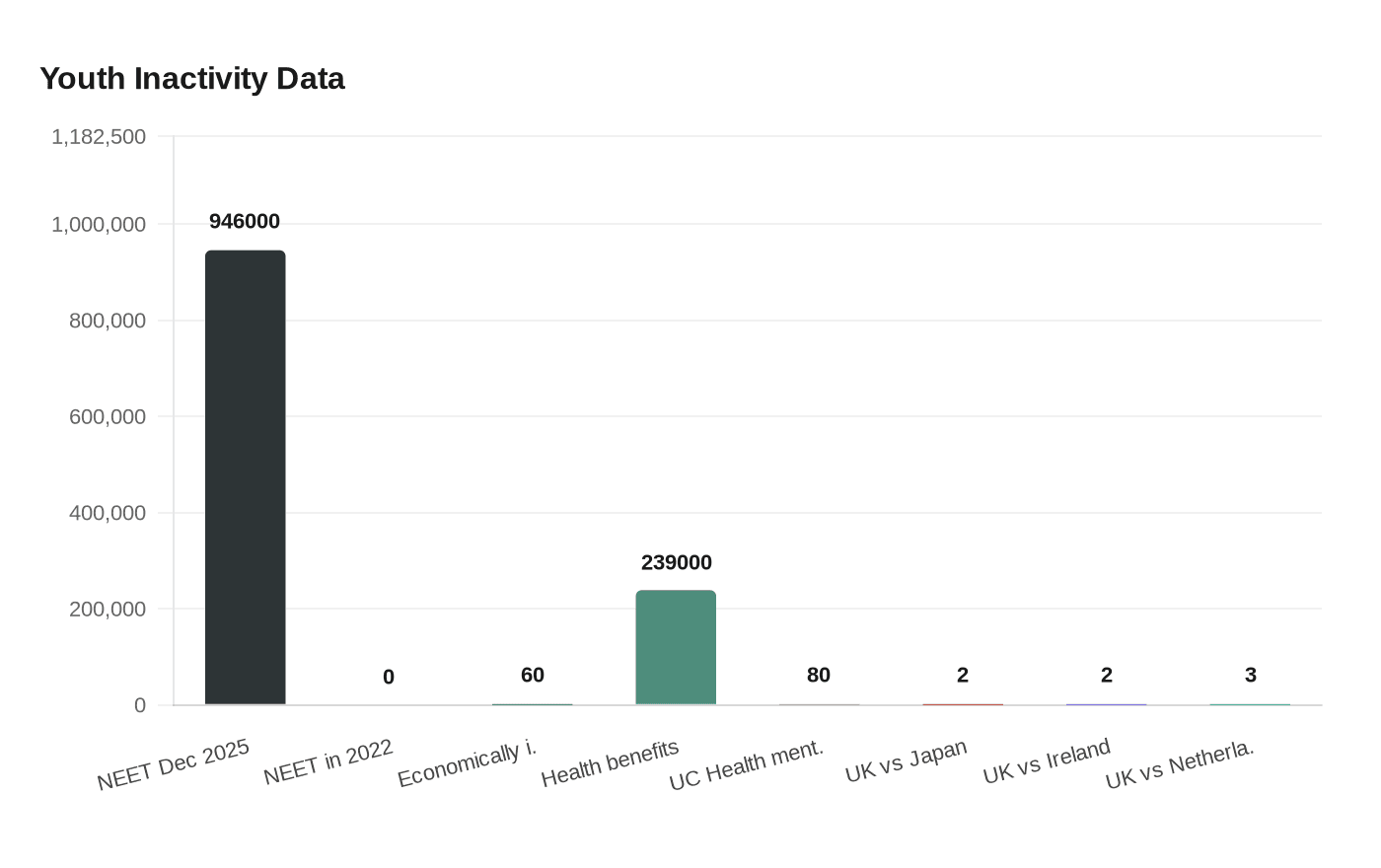
That broader lens matters because the government says 60% of young people who are NEET, about 580,000, are economically inactive. It also says being out of work under 23 can reduce lifetime earnings by more than £1 million. In England in 2024, young people who were NEET were nearly twice as likely to have a health condition as the overall 16 to 24 population, while the share with a mental health condition was nearly two and a half times the rate in 2012.
The welfare pressure is rising alongside that health burden. The number of young people receiving health-related benefits has climbed by more than 50% in five years to 239,000. Four in five young people on Universal Credit Health with a recorded condition are claiming because of mental health or neurodevelopmental conditions, underscoring how closely inactivity, disability and mental ill health now overlap.
Milburn’s panel, which includes Gavin Kelly, Tracy Brabin, Andy Haldane, Ravi Gurumurthy, Jennifer Dixon and Louise Casey, is expected to test policy ideas against that reality. The United Kingdom’s NEET rate is around double Japan’s or Ireland’s and three times the Netherlands’, a comparison that points to structural weaknesses rather than a short-term shock.
Local government has warned that young people with disrupted backgrounds, including care experience, mental health problems, substance misuse, youth offending, poverty, caring responsibilities, interrupted education and low attainment, are especially vulnerable, while councils say they have limited ability to deliver integrated support. The job-support site linked to the review says Milburn is working with health providers, labour market experts and employers, and wants views from young people with experience of being out of work, education or training, especially those with disabilities and mental health struggles.
Know something we missed? Have a correction or additional information?
Submit a Tip