Netherlands Approves Tesla FSD Supervised, First EU Country to Do So
The Netherlands became the first EU country to approve Tesla FSD Supervised, clearing the way for a summer 2026 pan-European rollout after 18 months of testing.
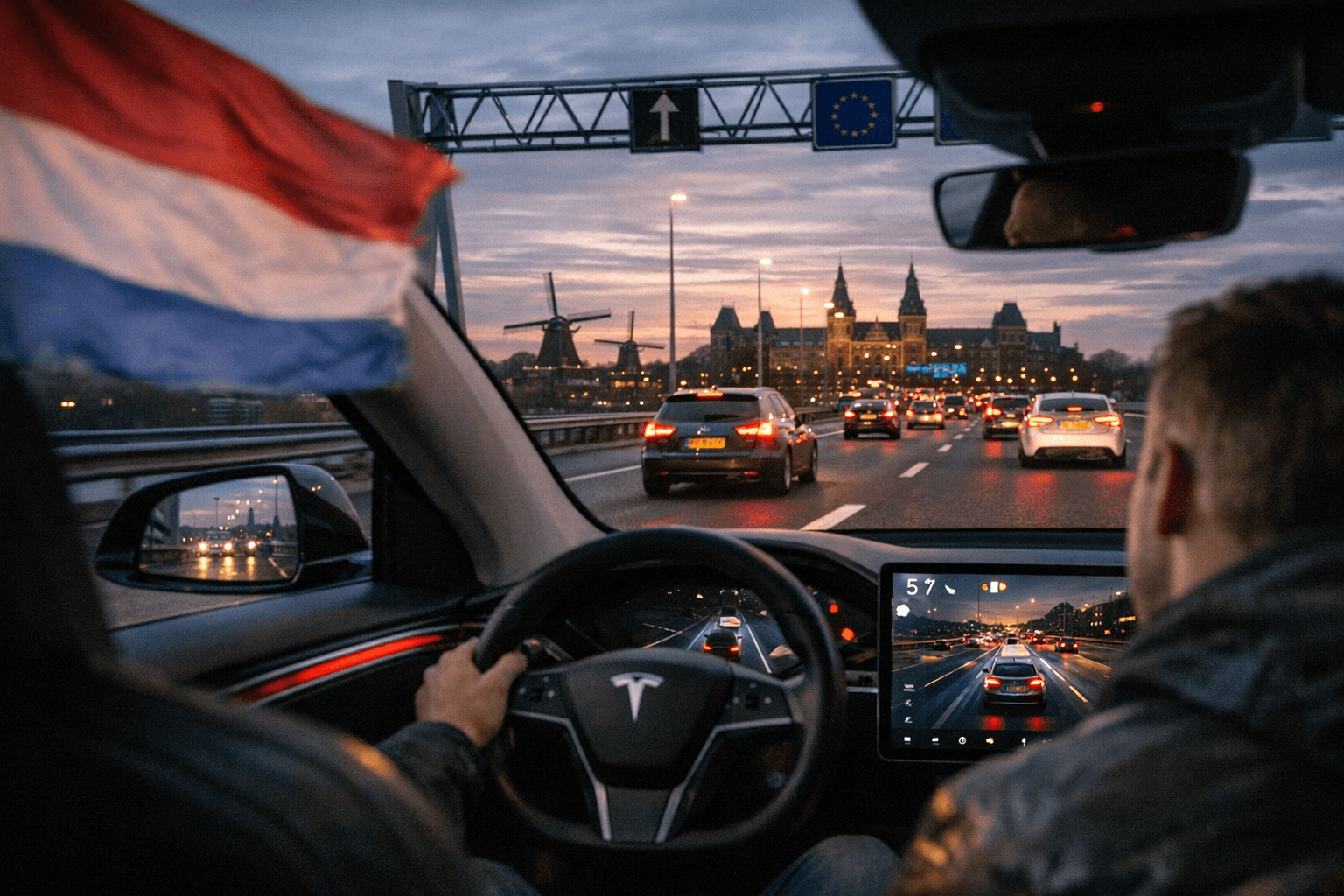
The RDW, the Netherlands' national vehicle authority, officially approved Tesla's Full Self-Driving Supervised on April 10, 2026, making the Netherlands the first European country to authorize the software on public roads after more than 18 months of regulatory scrutiny.
The approval draws clear boundaries. Under the UN R-171 regulation for Driver Control Assistance Systems and an Article 39 exemption under EU Regulation 2018/858, FSD Supervised is a Level 2 system, not an autonomous one. The RDW stated plainly that "the driver remains responsible and must always maintain control." The software handles steering, braking, route navigation, lane changes, traffic lights, roundabouts, and parking, but built-in sensors monitor attentiveness and eye focus continuously; inattention triggers warnings and can disable the system. Legal responsibility stays with the driver.
The testing record behind the decision was extensive: 1.6 million kilometers driven on EU roads, 13,000-plus customer ride-alongs, 4,500 track test scenarios, and documentation covering more than 400 compliance requirements. The timeline, however, slipped repeatedly. At Davos in January 2026, Elon Musk predicted approval by February. When Tesla announced a March 20 target, the RDW publicly contradicted it, stating its review was not complete. Tesla submitted final documentation on March 20, and the RDW set April 10 as the new deadline, which it met. Musk thanked Dutch regulators on X for being "extremely rigorous" and for "all the hard work required to make this happen."
Dutch Tesla owners with compatible vehicles can now activate FSD Supervised via over-the-air update at €99 per month or €7,500 as a one-time purchase. That lump-sum option is notable: Tesla discontinued the equivalent in North America, where the subscription also runs $99 per month. The Dutch FSD software version also differs technically from the U.S. build.
The Netherlands approval does not extend automatically to the rest of Europe. Germany's KBA, France, Belgium, and Italy can each recognize the Dutch type approval individually, but full EU-wide harmonization requires a vote by all 27 member states through the Technical Committee on Motor Vehicles (TCMV), typically a two-to-four month process. Tesla is targeting a complete EU rollout by summer 2026.
For U.S. regulators, the RDW's 400-requirement framework and 1.6-million-kilometer empirical baseline represent a documented methodology that the National Highway Traffic Safety Administration must now account for in its own FSD oversight work. European approval under a structured national process creates pressure to move beyond voluntary manufacturer reporting.
The strategic backdrop matters. Tesla's European registrations fell 27.8% in 2025, strained by Musk's political controversies and Chinese EV competition, and the FSD launch is a direct bid to rebuild momentum. Dutch regulators also challenged Tesla Europe's "no other vehicle can do this" claim, pointing out that Ford and BMW already hold comparable hands-off driving permits in Europe. Before the official approval, some European owners had used €500 CAN bus hardware hack devices to unlock FSD; Tesla has been remotely disabling those vehicles, with owners facing voided warranties and potential legal consequences.
This article was produced by Prism’s automated news system from verified source data, official records, and press releases, then run through automated quality and moderation checks before publishing. The system is built and supervised by the people who set the standards it runs under. Read our full AI policy.
Did this article answer your question?