Netherlands Becomes First EU Country to Approve Tesla Full Self-Driving
The Netherlands became the first EU country to approve Tesla's Full Self-Driving after 1.6M km of testing, setting a regulatory template that could reach Germany and France by summer 2026.
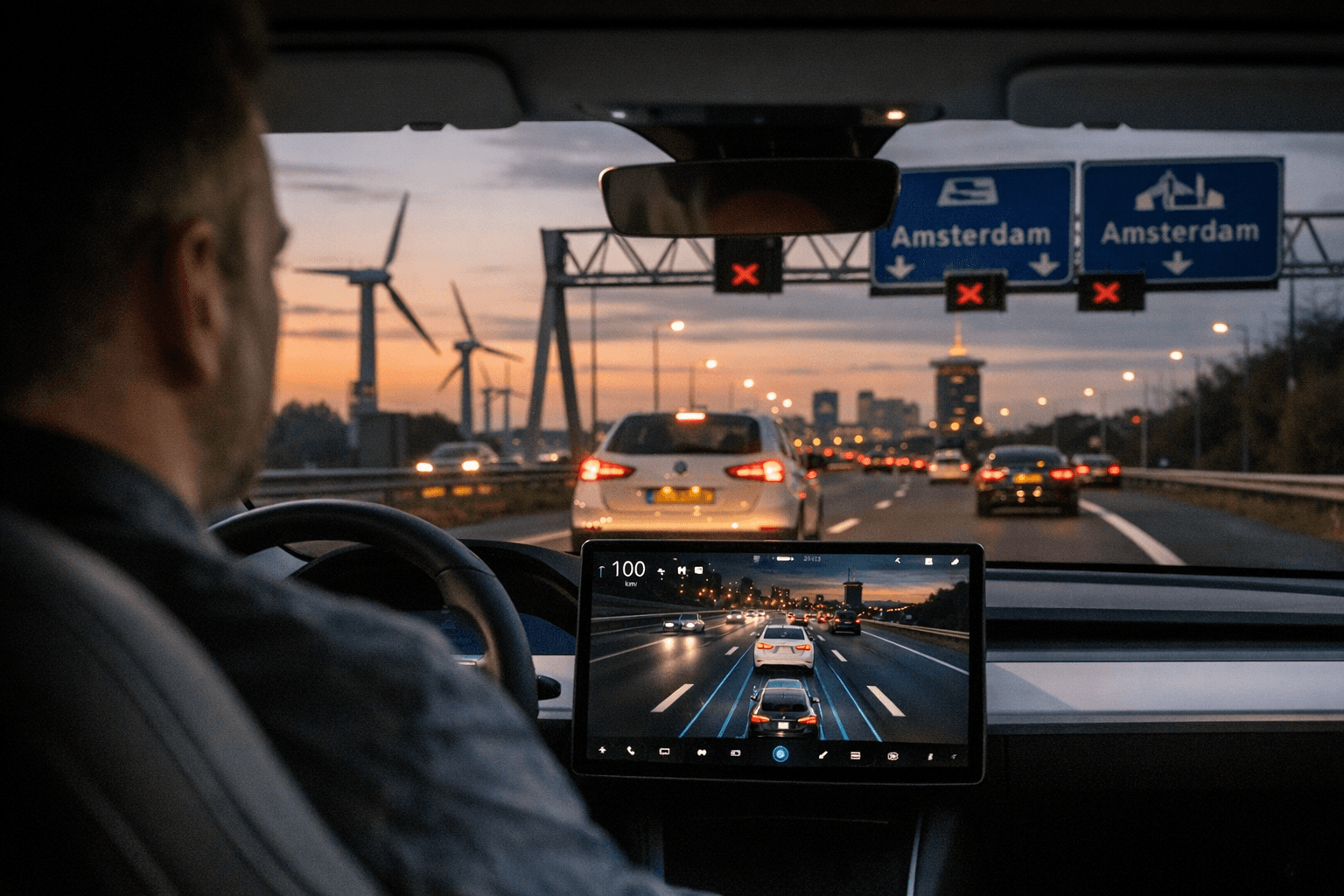
The Netherlands just handed Tesla its most consequential regulatory win in Europe. The RDW, the Dutch vehicle authority known formally as the Rijksdienst voor het Wegverkeer, issued a "European type approval with provisional validity in the Netherlands" for Tesla's Full Self-Driving Supervised system on April 10, 2026, making the country the first in the European Union to authorize the technology on public roads.
The approval is tightly scoped. FSD Supervised handles steering, braking, route navigation, and parking, but the driver must remain alert and capable of immediate intervention at all times. Hands are not required on the steering wheel, but the RDW was explicit about the limits: "It is therefore not permitted or possible, for example, to read a newspaper while driving." The vehicle's sensors actively monitor driver attention and will alert or disengage the system if attention lapses.
The authority was equally precise about the classification of what it approved. "A vehicle with FSD Supervised is not self-driving," the RDW stated. "It is a driver-controlled assistance system, which means that the driver remains responsible and must always remain in control." The system sits at Level 2 under international standards, alongside BMW's European motorway hands-off approval and Ford's BlueCruise authorization, both of which rely on the same Article 39 exemptions Tesla used.
What distinguished the Dutch application was the scale of evidence demanded. Tesla submitted documentation across more than 400 compliance requirements and accumulated over 1.6 million kilometers of test driving on EU roads, more than 13,000 customer ride-alongs, and over 4,500 track test scenarios across an 18-month process. The governing framework is UN R-171, which covers Driver Control Assistance Systems. The RDW also stressed that the European FSD software "differs substantially" from the US version, meaning American safety statistics do not apply to the European deployment.
Dutch Tesla owners can access the system now via an over-the-air update, version 14.3, which includes a rewritten AI compiler and claimed 20% faster reaction times. Pricing is €99 per month or €7,500 as a one-time purchase; in the US, the monthly subscription runs $99.
The path to April 10 involved repeated delays. At Davos in January 2026, Elon Musk said he hoped for European approval "next month." When he later claimed a March date, the RDW publicly corrected him, stating no approval was guaranteed. Tesla had originally targeted February 2026, then March 20, before the authorization was finalized.
Tesla's response once approval arrived was immediate. Ashok Elluswamy, Tesla's Vice President of Autopilot and FSD Engineering, confirmed the rollout to Dutch customer vehicles had begun. Tesla's Europe and Middle East division announced: "FSD Supervised has been approved in the Netherlands and will begin rolling out in the country shortly!" Musk credited the Dutch authority on X, calling the RDW "extremely rigorous in their review."
The Netherlands is a strategically deliberate starting point. Tesla's European headquarters is located there, and the RDW is regarded as one of the EU's most technically rigorous type-approval bodies, lending maximum credibility to the approval across member states. Under EU mutual recognition rules, Belgium could formally accept the Dutch approval within approximately 30 days, with Germany, France, and Italy expected to follow by late spring or early summer 2026. Tesla is targeting EU-wide approval by summer 2026, contingent on the European Commission's formal sign-off, which the RDW is expected to request.
The difference from how the US handles identical technology is fundamental. American regulators allow Tesla to deploy FSD updates by self-certification, with no prior approval required. EU law demands a formal type authorization before any such system reaches public roads, which is why European Tesla owners have been limited to Enhanced Autopilot for years. With the Netherlands setting the template, and Waymo pursuing a very different path with Level 4 fully driverless robotaxis in London, the Dutch model represents a distinct European philosophy on autonomous technology: graduated, supervised, and earned through verified kilometers.
Sources:
Know something we missed? Have a correction or additional information?
Submit a Tip