Nike Faces Investor Pressure as Market Share Slides and Short Interest Surges
Nike’s market share fell for a third straight year, and investors are betting the turnaround will take longer than Wall Street hoped.
Nike is facing a tougher question than a routine slowdown: whether its weakness is cyclical, or whether the company is losing ground in the running, lifestyle and direct-to-consumer businesses that once made it nearly untouchable.
The numbers are pushing investors toward the structural explanation. Nike’s share of the global sports footwear market fell to 22.9% in 2025, down 3 percentage points from the prior year and marking a third straight annual decline. At the same time, 4.67% of Nike’s outstanding shares were on loan as of May 1, a level more than 11 times the 0.41% recorded when Elliott Hill became chief executive on October 14, 2024, after returning from retirement to replace John Donahoe. Nike’s stock has also slipped to its lowest level since 2014, underscoring how much confidence has eroded.
The pressure is not just about sentiment. Nike’s fiscal third quarter of 2026 brought revenue of $11.3 billion, flat on a reported basis and down 3% in currency-neutral terms, while gross margin narrowed 130 basis points to 40.2%. For fiscal 2025, revenue fell 10% to $46.3 billion, and fourth-quarter sales dropped 12% to $11.1 billion as gross margin slid 440 basis points to 40.3%. Those figures point to a company still working through the costs of excess inventory and softer demand for staple franchises such as Dunk and Air Jordan.
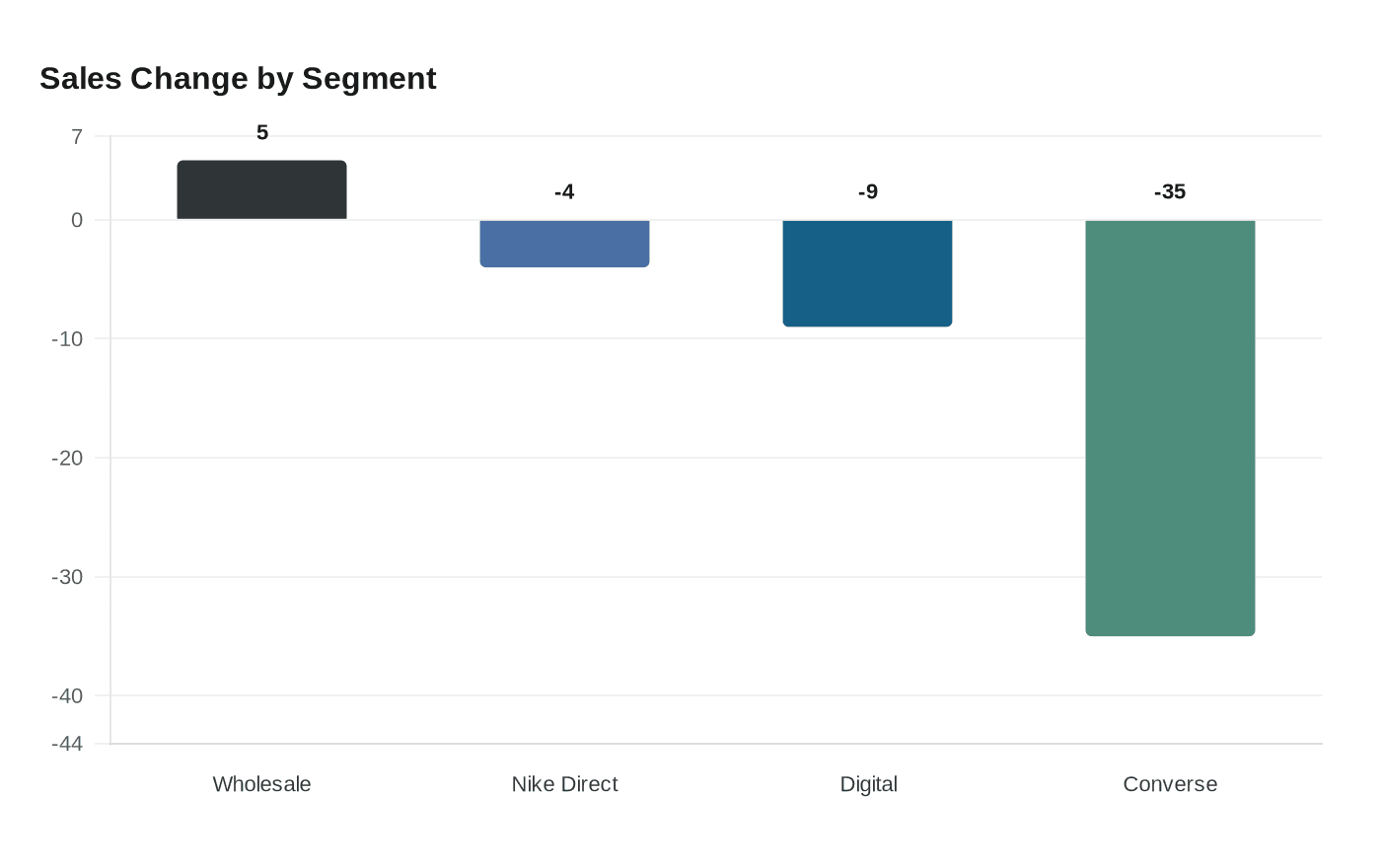
The weakness is not evenly spread across the business. In Nike’s fiscal third-quarter report, wholesale revenue rose 5%, but Nike Direct revenue fell 4%, NIKE Brand Digital sales dropped 9% and Converse revenue sank 35%. That split matters because it shows the problem is not simply a consumer slowdown. Nike is still moving product through wholesale channels, but its own digital and direct-to-consumer engine, once a major source of pricing power and margin expansion, has clearly lost momentum.
Hill has said the turnaround will take time. In a CNBC interview in October 2025, he said the comeback would take “a while.” Morningstar analyst David Swartz said shareholders have heard the same turnaround problems long enough and expected more progress by now. That impatience is easy to understand when rivals such as Adidas, On Running, Hoka and Deckers are gaining visibility in performance footwear, while a runner wearing ultra-light Adidas shoes recently broke the two-hour marathon barrier, a symbolic reminder that Nike no longer owns the innovation narrative.
For investors, the issue is no longer just whether Nike can restore growth. It is whether the company can recover the technological edge, cultural relevance and margin discipline that once made it the category leader. If that takes too long, the pressure on Hill will only intensify.
This article was produced by Prism’s automated news system from verified source data, official records, and press releases, then run through automated quality and moderation checks before publishing. The system is built and supervised by the people who set the standards it runs under. Read our full AI policy.
Know something we missed? Have a correction or additional information?
Submit a Tip