NLRB Guidance Explains How to File and What to Expect After Charges
Learn who can file an unfair‑labor‑practice charge, which forms and steps to use, where to file, and what to expect from the NLRB investigation and remedies.
1. Overview and purpose of the guidance
The NLRB’s guidance from the Office of the General Counsel explains how employees, unions, and employers can file unfair‑labor‑practice (ULP) charges and what happens after a charge is filed. The page itself carries an agency disclaimer: “This page was posted by the Office of the General Counsel, and it represents the General Counsel’s positions. It has not been reviewed or approved by the Board. The information contained here may be subject to unstated exceptions, qualifications, or limitations, and it may be rendered unreliable without prior notice by subsequent changes in the law.” Treat the guidance as the General Counsel’s current interpretation that may evolve.
2. Who may file a charge
Anyone can file a ULP charge: “Any person or organization may file a charge.” That means employees, unions, employers, and outside advocates can initiate a complaint. For Nintendo workers that could include individual employees alleging coercion, a union representative, or even a competitor organization raising a concern on behalf of workers.
3. Which forms to use and what to include
The Agency uses specific charge forms available in field offices and on the NLRB website, including NLRB‑501, NLRB‑508, and NLRB‑509. The forms “are self-explanatory and all sections of the forms should be completed before filing.” To initiate an investigation, a signed and dated charge form should be filed; the charge form should be fully completed and contain the full name and address of the person or organization filing the charge, the full name and address of the charged party, and a brief statement of the conduct constituting the alleged [...] a brief statement of the conduct constituting the alleged unfair labor practices. Special instruction for CG charges: paragraph 1(h) of Form NLRB‑508 should be modified by deleting reference to Section 8(b) and inserting reference to Section 8(g).
4. How and where to file
A charge may be e-filed with the Agency, or filed in person, by mail, or by facsimile at a field office in the Region in which the unfair labor practices are alleged to have occurred. If the alleged unfair labor practices occurred in more than one Regional Office, the charge may be filed in any of such Regional Offices. For filing with the General Counsel, see Sec. 102.33, Rules and Regulations. In addition, a charge may be filed with a Board 10020 CHARGE ALLEGATIONS agent away from the Regional [...]
5. Case numbering and designations (10014)
Each unfair labor practice charge is assigned a case number that includes the Regional Office number and two letters representing the statutory sections alleged to have been violated. Internal reference 10014 maps these two‑letter codes to statutory provisions: CA (8(a)(1), (2), (3), (4), and (5)); CB (8(b)(1)(A) or (B), (2), (3), (5), and (6)); CC (8(b)(4)(i) or (ii)(A), (B), and (C)); CD (8(b)(4)(i) or (ii)(D)); CP (8(b)(7)(A), (B), and (C)); CE (8(e)); CG (8(g)). Knowing the code helps you track where the charge sits in the system and what legal theory the Region is evaluating.
6. What happens after you file: investigation and remedies
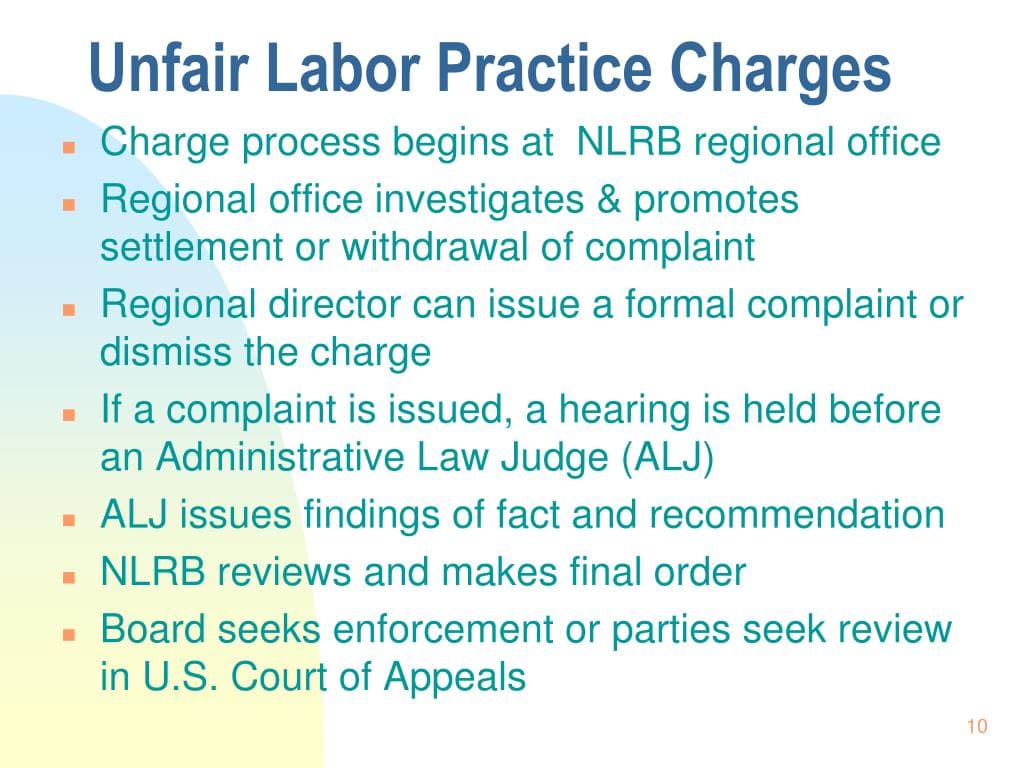
If an unfair labor practice charge is filed at an NLRB Regional Office, a Board Agent will be assigned to investigate the case. If the Regional Office determines that there is merit to the charge, it will seek remedies to stop the unlawful conduct and restore employees to the situation they were in before the unlawful conduct (through for example, reinstatement, monetary relief, or voiding a rule or policy). Regional Offices handle ULPs up to and including a hearing and decision from an Administrative Law Judge (ALJ), so filings can lead to sworn testimony and formal adjudication.
7. Common types of ULPs and practical expectations
Common ULPs include employer interference, restraint, or coercion of employees’ rights to organize or engage in protected concerted activities, described succinctly by counsel as: “Interference, Restraint, or Coercion: A charge that your business unlawfully interfered with employees’ rights to organize, form, join, or assist labor organizations, or to engage in other protected concerted activities.” Expect the Regional Office to investigate statements, policies, disciplinary actions, and workplace rules that might chill rights; even a policy that is not enforced can be unlawful if it chills employees from exercising rights.
- Prepare the full names/addresses of the filer and charged party before you call or e‑file.
- Keep contemporaneous notes and copies of any policies, notices, or discipline that relate to the alleged conduct.
- Save confirmation receipts or case numbers after e‑filing.
8. Assistance, e‑filing tools, and contact points
For help filing or navigating the charge process, the NLRB offers e‑filing and regional support: “If you believe that an employer or union is interfering with your rights as an employee under the National Labor Relations Act, you can call your NLRB regional office at 844-762-6572 and get assistance in filing an unfair labor practice charge, or e-file a charge here.” The Agency references tools such as E‑Filing, Online Charge and Petition, and My Account Portal. Practical tips:
9. Protections that apply to immigrant and other vulnerable workers
The guidance states plainly that “Employees are protected by the National Labor Relations Act regardless of immigration status and you can learn more about immigrant workers rights here.” Employers and unions cannot use immigration status as a shield to prevent employees from exercising NLRA rights; that protection matters for nearly every workplace, including multinational or locally staffed operations.
10. Operational caveats: shutdown/furlough notice and timing
The NLRB guidance includes an operational notice stating: “The National Labor Relations Board is currently in shutdown/furlough due to a lapse in appropriations. NLRB headquarters and all field offices are closed. This website remains available to the public but is not actively maintained during the shutdown. Accordingly, the E-Filing applications (E-Filing, Online Charge and Petition, and My Account Portal) remain available. Documents E-filed during the shutdown will be processed once normal operations resume.” It further cautions: “Please note that due dates to file or serve most documents continue to be tolled during the period of the shutdown. However, the due dates for filing unfair labor practice charges and certain representation petitions cannot be tolled. Click here for more information.” Because operational status can change quickly, verify current office availability and e‑filing processing before relying on timing for urgent filings.
11. Information disputes and the FLRA disclosure framework (caveat)
A separate body of procedural guidance from the Federal Labor Relations Authority (FLRA) addresses disputes over production of information under section 7114(b)(4) and Privacy Act/FOIA issues. As the FLRA explains, “When an unfair labor practice charge is filed alleging a violation of section 7114(b)(4), the necessity of the requested information is in dispute and the parties are unable with the Region's assistance to agree on whether or to what extent requested information must be provided, the Region should follow the following decisional process: [...] The Regional Offices must ascertain whether the requested information is barred from disclosure by the Privacy Act.” Because FLRA rules apply to federal sector cases (a different statutory scheme), treat this as a useful comparator for large information disputes rather than as NLRB procedure.
12. Role of the General Counsel and evolving priorities (outside analysis)
The General Counsel directs regional enforcement priorities and prosecutions; as one legal analysis states: “Appointed by the President for a four-year term with Senate consent, the General Counsel functions independently from the Board. This role involves investigating and prosecuting unfair labor practice cases and overseeing the NLRB’s regional offices – providing them direction about which kinds of cases to prosecute and which issues to prioritize. While the Board adjudicates cases, the General Counsel determines which cases to prosecute and provides guidance on legal interpretations.” That analysis also notes expectations about future shifts: “The General Counsel will shift strategic priorities. Once a permanent GC is installed, we expect the tone and direction of investigations and prosecutions to shift significantly away from its recent pro-labor stance. We expect a narrower view of “employee” status under the NLRA, confirmation that gig workers are independent contractors outside the scope of federal labor law, and broader employer authority over employee activities.” Treat those lines as outside legal commentary about likely enforcement trends, not as binding NLRB policy.
13. Practical takeaway for Nintendo workers
If you believe your rights have been chilled or violated at Nintendo, start by documenting the conduct and using the NLRB charge forms (NLRB‑501, NLRB‑508, NLRB‑509) to make a clear, signed, dated complaint that includes full names and addresses and a concise statement of the alleged conduct. Keep the two‑letter case designations and regional filing rules in mind so you can track the case, and use the NLRB’s e‑filing tools or call 844‑762‑6572 for help. Protect your evidence, know your protections (including immigrant‑worker protections), and be prepared that investigations can lead to remedies ranging from reinstatement to monetary relief or voiding unlawful policies.
Closing practical wisdom Filing a ULP charge is the workplace equivalent of pressing Start: it triggers an assigned investigator, creates an official case number, and sets a clock in motion. Be precise on the form, preserve your evidence, and use the Agency’s e‑filing or regional assistance to avoid procedural missteps, procedural accuracy often determines whether the merits get heard, and careful documentation gives your complaint the best chance to press through to remedy.
Know something we missed? Have a correction or additional information?
Submit a Tip