Nvidia bets on $200 billion AI agent CPUs as record revenue surges
Nvidia says AI agents could drive a $200 billion CPU market as revenue hit $81.6 billion and data-center sales rose 92%.
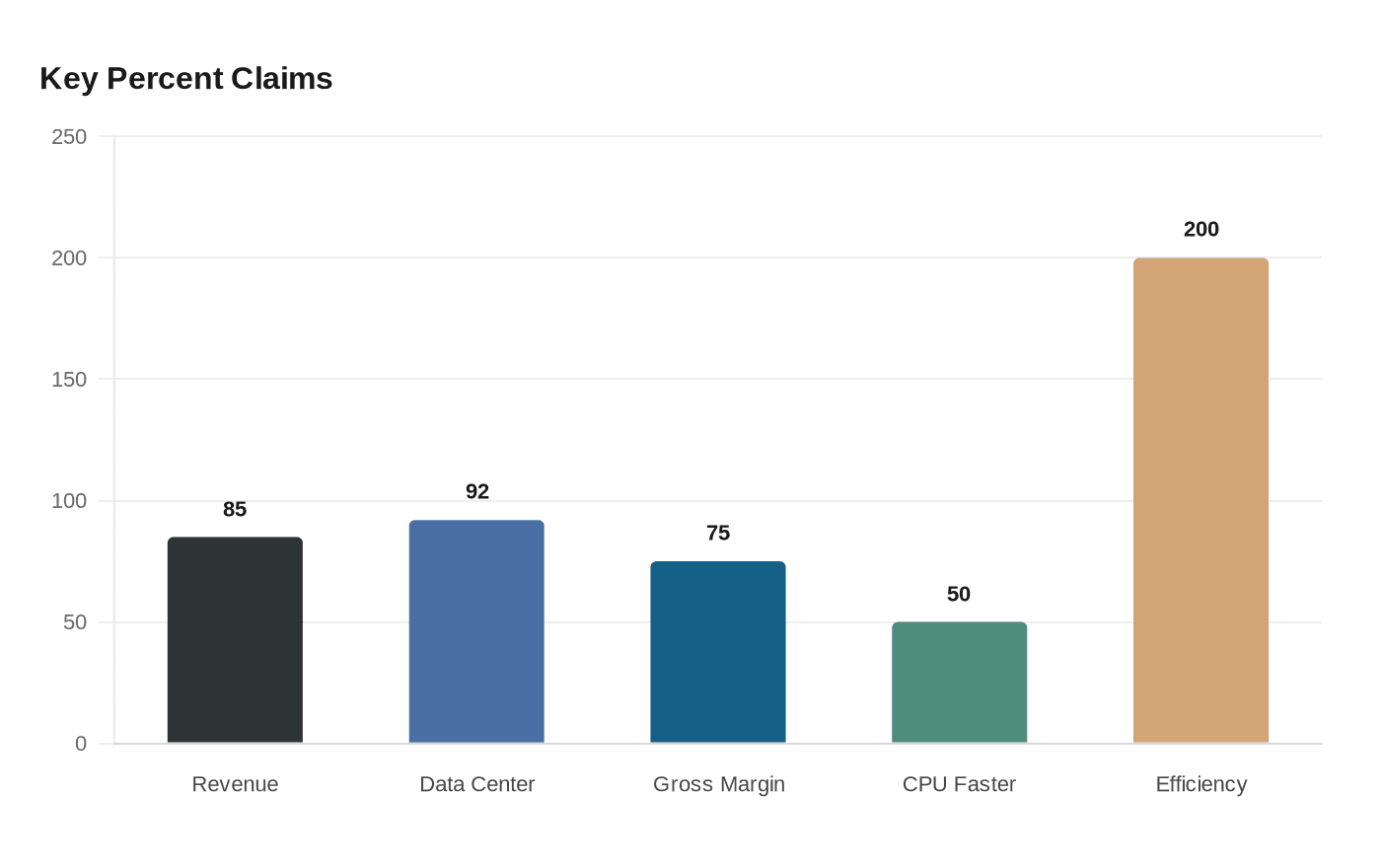
Nvidia is betting that the next giant market in artificial intelligence will not come from GPUs alone, but from CPUs built for AI agents. Jensen Huang put a $200 billion figure on that opportunity as Nvidia reported first-quarter fiscal 2027 revenue of $81.6 billion, up 85% from a year earlier, with data-center sales of $75.2 billion, up 92%, and gross margin of about 75%.
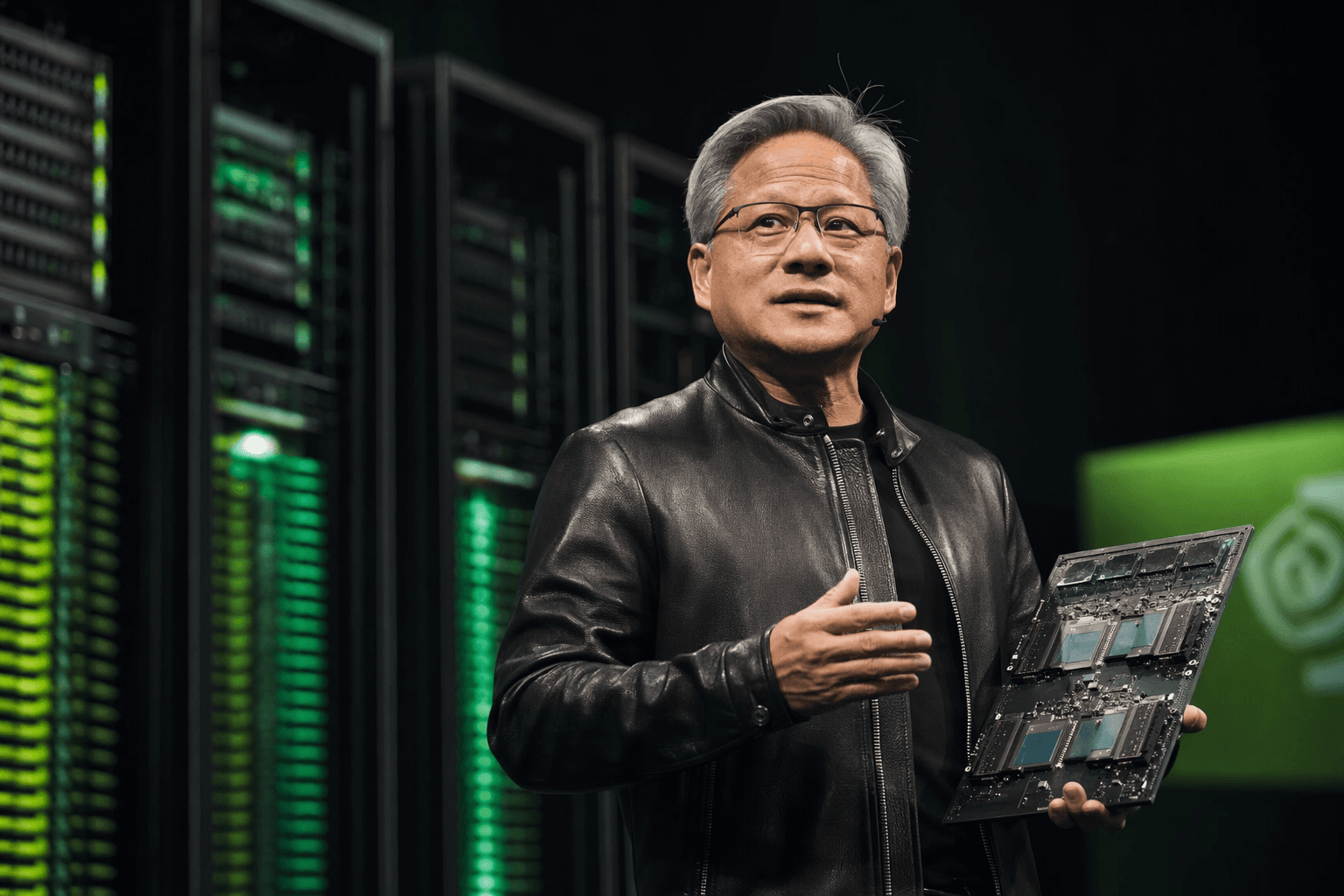
The pitch rests on a shift Nvidia says is already under way in enterprise computing. Huang said the buildout of AI factories is accelerating and declared that “agentic AI has arrived.” Nvidia is framing its Vera processor as the hardware foundation for that change, arguing that AI systems that reason, plan and act across large workloads need a different class of CPU infrastructure than the general-purpose chips that have dominated rack-scale computing.
Nvidia launched Vera on March 16, 2026, as its first CPU purpose-built for agentic AI and reinforcement learning. The company says Vera delivers twice the efficiency and is 50% faster than traditional rack-scale CPUs. Nvidia is pairing that claim with a broad partner list that spans cloud and hardware vendors, including Alibaba Cloud, ByteDance, Meta, Oracle Cloud Infrastructure, CoreWeave, Lambda, Nebius and Nscale, alongside Dell Technologies, HPE, Lenovo, Supermicro, ASUS, Compal, Foxconn, GIGABYTE, Pegatron, Quanta Cloud Technology, Wistron and Wiwynn.
The economic case is whether customers will actually buy this new layer of silicon at scale. Nvidia says its Vera rack can integrate 256 liquid-cooled Vera CPUs and support more than 22,500 concurrent CPU environments, a sign that the company sees CPUs becoming infrastructure for agentic and physical AI rather than support chips sitting in the background. That is the market thesis Nvidia is asking investors to buy: if AI agents become a core enterprise workload, the spending pool could expand far beyond today’s GPU-heavy buildout.
Still, the market is not open territory. Intel and AMD remain entrenched in server CPUs, while cloud providers continue to design more of their own chips to control costs and reduce dependence on outside suppliers. Nvidia’s answer is that its scale, software stack and integration with AI factories can lift it above commodity competition. The company is also changing how it describes its business, moving to a new reporting framework with Data Center and Edge Computing as its two market platforms, and splitting Data Center into Hyperscale and ACIE.
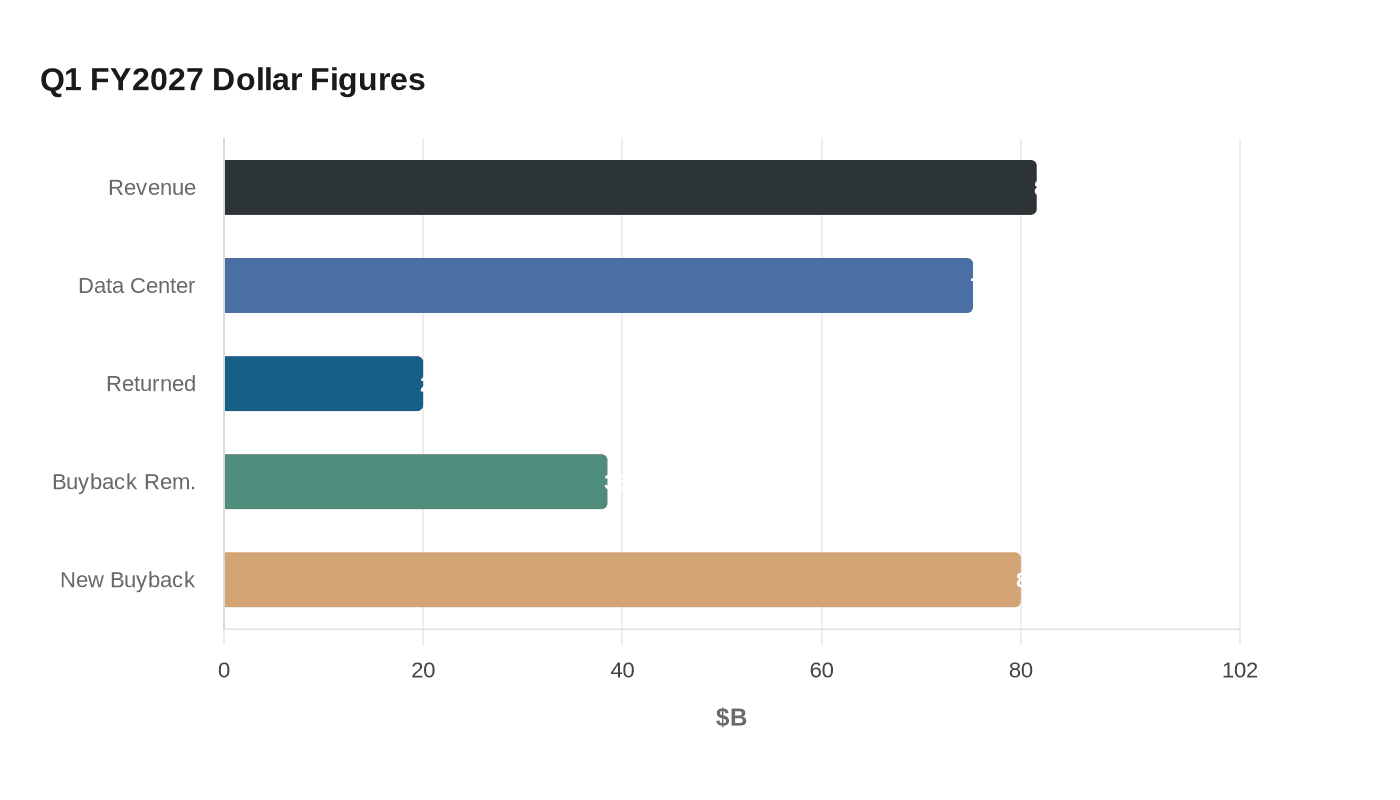
The financial backdrop gives Nvidia room to press that argument. The company returned about $20.0 billion to shareholders during the quarter, said $38.5 billion remained under its buyback authorization, approved an additional $80.0 billion buyback on May 18, 2026, and raised its quarterly dividend to $0.25 per share from $0.01. Nvidia’s results call was webcast at 2:00 p.m. PT on May 20, 2026, as the company tried to show that its latest growth engine is not just another product line, but the next phase of AI infrastructure spending.
Know something we missed? Have a correction or additional information?
Submit a Tip