Oil Prices Drop as Trump Signals Active Iran Peace Talks Underway
Brent crude plunged as much as 14% on Monday after Trump posted that U.S.-Iran talks are delivering "major points of agreement" — Tehran denied any negotiations exist.

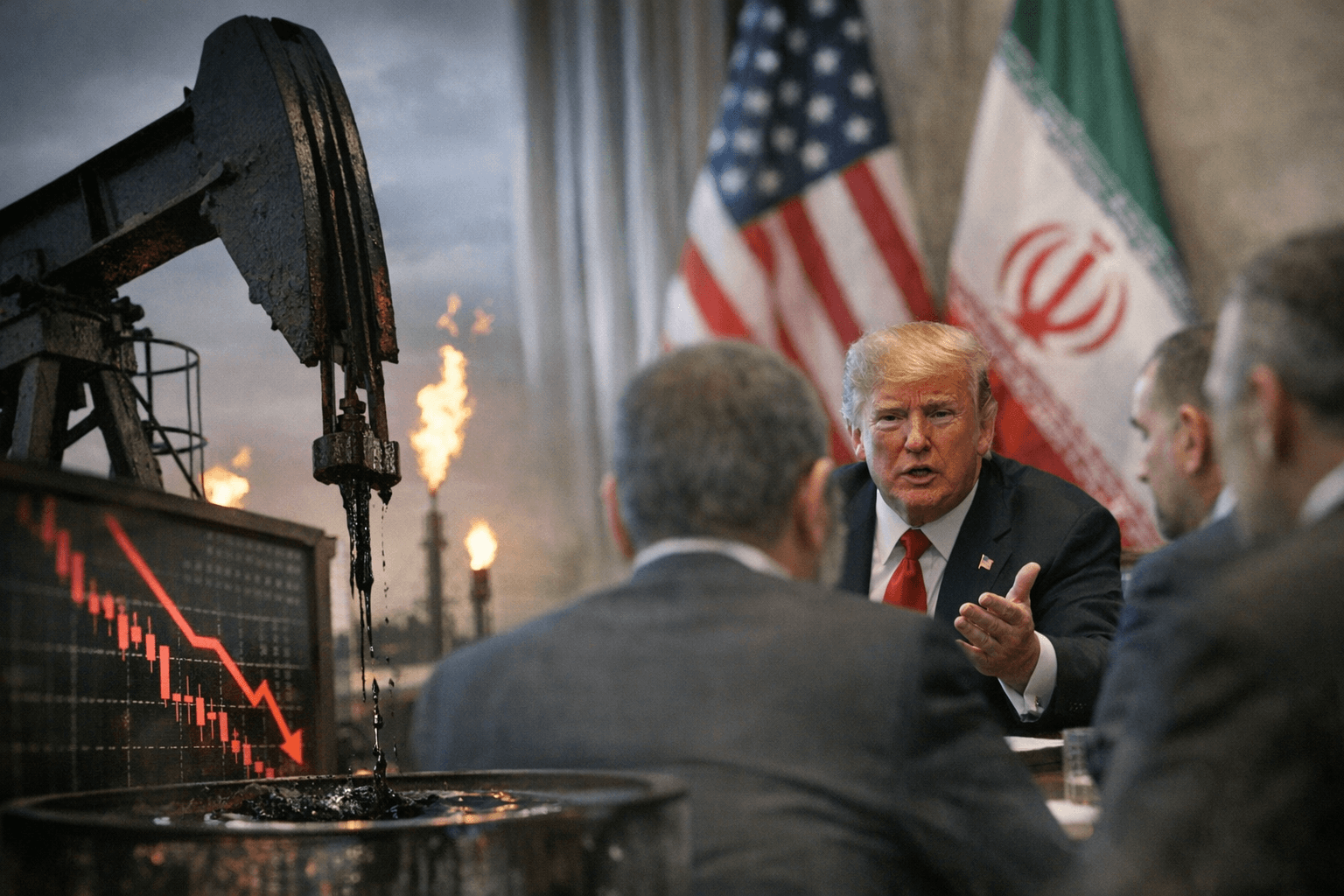
Oil prices tumbled Monday after President Donald Trump said the U.S. and Iran had held productive talks and that he ordered a halt on strikes against key Iranian energy infrastructure. Tehran's denial that any negotiations were taking place left markets swinging between relief and deep uncertainty in one of the most volatile trading sessions since the war began.
In an all-caps post on Truth Social Monday morning, Trump wrote that the U.S. and Iran had "very good and productive conversation" over the last two days focused on ending hostilities, and that he had instructed the Department of War to postpone military strikes against Iranian power plants and energy infrastructure for a five-day period, "subject to the success of the ongoing meetings and discussions."
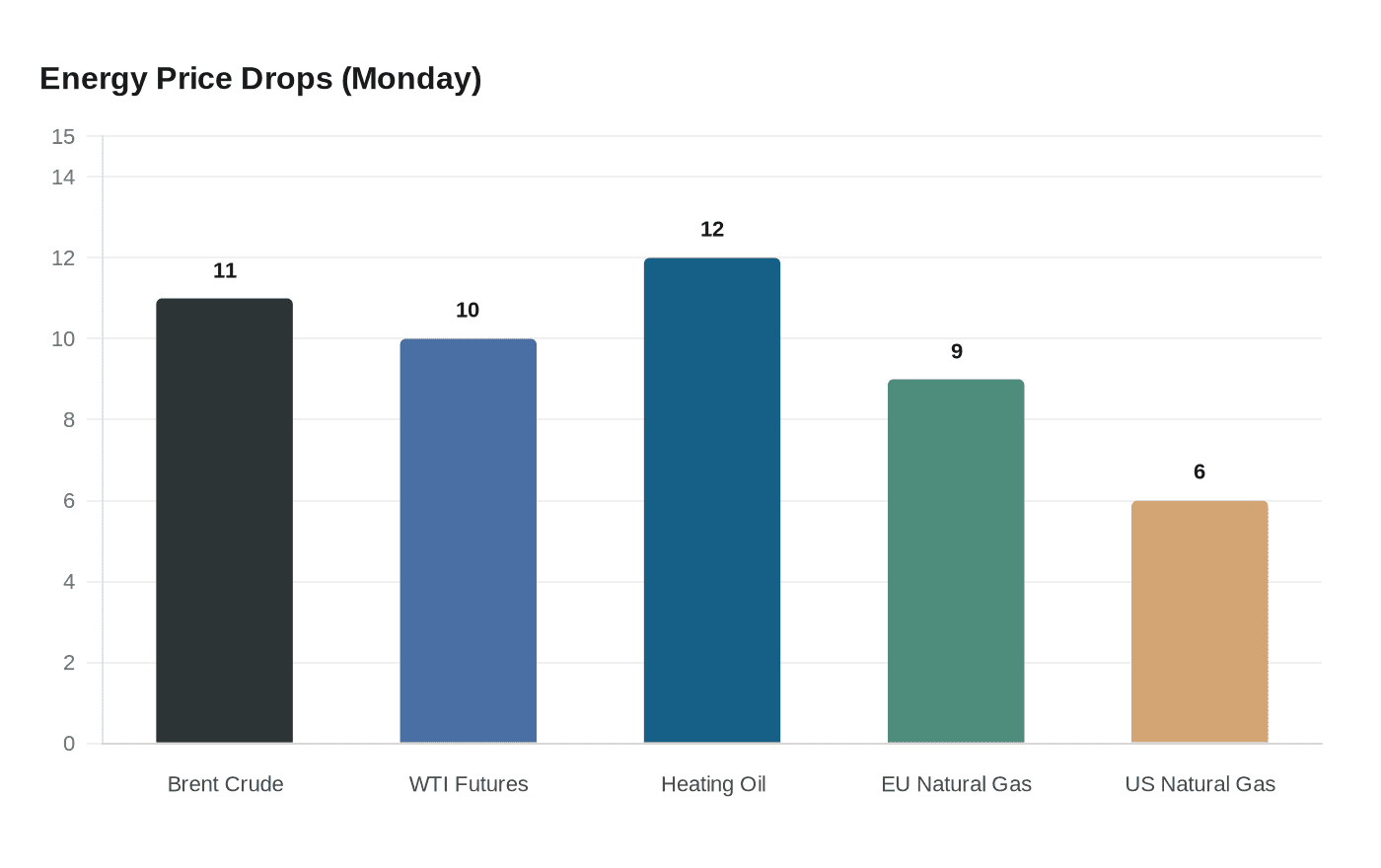
Oil fell sharply, posting one of the biggest price swings on record. Brent and West Texas Intermediate both tumbled more than 14% before clawing back some losses, with the global benchmark closing below $100 for the first time in almost two weeks. Brent crude fell close to 11% to $99.94 per barrel after topping $112 on Friday, while West Texas Intermediate futures dropped more than 10% to $88.13 per barrel. U.S. natural gas prices dropped 6% Monday, European natural gas futures slid 9%, and heating oil prices dropped 12%.
The reversal was all the more dramatic for its speed. On March 21, Trump had issued an ultimatum to Iran demanding it "fully open, without threat" the Strait of Hormuz within 48 hours, threatening to otherwise strike Iranian power plants, "with the biggest one first." In response, Iran doubled down, threatening to "completely" close the strait and strike vital infrastructure across the region, including energy and desalination facilities.
Iran's Foreign Ministry said there had been no talks between Iran and the U.S., while acknowledging some countries in the region were working to reduce tensions. Iranian state media quoted an unnamed senior security official as saying: "There is been no negotiation and there is no negotiation, and with this kind of psychological warfare, neither the Strait of Hormuz will return to its pre-war conditions nor will there be peace in the energy markets."
An Israeli official told Axios that U.S. envoys Steve Witkoff and Jared Kushner had been in touch with the speaker of the Iranian parliament, Mohammad Bagher Ghalibaf. Trump did not name the Iranian interlocutor, saying he did not want to get him killed, but claimed the U.S. and Iran were aligned on many of the key issues. A source with knowledge of the discussions said there did not appear to have been any direct talks yet between Ghalibaf and Trump's team. Ghalibaf himself denied that any "negotiations" had taken place and called the U.S. claims an effort to manipulate markets.
Iranian officials also accused Trump of delaying his threat to strike Iran's energy infrastructure in order to ease market instability and to buy time for U.S. soldiers to reach the Persian Gulf.
The supply picture adds another layer of complexity. IEA member nations on March 11 agreed to release a record 400 million barrels of oil from strategic stockpiles to address the supply disruption triggered by the Iran war. Separately, the Trump administration temporarily lifted sanctions on Iranian oil at sea, allowing the sale of 140 million barrels sitting on tankers, an amount the U.S. Energy Information Administration said was enough to satisfy global demand for roughly a day and a half.
The global energy crisis stemming from the conflict has already surpassed the oil shocks of the 1970s in severity, according to the IEA's executive director. In each of the two oil crises of 1973 and 1979, the world lost about 5 million barrels of oil a day. "Today — only as of today — we lost 11 million barrels per day, so more than two major oil shocks put together," IEA executive director Fatih Birol said.
American drivers are already feeling the consequences: the national average for a gallon of regular gasoline has jumped to over $3.84, up from $2.98 before the U.S. and Israel attacked Iran on February 28, according to motor club AAA.
Goldman Sachs sharply raised its oil price forecasts, expecting Brent to average $110 in March and April, up from a previous forecast of $98. The bank also upgraded its WTI estimates to $98 in March and $105 in April. Should Hormuz flows remain at 5% of normal for 10 weeks, daily Brent prices will likely exceed their 2008 record level, Goldman said.
One Wall Street analyst struck a cautiously optimistic note. "Equity markets finally found an off-ramp to the dramatic uncertainty and significantly oversold conditions due to the Iranian conflict," wrote Jeff Kilburg, founder and CEO of KKM Financial. "If this proves to be a foundation for peace in the Middle East, equities could get back to all-time highs." Most traders, though, remained wary, given that any market relief depends entirely on whether talks Iran denies having will actually produce a deal.
Know something we missed? Have a correction or additional information?
Submit a Tip