Palantir lifts revenue outlook as AI defense demand surges
Palantir’s U.S. government revenue jumped 84% to $687 million, showing how much of its AI boom now runs through Pentagon contracts and battlefield software.
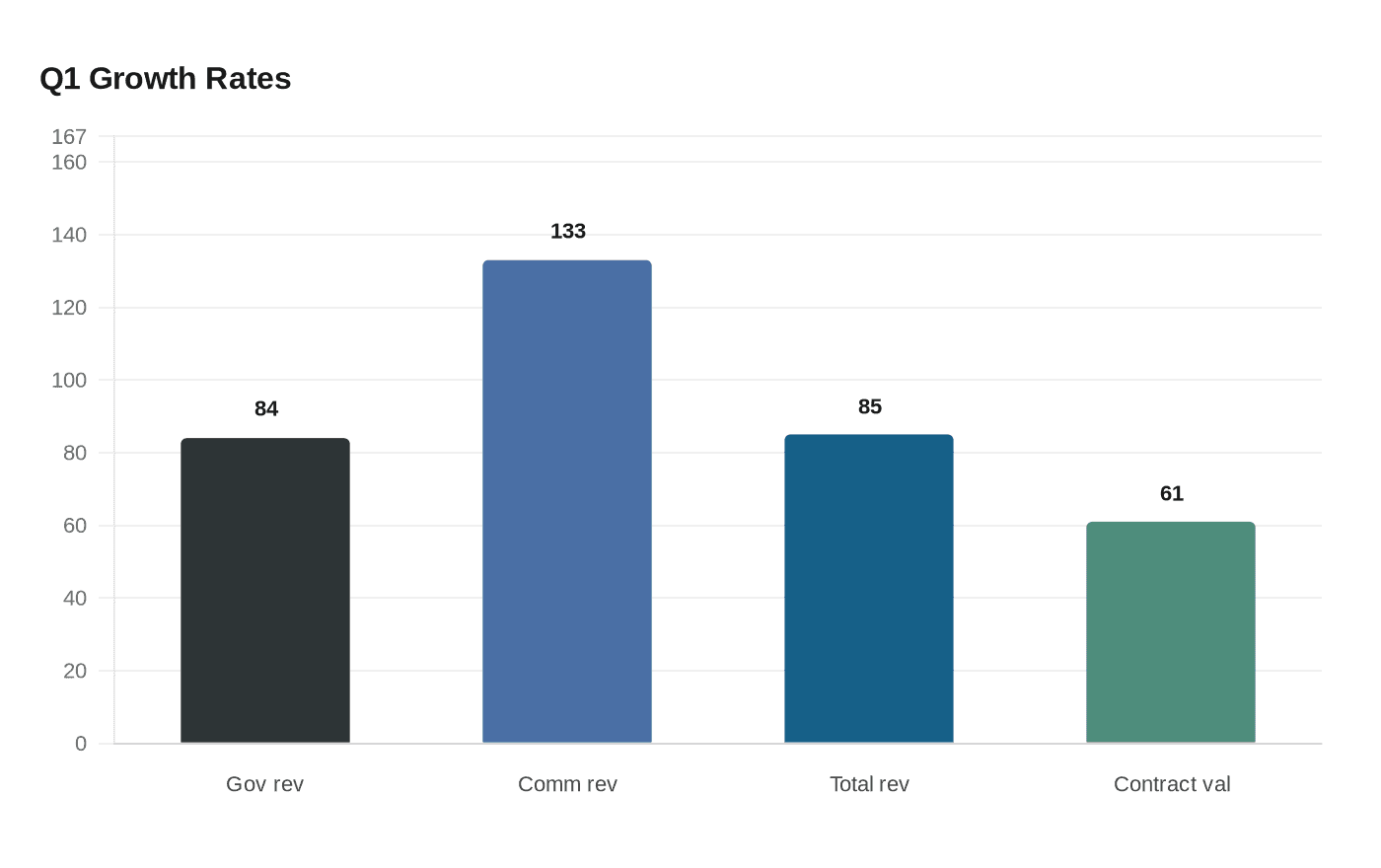
Palantir’s latest surge is being driven as much by Washington as by commercial customers. In the first quarter, U.S. government revenue climbed 84% from a year earlier to $687 million, while U.S. commercial revenue jumped 133% to $595 million, helping push total revenue up 85% to $1.633 billion.
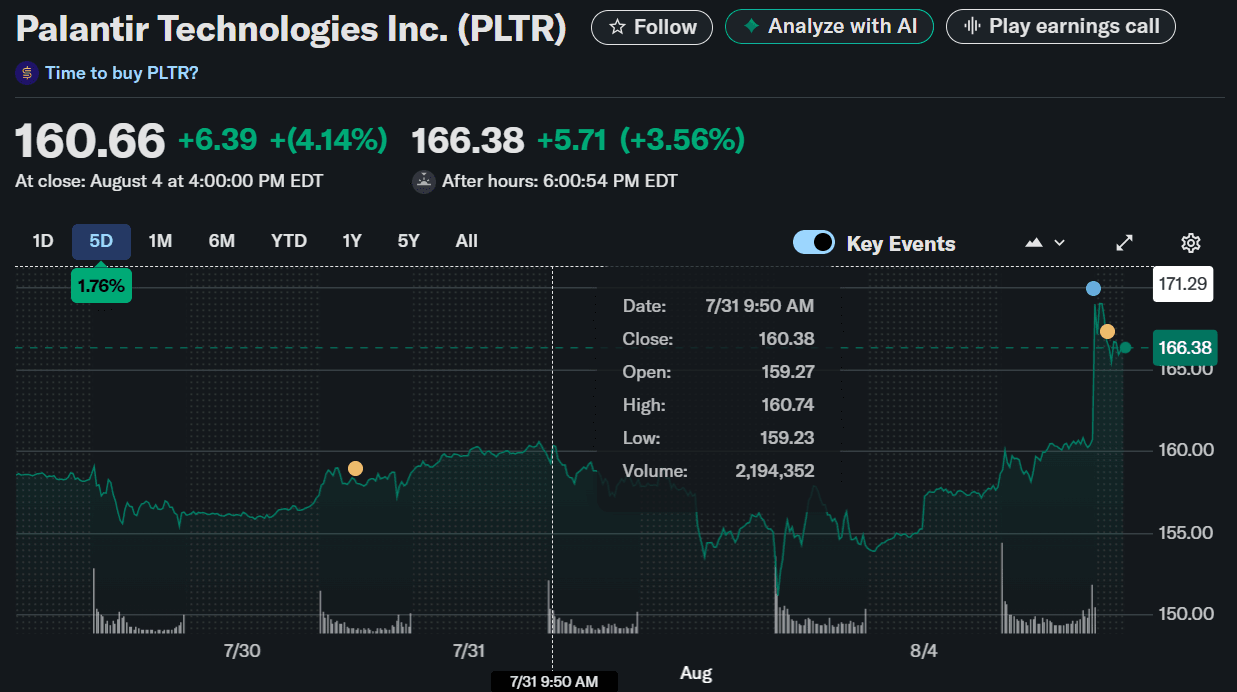
That momentum was strong enough for Palantir to raise its full-year 2026 revenue outlook to $7.65 billion to $7.66 billion, from a prior forecast of $7.18 billion to $7.20 billion. The company also guided second-quarter revenue to $1.797 billion to $1.801 billion, above analyst expectations, and shares were little changed to slightly higher in extended trading after the update.

The numbers point to a business that is increasingly being built around federal demand. Palantir closed 206 deals of at least $1 million in the quarter, including 72 deals of at least $5 million and 47 of at least $10 million, and posted total contract value of $2.41 billion, up 61% from a year earlier. In 2024, Palantir generated $2.9 billion in revenue, with 55% coming from government customers and 66% from U.S. customers, underscoring how central public-sector spending has become to the company’s expansion.

What taxpayers are buying is not a generic productivity tool. Palantir’s systems are being used to digest huge volumes of data, help identify targets and support command-and-control decisions. At the center of that push is Maven AI, a platform tied to Project Maven, which began with a Pentagon memorandum on April 26, 2017, creating the Algorithmic Warfare Cross-Functional Team. A September 2024 Defense Department inspector general document said Maven had been integrated into the National Geospatial-Intelligence Agency’s geospatial intelligence operations and fielded to Defense Department mission areas, signaling that the program had moved well beyond an experimental phase.

The policy backdrop suggests this is more than a temporary rush. A March 6, 2025 Pentagon memo said the Defense Department was trying to move from a hardware-centric acquisition model to a software-centric one, while a January 9, 2026 AI strategy emphasized accelerating military AI dominance. That shift favors companies that can turn data integration and battlefield analytics into permanent infrastructure rather than one-off pilots.
Chief executive Alex Karp cast the company’s position in unusually blunt terms in a shareholder letter: "The United States remains the center, the constant core, of our business. And that business is erupting." For Palantir, the eruption is now visible in the budget lines of the Pentagon and the agencies around it, and in the prospect that AI procurement in national security is becoming a durable structural market.
This article was produced by Prism’s automated news system from verified source data, official records, and press releases, then run through automated quality and moderation checks before publishing. The system is built and supervised by the people who set the standards it runs under. Read our full AI policy.
Did this article answer your question?

