Polyploid plants may have thrived during climate upheavals
Extra chromosome sets may have helped plants ride out ancient climate shocks, offering clues for hardier crops and conservation in a warming world.
Why extra chromosomes may be a survival edge
Some plants may have had a hidden advantage during Earth’s most violent climate swings: extra copies of their genomes. The new picture emerging from a study of flowering plants is not just evolutionary trivia. It suggests that polyploidy, the condition of having more than two sets of chromosomes, may have helped plant lineages persist through extinction-level upheaval and could still matter as heat, drought, and other stresses intensify.
That matters because plants sit at the base of food systems and ecosystems alike. If extra genome copies can improve the odds of survival during disruption, then polyploidy may be one of nature’s oldest resilience strategies, with implications for crop breeding, biodiversity conservation, and the search for plants that can keep producing under pressure.
What polyploidy looks like in the real world
Most people are diploid, with two sets of chromosomes. Many plants are not. Polyploidy can arise through whole-genome duplication, when an organism ends up with more than two full chromosome sets. In practice, this trait is common in flowering plants and shows up in familiar crops and fruits.
Strawberries can have eight sets of chromosomes. Cultivated bananas can have three. Wheat can have as many as six. Those extra chromosome sets are not a curiosity tucked away in plant textbooks. They are part of the genetic architecture behind some of the world’s most important food plants, and they help explain why plant genomes can be so flexible.
The evidence from 470 genomes and 44 fossils
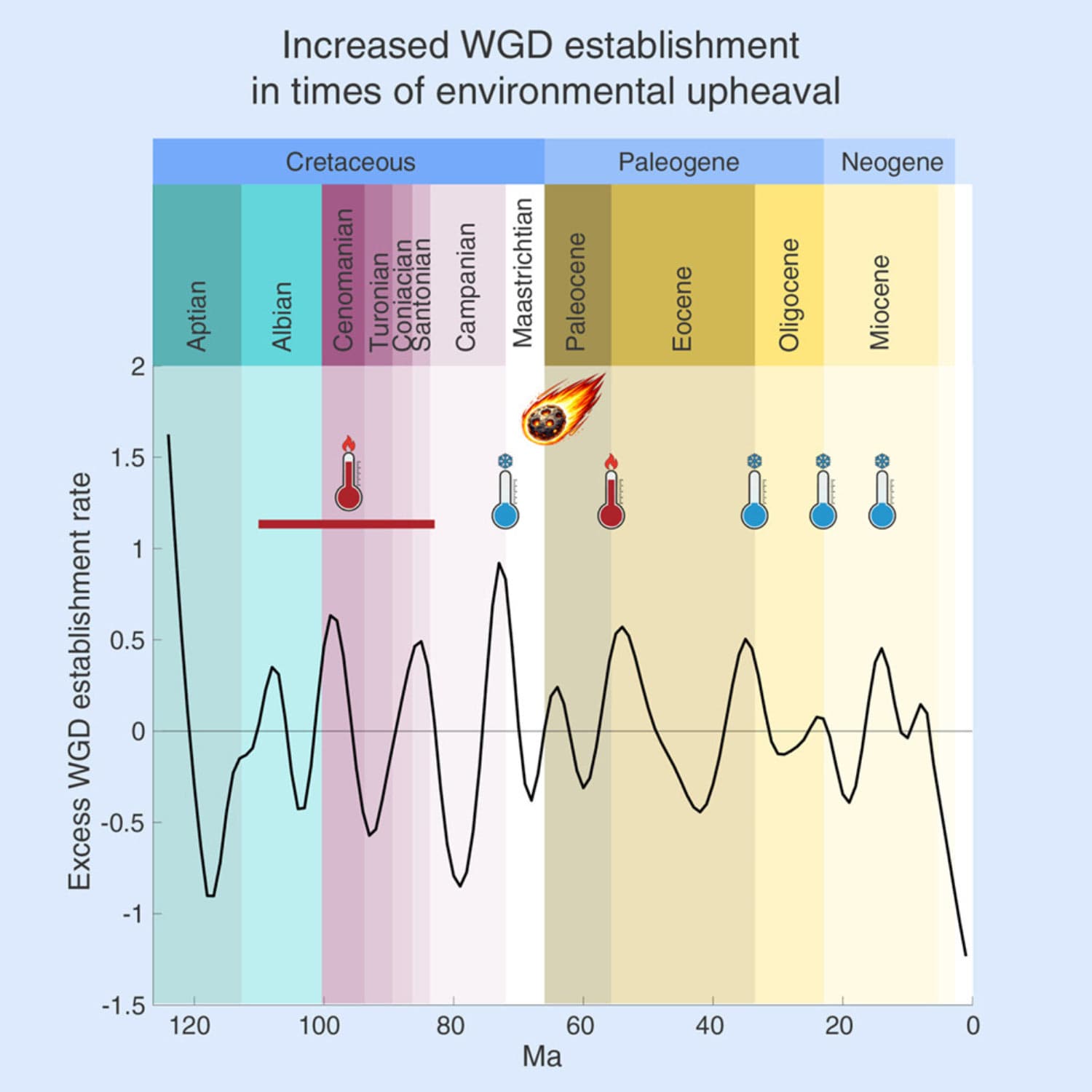
Researchers from VIB and Ghent University tested the idea at scale, analyzing genomes from 470 flowering plant species and using 44 plant fossils to help date ancient duplication events. From that work, they identified 132 ancient whole-genome duplication events. The pattern stood out because those events were not spread evenly across time. They clustered around periods of environmental upheaval.
Among the key intervals linked to those duplications were the asteroid-triggered mass extinction 66 million years ago, known as the K-Pg event, and the Paleocene-Eocene Thermal Maximum about 56 million years ago. The paper also ties duplication clusters to the Eocene-Oligocene Transition, the Middle Miocene Disruption, and several oceanic anoxic events. Taken together, the timing suggests that plant genomes repeatedly expanded around moments when climate and habitat conditions were shifting hard and fast.
That is a meaningful result for climate biology. It points to a deep evolutionary pattern: when the planet destabilized, some plants responded not only by adapting in place but by doubling down genetically.
Why extra genome copies can be costly
Polyploidy is not a free lunch. Larger genomes can require more nutrients to maintain, which makes them expensive in resource-poor environments. They can also increase the risk of harmful mutations and affect fertility, which helps explain why many duplicated genomes disappear over time. In stable conditions, whole-genome duplication can behave like an evolutionary dead end rather than a winning strategy.
That cost-benefit tension is part of what makes the finding so interesting. If polyploidy carries such clear burdens, why is it so common in plants? Yves Van de Peer of Ghent University, who has studied polyploidy for 25 years, says this work helps address that puzzle, often described as the polyploidy paradox: a trait that can be costly, yet remains widespread across plant life.
Why it may help during climate shocks
The advantage of extra genetic material appears most pronounced when conditions turn harsh. Whole-genome duplication can increase genetic variation, giving evolution more raw material to work with. Extra copies of genes can also take on new functions over time, which may let a plant lineage respond more effectively to heat, drought, global cooling, or other environmental shocks.
That is the survival logic at the heart of the study. In calm periods, duplication can drag. In turbulent ones, it may provide flexibility, redundancy, and a better chance that at least some cells, tissues, or descendants can cope with change. The researchers argue that this helps explain why polyploid plants may have thrived during major climate upheavals over the last 150 million years.
What the findings mean for food security
The practical significance goes beyond deep time. The authors say the result has implications for rapid climate change today, because genome duplication may raise the odds that some plant lineages survive environmental turmoil. For agriculture, that points toward a valuable lesson: resilience may sometimes come from preserving or using plants with duplicated genomes, not just from squeezing higher yields out of existing varieties.
That does not mean polyploidy is a silver bullet. Fertility costs, nutrient demands, and genetic instability still matter. But in a world where crop production faces hotter summers, erratic rainfall, and more frequent stress events, the evolutionary logic behind extra chromosome sets may be useful for breeding programs seeking hardier varieties. Polyploid crops already anchor parts of global food supply, and the new research strengthens the case for studying them as climate-adaptation tools, not just as botanical oddities.
A conservation lens for a warming planet
The same logic extends to conservation. If certain plant lineages are more likely to persist through upheaval because of genome duplication, then conservation strategies should pay attention to genetic makeup as well as habitat boundaries. Protecting diversity may mean protecting the evolutionary options that polyploid species represent, especially as rapid environmental change reshapes ecosystems faster than many species can move or adapt.
That is the larger lesson from the study published in Cell. The ancient record suggests that plants have already passed through planetary shocks by carrying extra genomic baggage that sometimes became an advantage. In the climate era now unfolding, that same genetic surplus may prove to be one of nature’s most important survival tools.
Know something we missed? Have a correction or additional information?
Submit a Tip