Postpartum care lasts a year, experts warn as maternal deaths persist
A year after birth, many women are still in crisis while care has already ended. Experts say the real postpartum window is 12 months, and the death toll remains disturbingly high.

A year-long recovery is still being treated like a six-week errand
A year after her daughter was born, one mother is still dealing with health complications, a reminder that childbirth is not the finish line many systems assume it is. The medical reality is harsher than the old 6-week checkup model: postpartum care now has to be understood as a year-long period, with risks that can surface long after the hospital discharge paperwork is signed.
That shift matters because the stakes remain deadly. The Centers for Disease Control and Prevention reported 649 maternal deaths in the United States in 2024, and the maternal mortality rate was 17.9 deaths per 100,000 live births, not significantly different from 18.6 in 2023. The CDC also says more than 80% of pregnancy-related deaths are preventable, a statistic that turns postpartum care from a follow-up issue into a public-health test of basic system performance.
The postpartum window is longer than most care models
The American College of Obstetricians and Gynecologists says postpartum care should be an ongoing process, not a single appointment. It recommends contact with an obstetrician-gynecologist or other obstetric care provider within the first 3 weeks after birth, followed by a comprehensive postpartum visit no later than 12 weeks postpartum.
That timeline still leaves out a large part of the risk. CDC Maternal Mortality Review Committees review deaths during or within one year of pregnancy, reflecting the broader understanding that pregnancy-related danger does not end when delivery does. Public-health evidence linked to the Agency for Healthcare Research and Quality shows that 52% of pregnancy-related deaths occur in the postpartum period, with 19% in the first 6 days after birth, 21% from 7 to 42 days, and 12% from 43 days to 1 year.
Deaths after delivery expose a fragmented system
The numbers point to more than biology. Researchers and maternal-health advocates say postpartum deaths often reflect system failures: poor care coordination, delayed treatment, misdiagnosis, and weak follow-up after discharge. In practice, that can mean warning signs are missed, complications are not escalated quickly enough, and women are left to navigate recovery on their own.
That fragmentation is especially dangerous because the postpartum period can include overlapping medical needs. Public-health research, including work tied to the Postpartum Assessment of Health Survey and Columbia University, has found substantial unmet needs in the year after birth, from follow-up on pregnancy complications and recovery from childbirth to chronic disease management, mental health care, and contraception. A single visit cannot reasonably absorb that entire burden.
Racial disparities remain severe
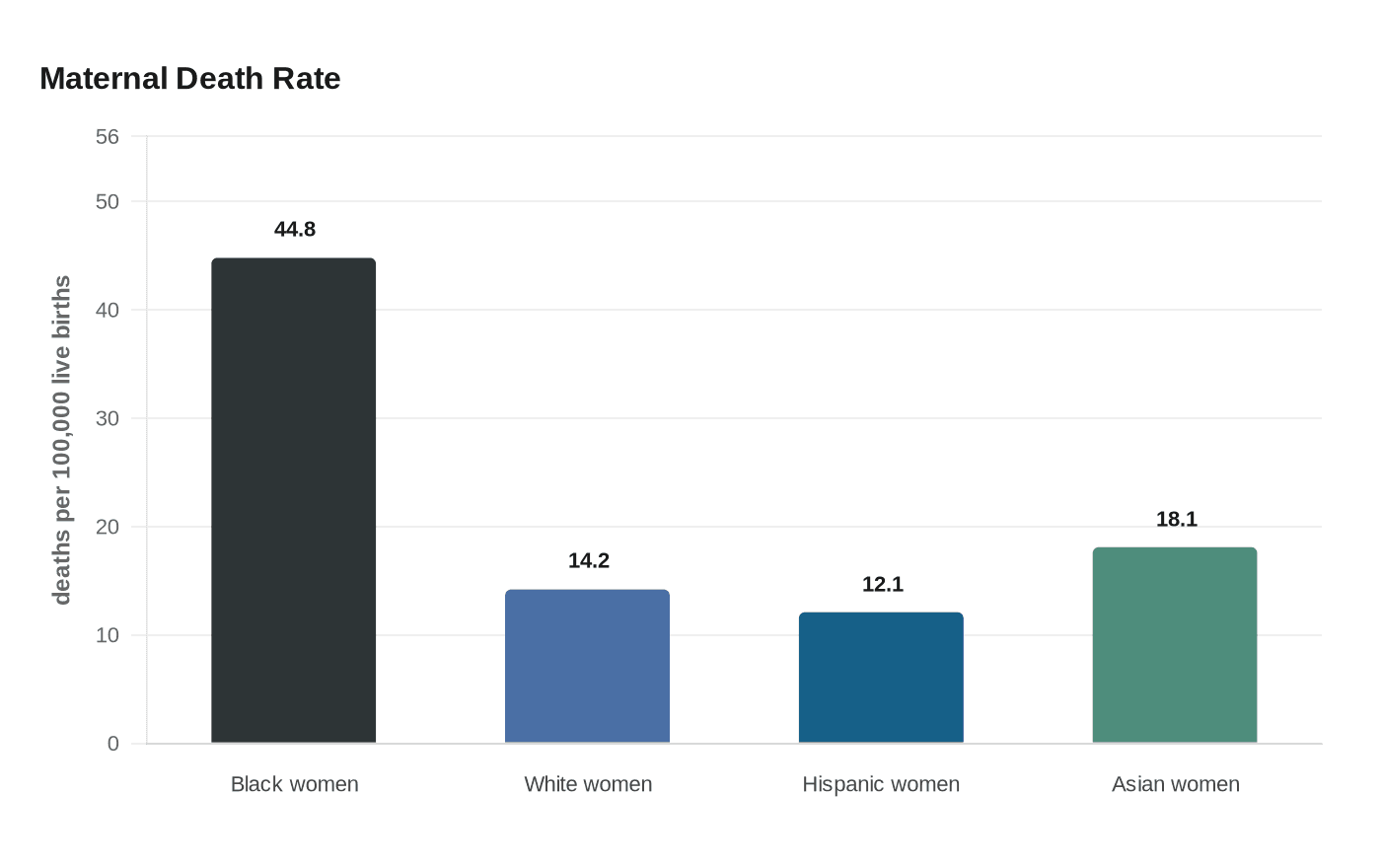
The maternal death crisis is not affecting all women equally. In 2024, Black women had a maternal mortality rate of 44.8 deaths per 100,000 live births, far higher than the rate for white women, at 14.2, Hispanic women, at 12.1, and Asian women, at 18.1. Those figures show that race remains one of the clearest predictors of danger in American maternity care.
The disparity is not just a gap in outcomes. It is also a clue about how systems work, or fail to work, when patients need urgent attention, continuity of care, and credibility when reporting pain, bleeding, shortness of breath, mood changes, or other warning signs. National experts have argued that the United States still lags other high-income countries in maternal outcomes, and the racial divide is one of the starkest signs of that lag.
What effective postpartum care should cover
The strongest evidence points to a simple idea: postpartum care has to be treated as a continuum rather than a single checkup. That means tracking physical recovery, mental health, blood pressure problems, blood loss, pain, sleep disruption, and the return of chronic conditions that may have been stabilized during pregnancy.
- Early contact within 3 weeks of birth, not just one later appointment
- A comprehensive visit by 12 weeks postpartum
- Follow-up on pregnancy complications that can reappear or worsen after delivery
- Screening and treatment for depression, anxiety, and other mental-health needs
- Management of chronic conditions such as hypertension or diabetes
- Contraception counseling and recovery planning for future pregnancies
A more complete postpartum plan should also include:
This is the kind of care that the American College of Obstetricians and Gynecologists is trying to normalize, and it aligns with concerns long voiced by clinicians and organizations including the American Academy of Family Physicians and the Association of Women’s Health, Obstetric and Neonatal Nurses. The message is consistent across the field: the system has to be built for recovery, not just delivery.
Why the crisis persists even as awareness grows
Awareness has improved, but access has not caught up. Many women leave the hospital with limited support, then face insurance gaps, transportation barriers, short appointment windows, and providers who are not prepared to manage problems that emerge weeks or months after birth. That is especially dangerous when the biggest threats are not always immediate, and when more than 80% of pregnancy-related deaths are considered preventable.
The result is a care model that remains too narrow for the medical reality. A woman can be discharged as if the hardest part is over, even while her body is still recovering, her mental health may be shifting, and serious complications can still emerge. The argument now being made by experts is not subtle: postpartum care must be treated as a full year of surveillance, treatment, and support if the United States wants maternal death rates to fall in a meaningful way.
The central failure is not that postpartum risk is hidden. It is that the system still acts as if it ends at birth, when for too many women, the real crisis has only just begun.
Know something we missed? Have a correction or additional information?
Submit a Tip