Sánchez Challenges Trumpism, Defends Spain’s Welfare State and Foreign Policy
Sánchez is testing an anti-Trump playbook built on welfare spending, NATO restraint, and trade defiance. The question is whether Spain can export it beyond its own politics.
Spain’s countermodel to Trumpism
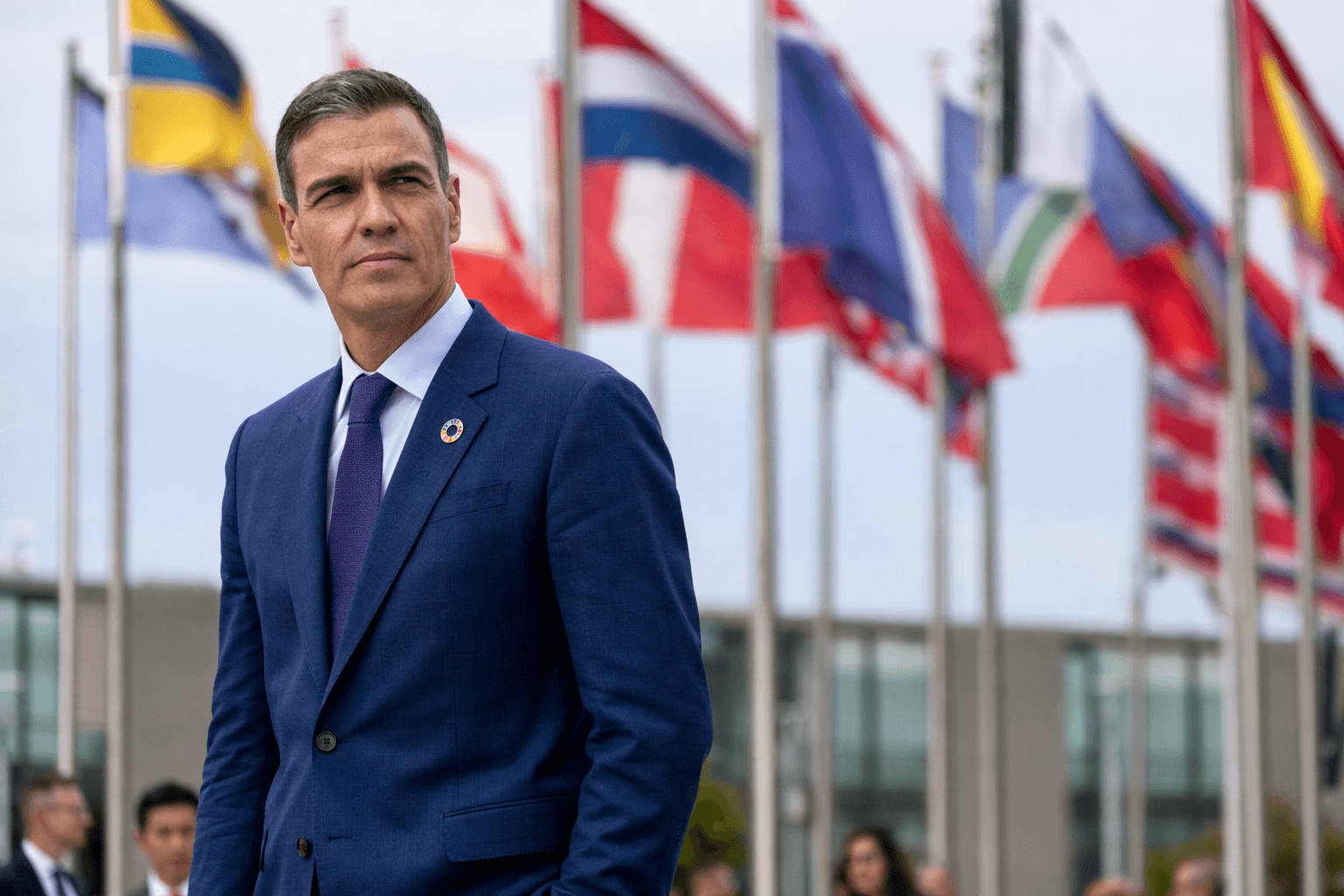
Pedro Sánchez has turned Spain into one of Europe’s sharpest counterexamples to Trump-era politics. His governing message is simple but unusually coherent in practice: defend the welfare state, resist coercive trade pressure, keep NATO commitments on Spain’s terms, and preserve room for independent diplomacy even when Washington objects. That mix has made him a useful foil to Donald Trump at home and abroad, but it has also exposed the limits of any anti-Trump strategy that depends on a very specific domestic coalition.
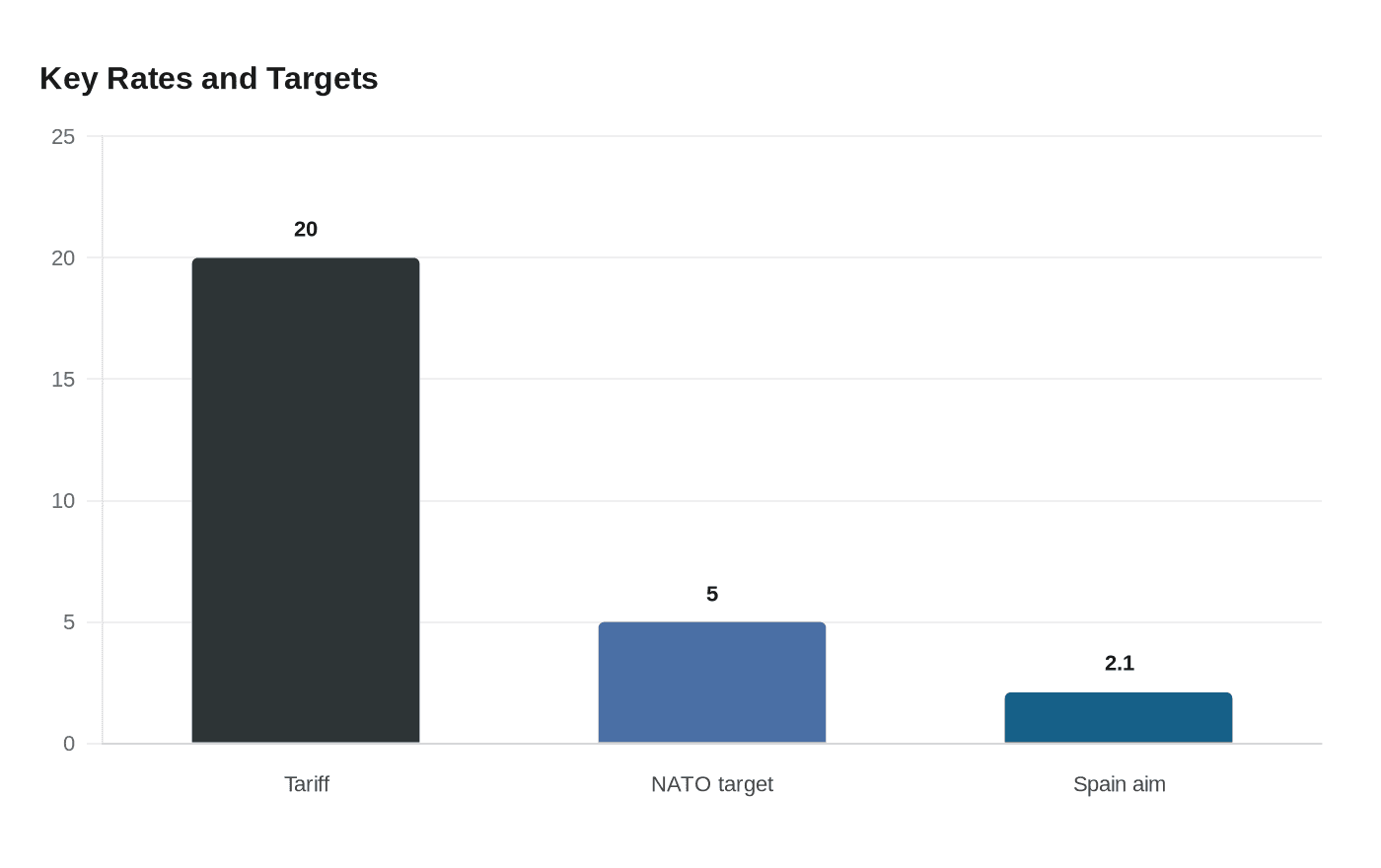
The clearest test came in trade. In April 2025, Sánchez’s government announced a €14.1 billion aid package to blunt the impact of Trump’s 20% tariff on EU imports. The response was not rhetorical alone. Madrid said €6 billion would go out as public loans for affected companies and another €400 million would support the automotive sector, signaling a deliberately interventionist state willing to absorb shock in order to protect jobs and output. The Spanish Chamber of Commerce estimated the tariffs could shave as much as €4.3 billion off the economy in 2025, with the most exposed sectors concentrated in agri-food, especially olive oil and wine, alongside machinery and electrical equipment exports to the United States.
Sánchez framed the tariffs as an “unprecedented” and “unilateral” attack, and his argument went beyond trade policy into political economy. By presenting the U.S. move as a threat to Spanish firms and households rather than as an abstract dispute over market access, he cast the state as insurer of last resort. That is the heart of his governing model: when external pressure rises, the answer is not austerity or retrenchment, but redistribution and stabilization.
Welfare state first, defense spending second
The same logic shaped Sánchez’s clash with Trump over NATO in June 2025. He rejected a 5% of GDP defense target as unreasonable, insisting Spain could meet alliance commitments without massive tax increases or cuts to social spending. Instead, his government said Spain would aim for about 2.1% of GDP on defense, a figure that preserved room for pensions, health care, and other core welfare guarantees. Spain’s position also mattered because it is the lowest military spender among NATO allies, according to reporting from Euronews and AP in June 2025, making every incremental increase politically sensitive.
The deal-making was not just about budgets. Reuters reported that Spain reached an understanding with NATO allowing it to avoid the 5% benchmark, and Sánchez used that outcome to argue that alliance loyalty does not have to mean blank-check militarization. Trump responded by saying Spain was the only country refusing to pay and threatened higher tariffs, turning defense policy into another front in a broader fight over sovereignty, burden-sharing, and who gets to define responsibility inside the alliance.
That confrontation reveals both the strength and fragility of Sánchez’s position. On one hand, he has defended a concrete model: keep defense spending closer to 2.1% of GDP, preserve welfare programs, and argue that Europe’s security obligations can be met without mimicking the most hawkish U.S. assumptions. On the other, the arrangement depends on Spain’s ability to persuade allies that its restraint is disciplined rather than evasive. If the model is to endure, it has to look like a credible alternative to escalation, not merely a national exception.
Politics at home, leverage abroad
Sánchez’s tough posture toward Trump has also become politically useful inside Spain. His coalition has been under pressure from corruption scandals and a fragile parliamentary majority, and the confrontation with Washington helped him rally center-left and regional partners such as Sumar, PNV, and Junts. The Partido Popular avoided openly siding with Trump, which left Sánchez with room to present himself as the leader defending Spanish interests against foreign pressure while his opponents hesitated to challenge the frame.
That matters because his foreign-policy stance is inseparable from coalition management. Sánchez does not just oppose Trumpism in principle; he uses that opposition to hold together a governing bloc that would otherwise be more vulnerable to fragmentation. The benefit is immediate: a nationalist argument for social spending can unify disparate partners faster than a technocratic defense of fiscal prudence. The risk is longer-term: if every dispute with Washington becomes a loyalty test, Spanish diplomacy can become increasingly personalized around Sánchez himself.
Business leaders have warned about that downside. A harder line could complicate trade and investment ties with the United States, especially if tariffs escalate or if foreign firms conclude that Spain is becoming a more politically confrontational market. Reuters reported that Sánchez’s approach was popular with Spanish voters but worried firms and opposition politicians, which captures the central tension in his strategy: the politics are durable only if the economics do not turn against him.
China as a second pillar of autonomy
Sánchez’s independence from Trump is not limited to defending Spain against tariffs or resisting NATO pressure. It also shows up in his deepening relationship with China. In April 2026, Reuters reported that Sánchez was making his fourth visit in as many years, a pattern that underlines how deliberately he has pursued a more autonomous foreign policy. Spanish officials described China as a stabilizing force, and the visits signaled that Madrid is willing to diversify its external relationships rather than remain tightly tethered to Washington’s preferences.
The numbers help explain why that shift matters. Reuters reported that Chinese firms invested €643 million in Spain in 2025, up from €149 million in 2024, and that total Chinese investment in Spain reached €9.7 billion between 2010 and 2025. Those figures do not prove strategic realignment on their own, but they do show why Sánchez’s foreign policy is attractive to the Spanish state: it gives Madrid more options at a time when transatlantic politics are unstable and U.S. trade policy is more volatile.
Still, the China strategy carries its own risks. Firms and opposition figures worry that a more independent line could strain Spain’s relationship with Washington just as Europe needs cohesion on trade, defense, and industrial policy. Sánchez appears willing to absorb that tension because it reinforces a broader message: Spain will not accept that economic security or alliance discipline must always be defined by U.S. domestic politics.
A durable democratic alternative, or a Spanish exception?
Sánchez’s anti-Trump governing model is real enough to matter. It combines redistributive economics, multilateralism, skepticism toward military escalation, and an instinct to protect domestic autonomy when outside powers apply pressure. In that sense, it offers a visible European rebuttal to Trumpism, one built less on slogans than on spending choices, alliance bargaining, and diplomatic diversification.
The harder question is whether it can travel. Spain’s political fragmentation, the leverage of regional parties, its relatively low defense baseline, and the electoral usefulness of confronting Trump may all be specific to Madrid’s current conditions. That does not make the model irrelevant. It means Sánchez is not simply denouncing Trumpism; he is stress-testing whether a democracy can resist it while still paying for the welfare state, honoring alliances, and keeping enough room to act independently. For now, Spain is showing that the answer can be yes, but only if the government is willing to turn ideology into budget lines, coalition discipline, and hard diplomatic choices.
This article was produced by Prism’s automated news system from verified source data, official records, and press releases, then run through automated quality and moderation checks before publishing. The system is built and supervised by the people who set the standards it runs under. Read our full AI policy.
Did this article answer your question?