SpaceX IPO Could Reserve 30% for Retail Investors, Triple the Norm
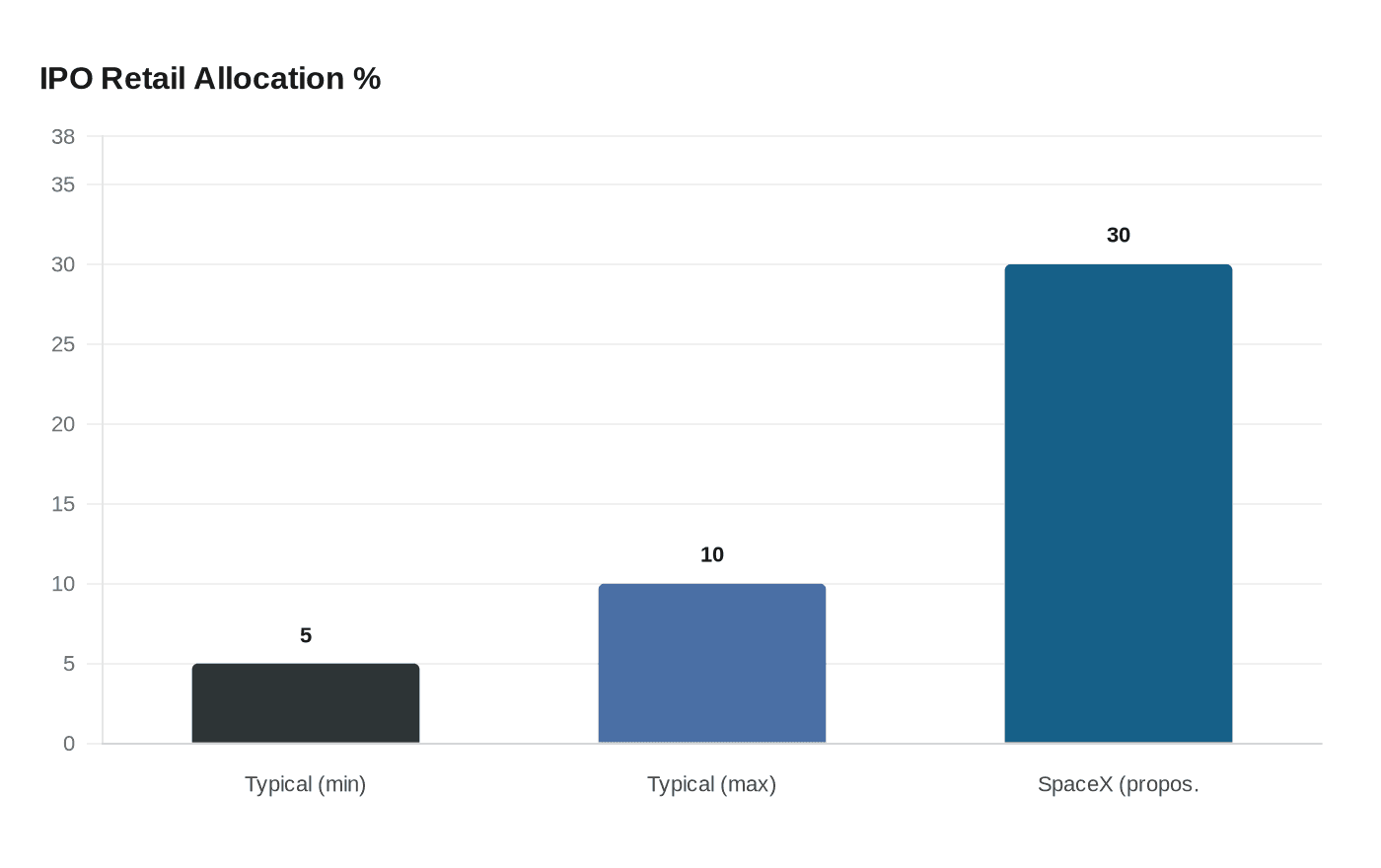
Elon Musk is discussing giving retail investors up to 30% of SpaceX's IPO — at least triple the Wall Street norm of 5–10%.

Bret Johnsen, SpaceX's chief financial officer, carried a striking message to Wall Street this week: Elon Musk wants ordinary investors to own an unusually large slice of what could be the biggest public offering in history.
Musk is discussing allocating as much as 30% of SpaceX's initial public offering to individual investors, at least three times the usual retail slice, according to a person familiar with the matter. In public listings, companies typically allocate no more than 5% to 10% of shares to retail investors.
The plan, relayed to Wall Street by Johnsen, pairs the oversized retail allocation with an unusually hands-on approach to choosing bankers. SpaceX is assigning some firms narrowly defined roles based on personal relationships and past ties rather than allowing them to broadly compete for investors, sources said, cautioning that the plan is not final and could change.
The rationale is deliberate. SpaceX is betting that those investors, many of whom have tracked the company for years in private markets, are less likely to rush for the exits immediately after listing, or engage in "pop-and-dump" trading. The strategy reflects Musk's calculation that his loyal following represents a more stable shareholder base than the institutional money managers who typically dominate IPO allocations.

SpaceX has assigned banks to specific investor pools and geographies in what market participants describe as a "lane" structure, directing firms to focus on defined parts of the offering rather than compete broadly across the deal. As part of that effort, Musk handpicked Bank of America to focus on domestic retail distribution, according to four people familiar with the matter. Morgan Stanley is expected to handle smaller-ticket retail investors through its E*Trade platform, while UBS will market to high-net-worth individuals and family offices internationally.
Barclays, Citi, Deutsche Bank, Mizuho, Morgan Stanley, and RBC declined to comment. Bank of America also declined to comment, and SpaceX did not respond to a request for comment.
The Information previously reported that the allocation to individual investors could exceed 20%, with defined roles for banks — a figure Reuters' sources now exceeded with the 30% figure.
The scale of the potential offering is staggering by any historical measure. The largest IPO on record so far is Saudi Aramco, which raised about $29 billion in 2019. Barron's has reported that SpaceX could look to raise $50 billion at a valuation upwards of $1.8 trillion, which would shatter that record. In a separate exclusive from January, Reuters reported that SpaceX generated revenue of about $15 billion to $16 billion in 2025.
The plan's bank selection is attributed to four people familiar with the matter, and all sources asked not to be identified because the process remains confidential. The unconventional structure, if it holds, would mark a fundamental break from how trillion-dollar companies have historically reached public markets, where institutional investors have long controlled the terms of entry.
SpaceX has not yet finalized the size or timing of the offering, which is expected to test investor appetite for what could be one of the largest IPOs in history.
Know something we missed? Have a correction or additional information?
Submit a Tip