Spain Permanently Withdraws Its Ambassador to Israel, Deepening Diplomatic Rift
Madrid formally ends its ambassador's posting in Tel Aviv, leaving both nations represented only by chargés d'affaires in a sharp break over Gaza and Iran.

Spain has formally terminated the appointment of its ambassador to Israel, Ana María Sálomon Pérez, publishing the decision in its official state bulletin on Wednesday and reducing its embassy in Tel Aviv to chargé d'affaires leadership. The move marks the most concrete diplomatic rupture between the two countries since relations were established in 1986.
The decision was approved during a cabinet meeting on a proposal by Foreign Minister José Manuel Albares, formalizing what had already become a prolonged absence. Sálomon Pérez had been recalled to Madrid for consultations in September 2025, a recall that a foreign ministry source described as being "indefinitely." Wednesday's gazette publication converted that temporary measure into a permanent downgrade.
The timing reflects the cascading deterioration in relations that followed U.S.-Israeli strikes on Iran. Prime Minister Pedro Sánchez publicly condemned those strikes as "illegitimate" and refused to allow U.S. military forces to use air bases on Spanish territory, positioning Spain as one of the most openly critical European governments toward both Washington and Tel Aviv on the issue. Standing before cameras earlier this month, Sánchez reduced Spain's position to two words: "no to war."
The bilateral relationship had already been under severe strain for more than two years. Spain recognized the State of Palestine in May 2024, prompting Israel to withdraw its own ambassador to Madrid in protest. With Wednesday's announcement, both countries are now represented at chargé d'affaires level in each other's capitals, a symmetry that underscores just how far ties have fallen.
Spain had taken a series of confrontational policy steps before the formal withdrawal. The government imposed nine measures against Israel, including a full arms embargo, and banned aircraft and ships carrying weapons to Israel from using Spanish ports or airspace during Israel's military campaign in Gaza.
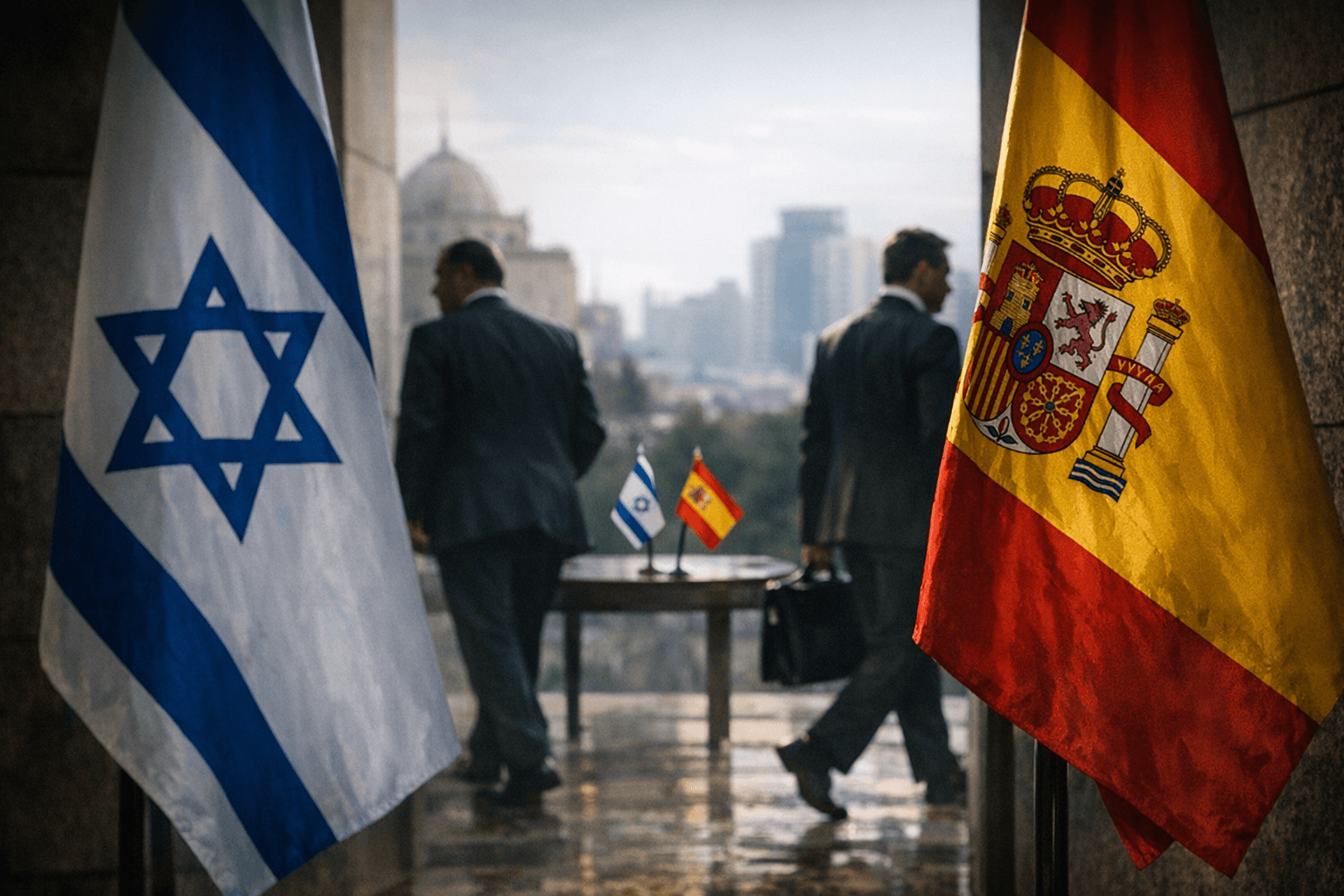
The rhetoric between the two governments has been correspondingly sharp. Israeli Foreign Minister Gideon Sa'ar responded to Spanish criticism of the Gaza campaign by calling the Spanish government "anti-Semitic." Sa'ar's government also reportedly banned Spanish Deputy Prime Minister Yolanda Díaz and Minister of Youth Sira Rego from entering Israel. The Netanyahu government, for its part, accused Sánchez of waging an "anti-Israeli" campaign to distract from domestic corruption scandals.
Relations between the two countries had been generally constructive from their establishment in 1986 through the outbreak of the Gaza war in October 2023. Within three years, both embassies have lost their top diplomats.
The downgrade places Spain in a category of its own among major European Union states in its formal diplomatic posture toward Israel. While other EU members have expressed criticism of Israeli military operations in Gaza and concern about the Iran strikes, none has moved to reduce ambassadorial representation to chargé level.
The Spanish foreign ministry has not publicly stated whether or when full ambassadorial ties might be restored. Given the sequence of events, including the arms embargo, the base-access refusal, and now the formal downgrade, any restoration would require a significant shift in both countries' political posture.
Know something we missed? Have a correction or additional information?
Submit a Tip

