Switzerland and France agree joint security plan for G7 summit
Switzerland and France have locked in a joint military plan for the G7 in Évian-les-Bains, with Lake Geneva and its airspace under tight watch. Swiss forces will also mobilize up to 5,000 troops.

Switzerland and France have agreed on a joint military framework for the G7 summit in Évian-les-Bains, underscoring how a diplomatic gathering in one of Europe’s most stable regions now requires security planning closer to a wartime posture than a ceremonial summit detail. The non-binding Joint Procedural Document, approved by the Swiss Federal Council on June 5, set out how the two militaries will cooperate around Lake Geneva and in the airspace above it when leaders meet from June 15 to June 17.
The Swiss Armed Forces’ support mission was first approved on January 28 and could involve more than 2,000 personnel, with the force rising as high as 5,000. Swiss officials have said around 4,000 troops will be deployed on Swiss territory, a scale that reflects the pressure on civilian and military authorities in Geneva, Vaud and Valais to secure roads, rail links, border crossings and the lakeside perimeter. The security effort will also cover buildings, surveillance, reconnaissance, transport and logistics.
The summit’s geography has driven much of the planning. Geneva International Airport is expected to be the main arrival point for participants and delegations, while most of the summit guests are expected to stay in France, though some may be housed on the Swiss side of the border. Swiss authorities have also said the gathering will bring the G7 leaders, the European Union and other invited heads of state and government, along with large numbers of media representatives, into a tightly managed corridor stretching across the Lake Geneva region.
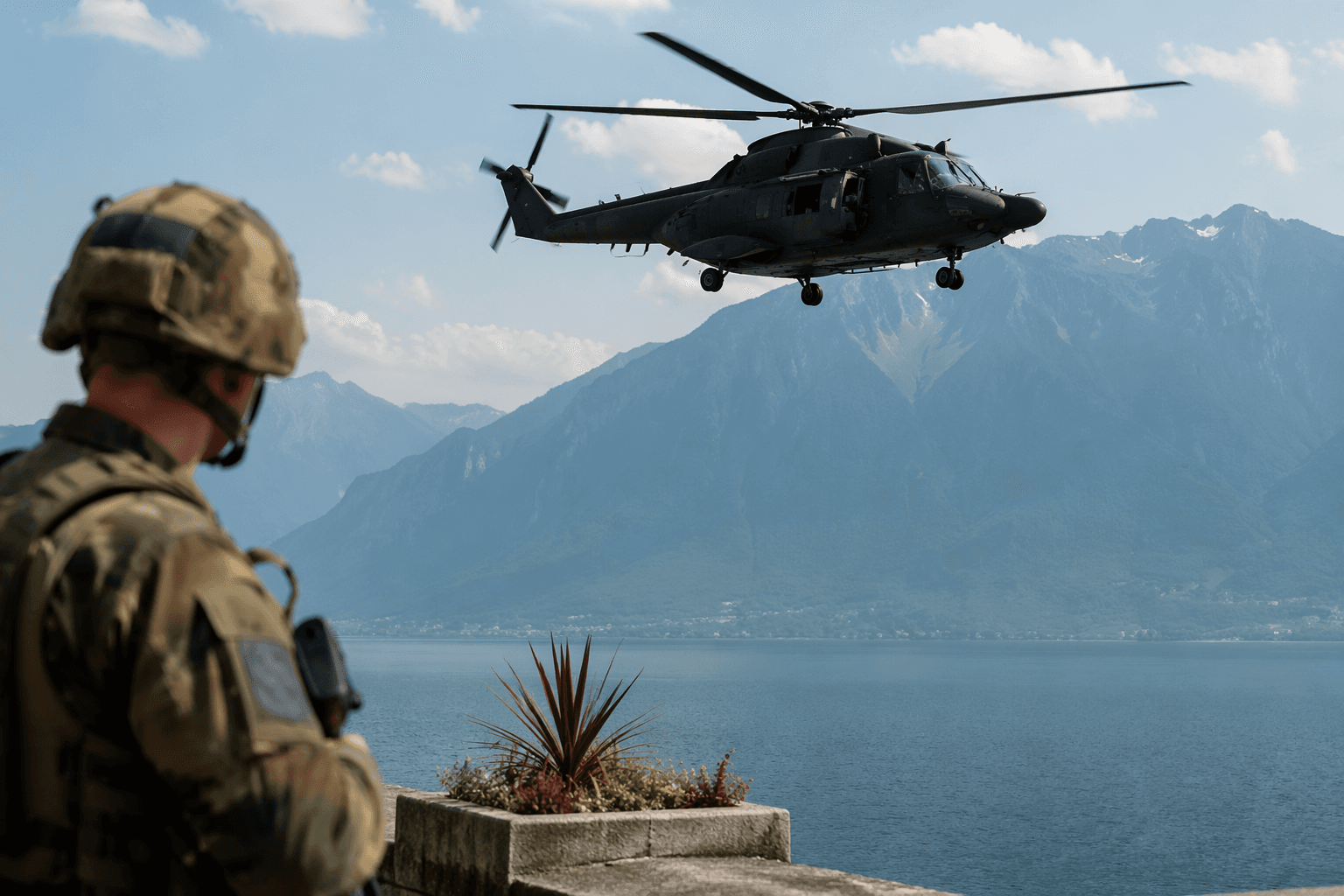
Airspace restrictions will run from June 10 to June 19, with the Swiss air force stepping up air policing and adding counter-drone capabilities as part of a broader effort to protect the summit. The security plan also includes protection against nuclear, biological and chemical threats, a sign that summit security has broadened far beyond crowd control and traffic management. On May 6, Switzerland decided to reintroduce temporary internal border controls with France for the same period, saying Geneva, Lausanne and the Lake Geneva region face security risks despite the summit taking place in France.
The Federal Council also decided on April 1 that the Confederation would contribute to the security costs borne by the cantons of Geneva, Vaud and Valais, which had requested federal support. Swiss customs authorities in Geneva have said the border measures will be partial and designed to limit disruption, but the message is clear: even in a neutral country, a high-stakes international summit now demands a cross-border security shield built well in advance.
This article was produced by Prism’s automated news system from verified source data, official records, and press releases, then run through automated quality and moderation checks before publishing. The system is built and supervised by the people who set the standards it runs under. Read our full AI policy.
Know something we missed? Have a correction or additional information?
Submit a Tip