Taiwan warns China may weaponise atemoya trade to trap farmers
China’s pledge to buy more atemoyas revived fears that Taiwan’s custard-apple growers could be lured into dependence, then squeezed again.
China’s pledge to buy more Taiwanese atemoyas at the Straits Forum in Fujian Province reignited a hard-fought debate in Taipei: whether Beijing is turning a niche fruit into leverage. Taiwan’s Ministry of Agriculture warned that the hybrid custard apple, grown about 90% in Taitung County, has become a case study in how selective market access can be used to pressure farmers.
The ministry said China had already disrupted the trade repeatedly. It suspended atemoya imports in September 2021 over pesticide concerns and alleged quarantine problems, partially resumed them on June 20, 2023, and then added a 20% tariff plus 9% value-added tax on Sept. 25, 2024. Officials described the pattern as China’s “raise, trap, kill” strategy, arguing that it leaves growers exposed to sudden swings in demand and price.
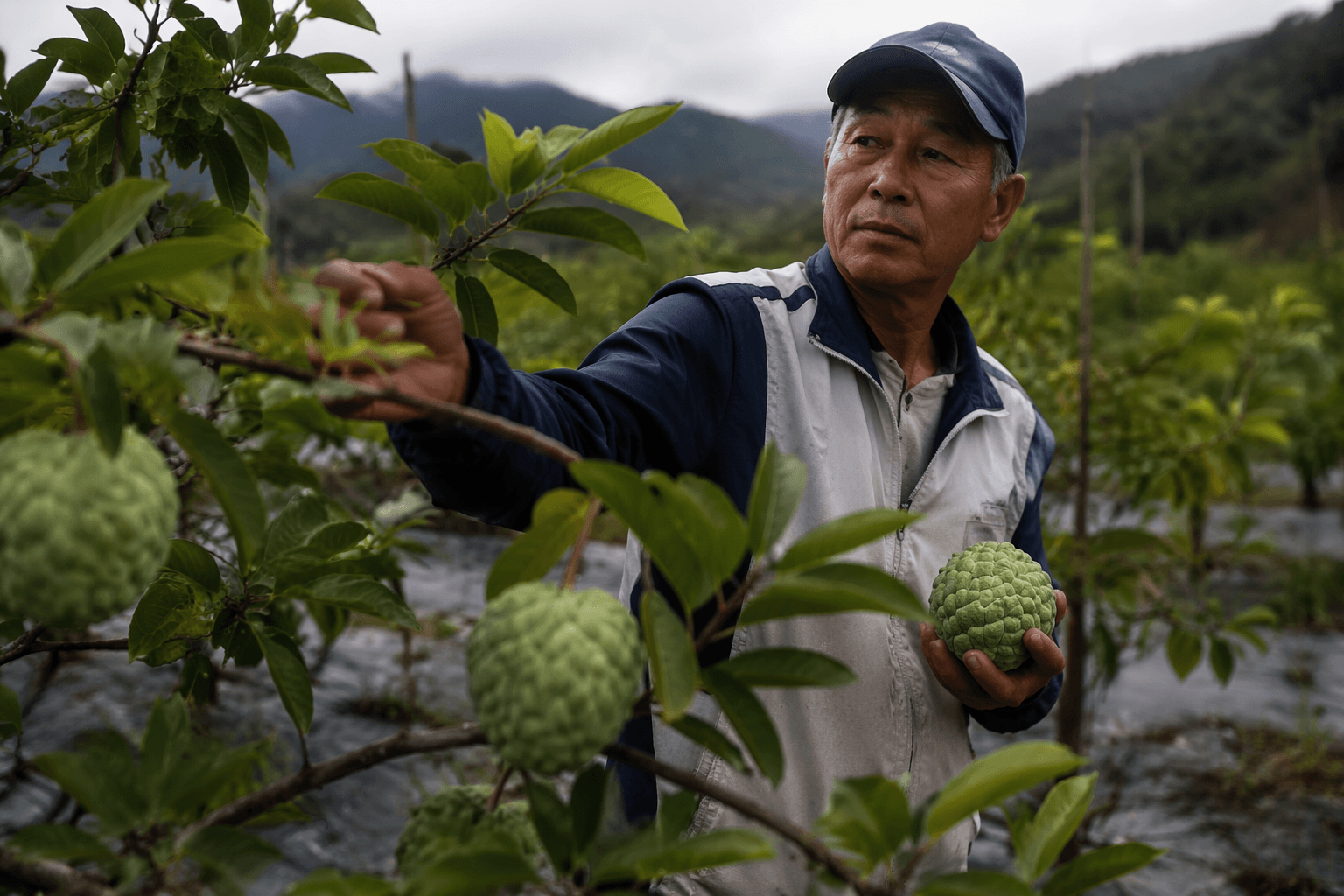
The numbers explain why the warning landed so sharply. In 2020, China took more than 95% of Taiwan’s atemoya exports, about 13,500 tonnes worth NT$1.5 billion, or US$47.49 million. After the 2021 suspension, one Taitung farmer said his revenues were cut in half and that 80% to 90% of his fruit had previously gone to China. For an industry concentrated in a single county and heavily dependent on one buyer, the costs of political disruption are immediate and personal.
Politics at the forum sharpened the dispute. Taitung County Magistrate Yao Ching-ling took part through prerecorded video after being barred from attending in person, and five Taiwanese groups signed procurement agreements on agricultural products with Chinese officials. The Taiwan Mainland Affairs Council warned that participants could face investigation, saying the Straits Forum is a Chinese Communist Party united front platform. Kuomintang lawmaker Huang Chien-pin accused the central government of politicizing the issue instead of fixing distribution problems, reflecting the split between those who see trade as opportunity and those who see dependency as risk.
The Ministry of Agriculture said Taiwan needs stable, rule-based export markets that follow scientific and international standards, not a system in which Beijing can open and close the door at will. It is pushing growers toward diversified, higher-value outlets and more processing, including frozen cubes, purées and alcoholic beverages, to reduce reliance on China. The wider pattern is familiar: Beijing has also moved against Taiwanese pineapples, wax apples, grouper and citrus, reinforcing the view in Taipei that farm trade can be used as a political instrument as readily as an economic one.
This article was produced by Prism’s automated news system from verified source data, official records, and press releases, then run through automated quality and moderation checks before publishing. The system is built and supervised by the people who set the standards it runs under. Read our full AI policy.
Know something we missed? Have a correction or additional information?
Submit a Tip