Traded Wild Animals Are 1.5 Times More Likely to Carry Human Diseases
Traded wild animals are 1.5 times more likely to carry human diseases, with every decade in trade adding another pathogen to the human spillover ledger.
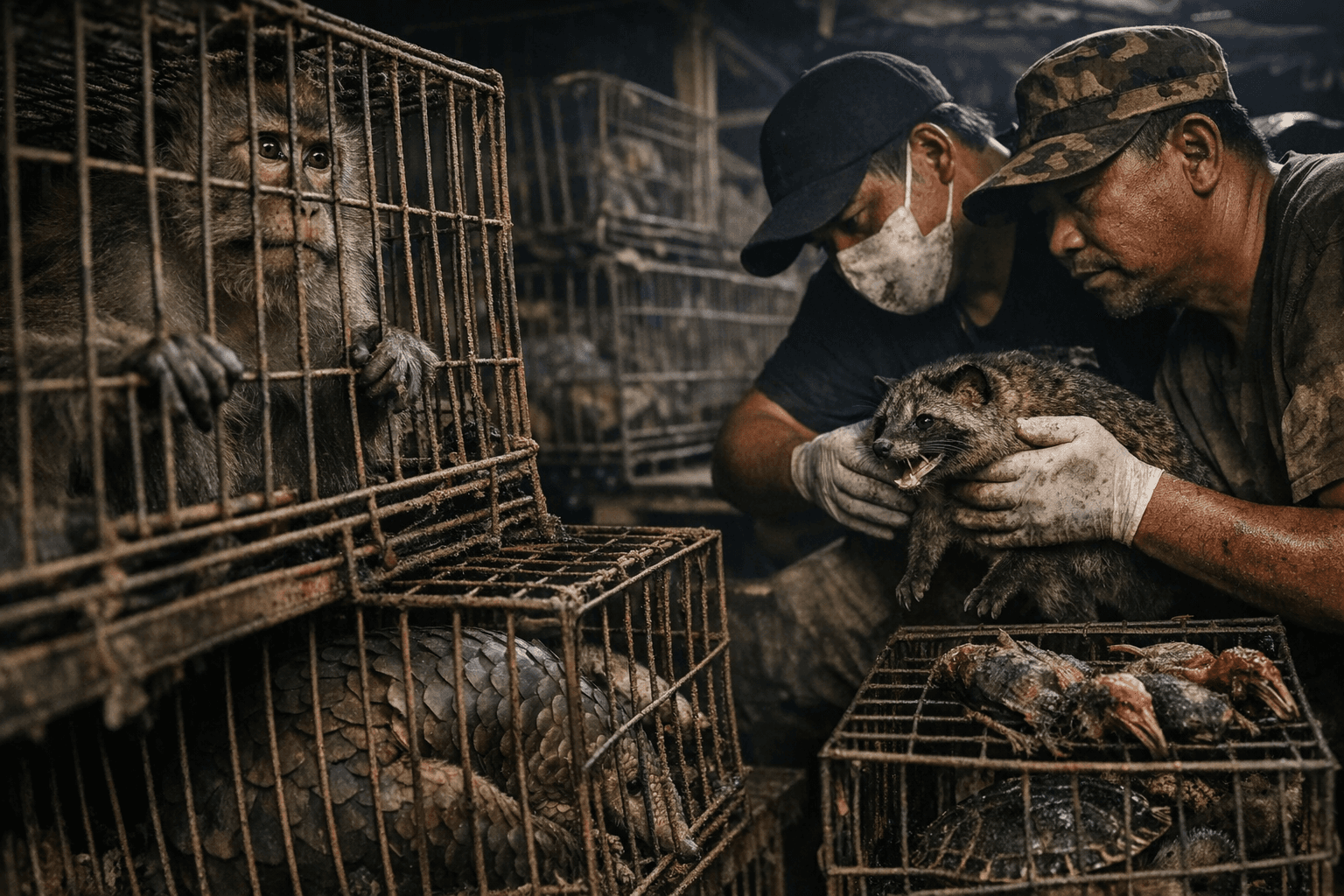
Wild animals bought and sold for food, pets, or traditional medicine carry roughly 1.5 times the burden of human-transmissible pathogens compared to their non-traded counterparts, according to a study published in the journal Science led by Colin Carlson and colleagues. The finding adds quantitative weight to a long-suspected link between the global wildlife trade and pandemic risk, arriving as that market continues to generate tens of billions of dollars annually with no sign of shrinking.
The illegal segment alone is valued at up to $20 billion a year, according to both INTERPOL and the 2024 U.N. Office on Drugs and Crime World Wildlife Crime Report, which ranked it among the world's largest criminal enterprises. Trafficking touches more than 4,000 animal and plant species from 162 countries and territories; despite some enforcement progress, UNODC found the trade "has not been significantly reduced in two decades." Research published in the NIH-indexed journal Emerging Infectious Diseases estimated the total market generates at least 1 billion direct and indirect contacts between wildlife, humans, and domestic animals every year.
That contact has consequences. Since 1980, more than 35 new infectious diseases have emerged in humans, roughly one every eight months, and wildlife trade-linked outbreaks have caused hundreds of billions of dollars in economic damage globally. The United States got a preview in 2003, when exotic African rodents shipped to a pet store in Illinois sparked the country's first mpox outbreak: Gambian giant rats infected prairie dogs, which then infected nearly 100 people who handled the animals. Multiple scientific papers have implicated the Huanan Seafood Wholesale Market in Wuhan, where live raccoon dogs, civets, and Himalayan marmots were packed into cramped quarters, as the likely origin point for COVID-19.
Carlson's team identified a particularly alarming temporal dimension. For every ten years a species spends in the wildlife trade, one additional pathogen makes the jump to humans. "That's significant," said Kevin Olival, a disease ecologist at the University of Hawai'i who was not involved in the study. With hundreds of species traded for decades or hunted for millennia, Olival was direct: "In a lot of ways, the toothpaste is out of the tube here."
Live animal markets are where the biology becomes most dangerous. "We're talking about animals in poor health, crowded conditions, weird combinations of species," Carlson said. "We know that viruses are evolving in real time in these markets as they move between species." Workers in these settings rarely have adequate protective gear. The illegal trade compounds the hazard further: endangered species such as pangolins and squirrel monkeys carry elevated spillover risk, possibly because they harbor more viruses or because illegal markets operate with even less hygiene oversight than regulated ones.
This creates a difficult policy problem. A blanket ban could push more of the trade underground, making spillovers harder to detect and trace. "We have to choose between criminalizing and pushing trade underground, or finding a way to do public health in [these] settings," Carlson said.
Regulators are beginning to move. CITES and the World Organisation for Animal Health signed a Memorandum of Understanding in March 2024 aimed at reducing zoonotic disease emergence tied to international wildlife trade, and WOAH published voluntary guidelines spanning the full supply chain two months later. But a 2025 scoping review in PLOS ONE found institutional responses remain "diverse," signaling the world still lacks a unified framework.
Olival's closing point was blunt. The 2003 mpox outbreak in the Midwest happened because people were buying animals at retail. "That cute, little furry [exotic] animal in your pet store," he said, "maybe think twice about it.
This article was produced by Prism’s automated news system from verified source data, official records, and press releases, then run through automated quality and moderation checks before publishing. The system is built and supervised by the people who set the standards it runs under. Read our full AI policy.
Did this article answer your question?