Trump and Petro seek reset in cordial Oval Office meeting
Trump hosted Colombia’s Gustavo Petro at the White House in a surprise thaw. They discussed drugs, Venezuela and security but announced no formal accord.

After months of public acrimony, President Donald Trump and Colombia’s Gustavo Petro met in the Oval Office for roughly two hours in a face-to-face encounter that officials described as unexpectedly cordial. No media were allowed inside, but the two leaders later released photographs and handwritten notes, and both framed the session as productive even as they stopped short of announcing a formal pact.
Petro posted a handshake photo on X with a note from Trump that read, "Gustavo - A great honor - I love Colombia," and shared an autographed copy of The Art of the Deal inscribed, "You are great." Petro joked in Spanish about the dedication: "What did Trump mean to say to me in this dedication? I don't understand English very well." Trump, when asked afterward whether the two had reached an accord on counter-narcotics, said, "Yeah, we did. ... We worked on it, and we got along very well. He and I weren't exactly the best of friends, but I wasn't insulted because I never met him. I didn't know him at all."
The substance of the talks centered on long-standing U.S. priorities. Officials said drug trafficking, security cooperation and Venezuela were high on the agenda, alongside migration and bilateral trade. U.S. leaders have pressed Colombia for operational cooperation against narcotics routes that flow north to the United States, while Washington is also keen to curb influence from Venezuela and to limit the illicit revenues that sustain Colombian armed groups.
The meeting follows a turbulent period in bilateral ties that included sharp rhetoric and punitive measures. Petro has accused Trump of complicity in Gaza and likened U.S. immigration agents to "Nazi brigades," while Trump has publicly labeled Petro a "drug lord." The dispute escalated into U.S. sanctions, threats of reciprocal tariffs and the withdrawal of financial aid, and at times included veiled suggestions of military options. Those episodes raised investor and diplomatic concerns and elevated the geopolitical stakes of a bilateral reset.
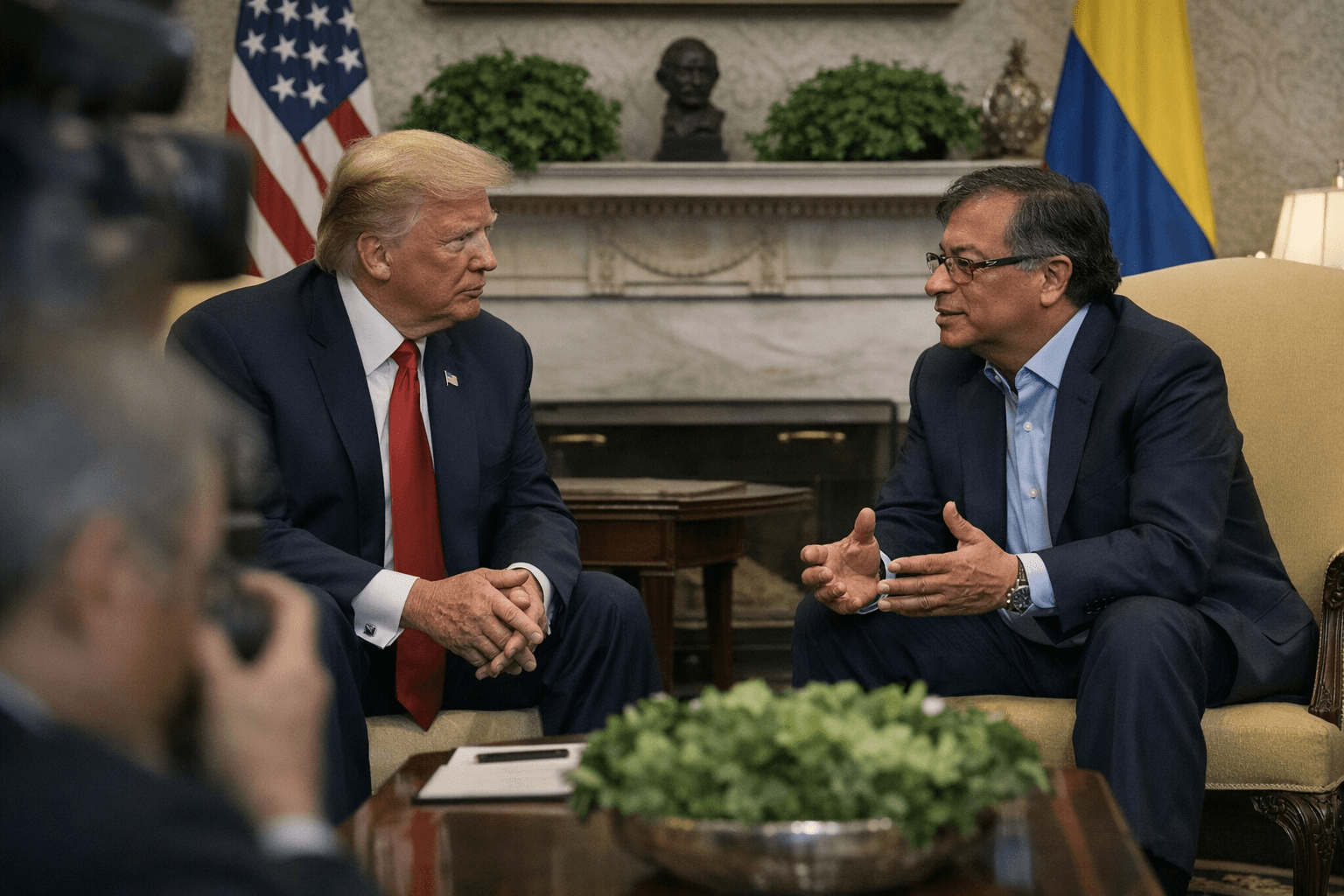
External voices framed the encounter as strategically significant but fragile. "The Trump administration remains deeply focused on Venezuela and drugs and will seek Colombian cooperation on both," said Kevin Whitaker, a former U.S. ambassador to Colombia. Elizabeth Dickinson of the International Crisis Group said, "There’s a lot of space here for mutual cooperation and shared success." Yet Brett Bruen, a former diplomat who runs the Global Situation Room, warned of the meeting's conditional nature: "Trump loves you one day, dislikes you the next day and reverts to loving you a couple days after."
Analysts also noted political timing. Petro is in the final months of his presidency, with a new Colombian leader due to take office on August 7, a reality that could limit any long-term commitments and shape his bargaining posture. Observers in Bogotá and Washington said Petrodiplomacy in this window may be driven as much by a desire to avert further punitive measures as by durable policy convergence.
Markets and policy makers will be watching for follow-up steps: whether the two governments formalize operational cooperation on counternarcotics, restore aid or reopen trade channels, and how Washington addresses security concerns tied to Venezuela. For now, the encounter offered a visual and rhetorical thaw that reduces immediate bilateral tension, but it left open the harder tests of implementation and the fragility of a reset built on personal chemistry rather than codified agreements.
This article was produced by Prism’s automated news system from verified source data, official records, and press releases, then run through automated quality and moderation checks before publishing. The system is built and supervised by the people who set the standards it runs under. Read our full AI policy.
Did this article answer your question?


