Trump Declares Major Combat Operations Against Iran as IRGC Threatens Strait of Hormuz
The IRGC declared the Strait of Hormuz will "never" revert to its pre-war state, threatening a chokepoint carrying roughly 20% of global oil supply.
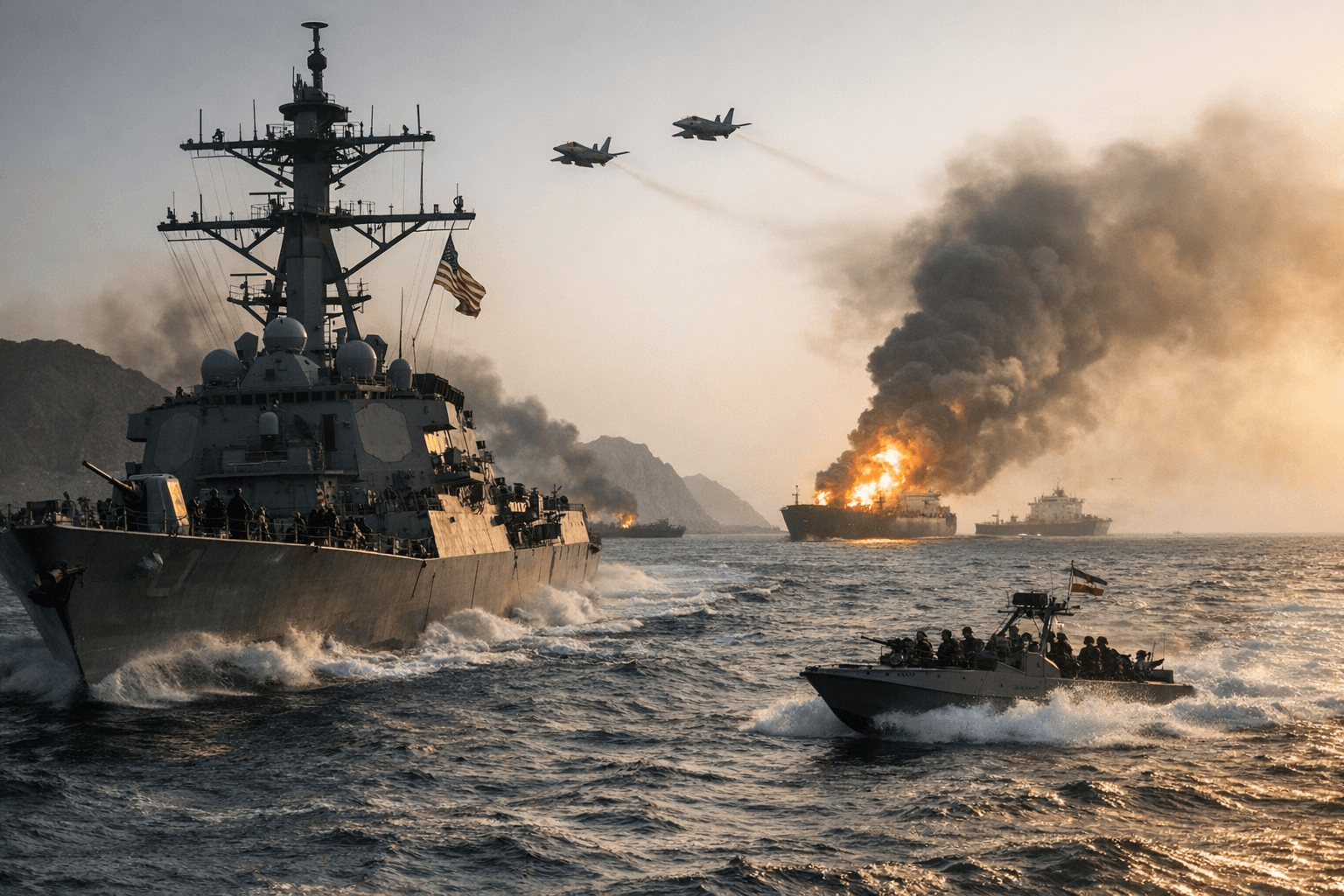
The IRGC's declaration that the Strait of Hormuz will "never" revert to its pre-war state came as a direct response to the joint U.S.-Israeli strikes that President Donald Trump announced as "major combat operations" against Iran on Feb. 28. The warning carries extraordinary economic weight: the strait, just 21 nautical miles wide at its narrowest point between Iran to the north and Oman and the UAE to the south, carries roughly 20 to 21 percent of the world's daily oil supply, between 17 and 21 million barrels per day, along with approximately 30 percent of global liquefied natural gas shipments.
The phrase "major combat operations" signals something qualitatively different from past U.S. strikes on Iranian targets. The January 2020 drone strike that killed IRGC Quds Force commander General Qasem Soleimani near Baghdad International Airport was a targeted killing; Trump's Feb. 28 announcement described a broader kinetic campaign conducted jointly with Israeli forces, representing the most significant direct U.S. military confrontation with Iran in decades.
The IRGC's Hormuz threat also marks a departure from its own historical posture. Former Iranian Vice President Mohammad Reza Rahimi threatened closure in 2011 and 2012 as Western sanctions tightened; the U.S. responded by deploying a second carrier strike group to the Persian Gulf. In 2019, following Trump's withdrawal from the JCPOA in May 2018, Iran shot down a U.S. RQ-4 Global Hawk surveillance drone over the strait area and seized multiple tankers, including Britain's Stena Impero. Each of those episodes ended without permanent changes to shipping access. The IRGC's current declaration that the strait will "never" revert implies something more structural than a negotiating position.
The economic consequences of a prolonged closure would extend well beyond Iran and its immediate neighbors. Saudi Arabia, the UAE, Kuwait, Iraq, and Qatar all depend on Hormuz to move their oil to market. The two main bypass routes, Saudi Arabia's East-West Pipeline at roughly 5 million barrels per day and the UAE's Abu Dhabi Crude Oil Pipeline at approximately 1.5 million barrels per day, together fall far short of replacing the strait's full throughput. Analysts have historically estimated that a full closure could spike crude prices by $30 to $50 or more per barrel in the short term.
The IRGC Navy, which patrols the Persian Gulf and Hormuz with fast attack craft, mini-submarines, and shore-based anti-ship missiles, was designated a U.S. Foreign Terrorist Organization in April 2019, the first time any component of a foreign government's official military received that designation. The IRGC was established after Iran's 1979 Islamic Revolution as a parallel force to the regular Artesh military, giving Iran's leadership a distinct instrument for both conventional and unconventional operations in the Gulf.
The U.S.-Israeli coordination behind the Feb. 28 strikes built on a deep operational foundation. Israel conducted unilateral strikes on Iranian soil in October 2024, targeting air defense and missile production sites, and the two countries co-develop military technology including Iron Dome and F-35 integration. The joint nature of the current campaign represents a new level of publicly acknowledged combined operations. Whether the IRGC's Hormuz declaration translates into active interdiction of commercial shipping will determine how quickly this conflict begins reshaping global energy markets.
This article was produced by Prism’s automated news system from verified source data, official records, and press releases, then run through automated quality and moderation checks before publishing. The system is built and supervised by the people who set the standards it runs under. Read our full AI policy.
Did this article answer your question?


