Tsinghua’s DISH prints millimetre-scale objects in 0.6s at 19-μm resolution
Tsinghua’s DISH method prints millimetre-scale parts in about 0.6 s with uniform 19‑μm features across a 1‑cm volume, and the team demonstrated a fluidic flow line with pump and strainer for continuous output.
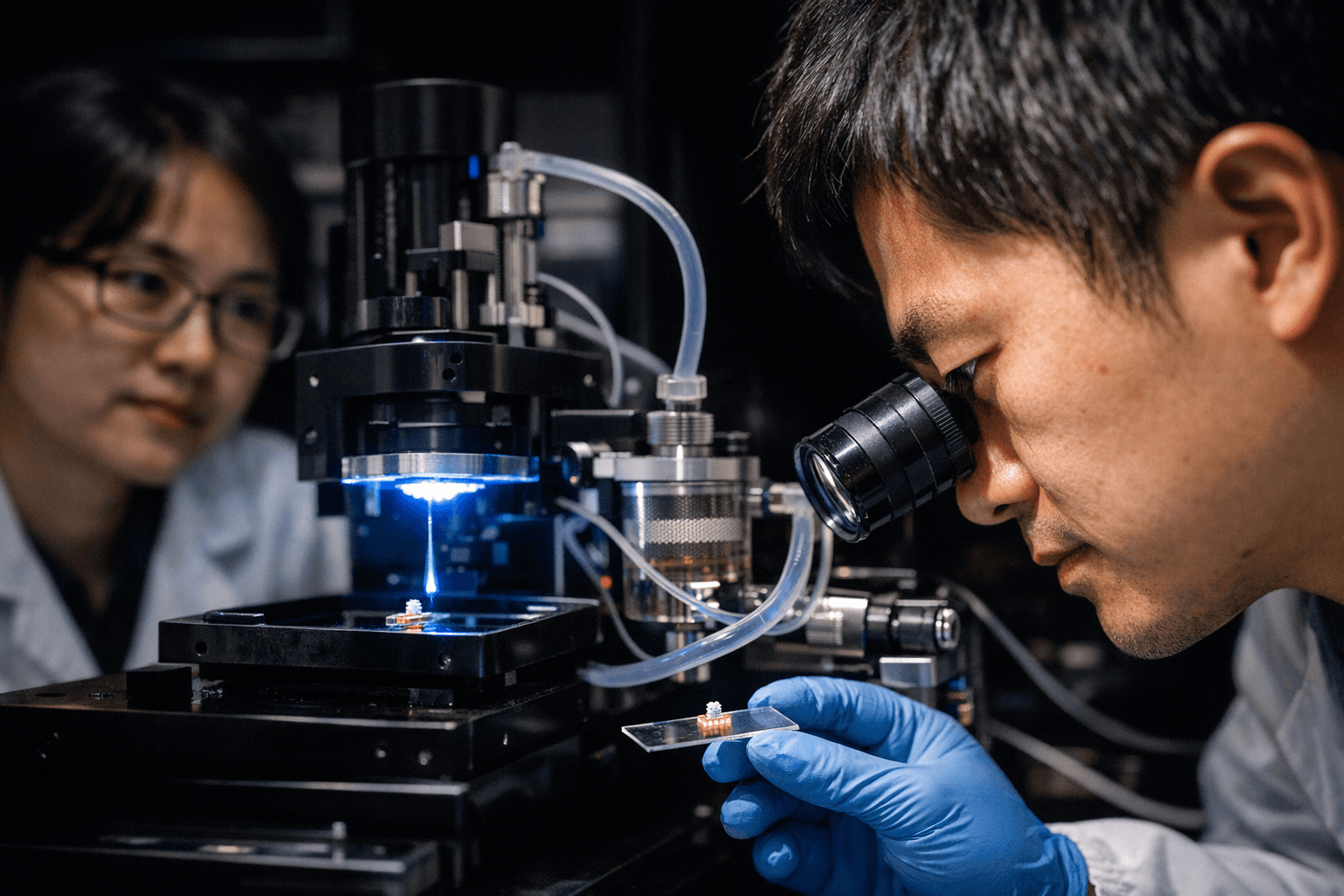
A Tsinghua University research team published a Nature paper describing DISH - Digital Incoherent Synthesis of Holographic Light Fields - and demonstrated complex millimetre-scale objects produced in roughly 0.6 seconds while maintaining about 19‑μm feature size uniformly across a 1‑cm range in the container. The Nature excerpt summarizes the advance: “In summary, we introduce a volumetric 3D printing method, DISH, capable of successively producing high-resolution, millimetre-scale objects within 0.6 s.”
DISH replaces sample rotation and mechanical staging with an optical approach that generates high-resolution 3D light distributions through continuous multi-angle projections and a high-speed rotating periscope. Tom’s Hardware captured the mechanics plainly: “Instead of spinning the material, the DISH technique keeps it stationary, and instead uses a high-speed multi-perspective light field that rotates around the material.” The Nature text adds that iterative optimization of holograms for different angles is central to maintaining that 19‑μm printing resolution across the measured 1‑cm volume.
The team also pushed beyond single-part demos to a laboratory-scale throughput experiment. Nature reports that the researchers integrated DISH with a fluidic channel for high-speed mass 3D printing and used “a pump ... to shift the products and replenish the printing material and a strainer ... to collect the printing products while separating the uncured material for reuse. The exposure time of each sample was 0.6 s (Supplementary Video 2).” Fig. 5a is cited in Nature for the fluidic-channel setup, underscoring that the paper supplies a visual demonstration of continuous output rather than a single static print.
The paper situates DISH as an answer to a long-standing trade-off in volumetric additive manufacturing between resolution and volumetric build rate. Nature frames the potential impact concretely: DISH “facilitates mass production of diverse 3D structures, which is critical for practical applications such as high-throughput drug screening, mass fabrication of photonics computing devices, and bioprinting.” Opinionated coverage has already started to land: igor´sLAB called the work “a technological bombshell” and wrote that the method could “be the breakthrough for the production of highly complex small parts – from lenses for smartphone cameras to biocompatible scaffolds for medicine,” even saying the advance makes conventional SLA or DLP printers “seem like relics from the steam engine era.”
Important methods and engineering details remain to be released or clarified in full: the supplied Nature excerpt does not include resin chemistry, light-source wavelengths or intensities, spatial light modulator hardware, rotation speed of the periscope, or the computational throughput for the iterative hologram optimization. The paper’s author list, DOI, and full methods are not present in the excerpts provided here, so independent reproduction and assessment of dimensional accuracy, yield, and parts-per-hour in the flow rig are still open questions.
If the 0.6‑s exposure and 19‑μm uniformity reported in Nature hold up under third-party replication and the missing hardware and material parameters prove industrially practical, DISH could rewrite throughput economics for millimetre-scale optics, microfluidic components, and cell-laden bioprints. For now, the Nature paper and its Supplementary Video 2 and Fig. 5a mark a clear lab-scale demonstration; the next steps are full-methods disclosure and independent validation before industry-scale deployment becomes credible.
Know something we missed? Have a correction or additional information?
Submit a Tip