United Chief Floats American Airlines Merger Idea in Trump Meeting
Scott Kirby raised a United-American merger with Donald Trump in a White House meeting that began as a Dulles airport discussion. The pitch signaled how far airline consolidation talk has moved.
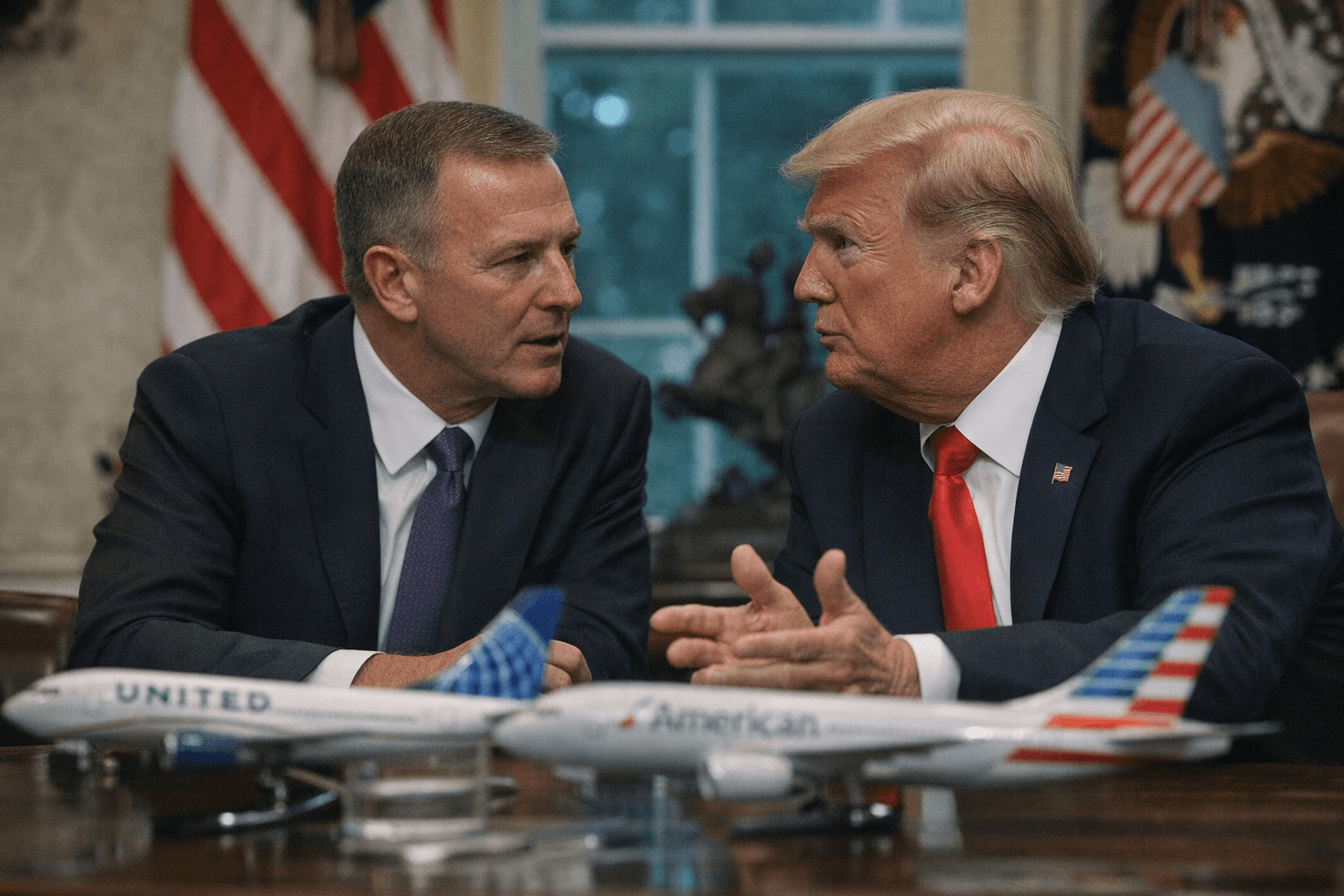
Scott Kirby raised the possibility of combining United Airlines and American Airlines in a late-February meeting with President Donald Trump, a striking move that pushed one of the industry’s biggest consolidation ideas into the White House orbit.
The merger idea surfaced at the end of a discussion that was originally focused on the future of Dulles International Airport, suggesting the topic came up after the formal policy agenda had already shifted. United declined to comment, the White House did not immediately respond to questions, and American Airlines also did not immediately respond.
Kirby is not an outside bidder testing an unfamiliar market. United’s investor materials show he previously served as American Airlines president from 2013 to 2016 and as US Airways president from 2006 to 2013, putting him at the center of the industry’s earlier wave of dealmaking. Bloomberg News reported that Kirby has also floated a possible combination with American to senior government officials, though it was unclear whether any overtures had followed or whether a formal process was underway.
The scale of any such deal would immediately draw antitrust scrutiny. Bureau of Transportation Statistics data show the top 20 carriers carried 87.8% of all U.S. passengers in 2024, and the market is already concentrated among a few giants. Southwest held 15.9% of domestic passengers, American 15.5%, Delta 15.1% and United 12.6%, leaving little room before travelers run into fewer choices and more pricing power.
A United-American merger would likely put fares, routes and service quality at the center of a regulatory fight. The Justice Department sued in August 2013 to block the US Airways-American merger, arguing it would substantially lessen competition, and later secured a settlement requiring divestitures of slots, gates and ground facilities at key airports. That case reduced the number of major domestic airlines from five to four and the number of legacy carriers from four to three, a reminder that Washington has already tried to slow the industry’s march toward fewer, larger players.
Transportation Secretary Sean Duffy said on April 7 that there is “room” for some U.S. airline mergers, but he also said regulators would focus on competition and ticket prices and could require larger carriers to shed assets. That leaves the industry in a familiar place: executives still chasing scale, regulators still watching market share, and travelers still exposed to the possibility that fewer rivals mean fewer choices.
This article was produced by Prism’s automated news system from verified source data, official records, and press releases, then run through automated quality and moderation checks before publishing. The system is built and supervised by the people who set the standards it runs under. Read our full AI policy.
Did this article answer your question?

