US-Iran Ceasefire Lifts Markets, but Long-Term Economic Damage Feared
Oil fell 14% on the ceasefire but UK food inflation is now forecast to hit 9%, triple earlier projections, as supply chain damage is already locked in.

The ceasefire between the US and Iran sent Brent crude down 14% to $93.93 per barrel on Tuesday, but the pipeline from crude benchmarks to petrol pumps to supermarket shelves runs long, and prices rarely fall as fast as they rose.
When hostilities between the US, Israel, and Iran caused the closure of the Strait of Hormuz on 28 February, approximately 20.3 million barrels of daily oil flow were disrupted. Brent crude surged from the mid-$60s to $117 per barrel over the following six weeks. Oil remains more than 40% above its pre-war price; most analysts do not expect a return to those levels.
In the UK, diesel climbed 34% to reach 190.6p per litre at the ceasefire, its highest level since late 2022. Petrol reached 157.7p per litre, 24p above its pre-war level. RAC head of policy Simon Williams said the best short-term hope was that "pump prices stop rising at the rate they have been and hopefully top out in the coming days," adding that much depends on "the stability of the ceasefire, whether oil shipments can move freely through the Strait of Hormuz, and the longer-term impact on oil production across the Gulf."
That uncertainty is warranted. Iran confirmed ships may transit the strait for a fee during the two-week ceasefire window, while Iran's Supreme Security Council warned "our fingers are on the trigger." Formal negotiations are not scheduled to begin until 10 April in Pakistan.
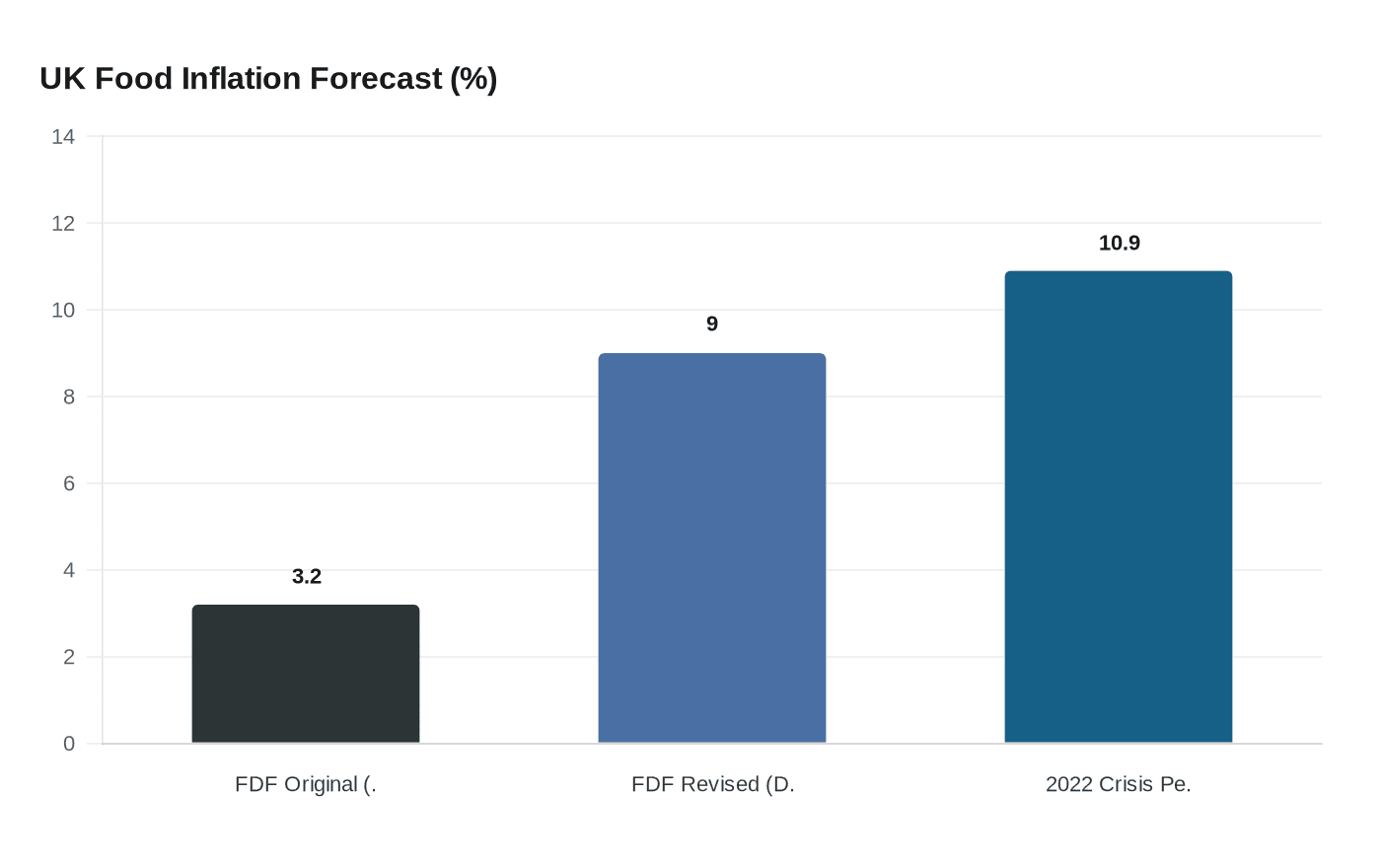
Further downstream, the damage to food prices may prove the most durable. The Food and Drink Federation, representing approximately 12,000 UK manufacturers, had forecast food inflation easing to 3.2% by December 2026. It has now upgraded that forecast to above 9%, roughly three times faster than its original projection and approaching the 10.9% peak of the 2022 cost-of-living crisis. Average grocery bills could rise by around £588 according to some estimates.
Dr Liliana Danila, chief economist at the FDF, attributed the reversal to simultaneous pressures: "mounting energy bills, rising transport and packaging costs and disruption across key supply chains." Energy contracts for manufacturers lock in costs weeks in advance; freight and packaging costs tied to crude prices have already been repriced. The destruction of Iran's South Pars petrochemical complex, which accounts for 85% of Iran's petrochemical output, compounded by Iran's retaliatory strike on Saudi Arabia's Jubail complex, removed a significant share of global methanol, urea, and polymer supplies used in food packaging and agriculture. Analyst Reza Ramezannejad warned the combined shutdown could "trigger a global industrial 'cardiac arrest'" and add 1.5% to 2% to global inflation.
Wider UK inflation is forecast to approach 4% in the second half of 2026, well above the Bank of England's 2% target. UK 10-year gilt yields fell 21 basis points after the announcement, and expected Bank of England tightening was scaled back from 60 to approximately 35 basis points by year-end. In the US, WTI crude fell 16.3% to $94.55 and S&P 500 futures surged more than 2.7%, but American consumers face the same embedded pipeline costs: elevated freight rates, petrochemical shortages, and crude prices still 40% above pre-war baselines.
Danni Hewson, head of financial analysis at AJ Bell, captured the paradox clearly: "One thing investors can see more clearly is the inflationary spike hurtling towards us, whether the Strait of Hormuz is reopened to global traffic in the coming days or not." The indicators that will confirm genuine relief are a ceasefire holding past its two-week window, unimpeded Strait access without tolls, and resumed output at South Pars and Jubail. Until those conditions are met, Tuesday's market surge reflects hope rather than resolution.
This article was produced by Prism’s automated news system from verified source data, official records, and press releases, then run through automated quality and moderation checks before publishing. The system is built and supervised by the people who set the standards it runs under. Read our full AI policy.
Did this article answer your question?

