U.S., Israel Launch Massive Strikes on Iran, Killing Supreme Leader Khamenei
Nearly 900 U.S.-Israeli strikes killed Supreme Leader Khamenei on Feb. 28; as of April 4, an American airman is missing after the first U.S. jet downed in combat since 2003.

The most consequential military strike in a generation opened without warning on Feb. 28, 2026, as U.S. and Israeli forces unleashed nearly 900 strikes within 12 hours against Iran's missile arsenals, air defense networks, military infrastructure, and top leadership. Among the dead in those opening hours: Ayatollah Ali Khamenei, Iran's Supreme Leader for more than three decades, killed when Israeli Air Force jets simultaneously struck three leadership meetings at his residential compound.
President Donald Trump, who announced the campaign as "major combat operations," urged Iranians in an online video to "take over your government" shortly after the strikes began. The U.S. military designated the operation "Operation Epic Fury"; Israel called its parallel campaign "Operation Roaring Lion." By April 3, the Atlantic Council reported U.S. and Israeli forces had struck more than 15,000 targets inside Iran since the operation launched.
The timing carried a specific, jarring irony. The strikes began while Washington and Tehran were engaged in active indirect nuclear negotiations. Just days before the first bombs fell, Omani Foreign Minister Badr Al-Busaidi said a deal was "within reach." Oman had served as the diplomatic intermediary threading those talks.
Khamenei's death triggered an immediate succession crisis. Iran's Assembly of Experts elected his son, Mojtaba Khamenei, as Supreme Leader on March 8, 2026. Parliamentary Speaker Mohammad Bagher Ghalibaf, senior official Ali Larijani, and President Masoud Pezeshkian all publicly pledged allegiance to the new supreme leader.
Iran has responded with sustained retaliation: waves of missiles and drones targeting Israel, U.S. military installations across the Gulf, including Al Udeid Air Base in Qatar, Camp Arifjan in Kuwait, and Prince Sultan Air Base in Saudi Arabia, as well as commercial shipping in the Strait of Hormuz. Iran has moved to restrict passage through the strait, a chokepoint through which a significant share of global oil supply flows. Trump issued a 48-hour ultimatum demanding Iran reopen it. A senior Iranian military official dismissed the demand as "a helpless, nervous, unbalanced and stupid action."
The conflict's human toll sharpened dramatically on April 3. An F-15E Strike Eagle, believed to be assigned to the 494th Fighter Squadron at RAF Lakenheath in England, was shot down by Iranian forces over southern Iran, becoming the first manned U.S. aircraft downed during Operation Epic Fury. One crew member was rescued near the crash site; the second remained missing as search efforts entered their second day. Iranian officials denied the missing airman had been captured or detained, though a regional Iranian governor offered a bounty for the crew member's location.
The same day, an A-10 Warthog attack aircraft crashed near the Strait of Hormuz; its pilot was safely recovered. Two U.S. search-and-rescue helicopters dispatched to support the F-15E recovery were struck by Iranian fire near Qeshm Island, injuring their crews before returning safely to base. In a single day, Iranian forces had struck four U.S. aircraft. The F-15E's loss marks the first time a U.S. fighter jet has been shot down in combat since an A-10 Thunderbolt II was downed during the 2003 invasion of Iraq, more than two decades ago.
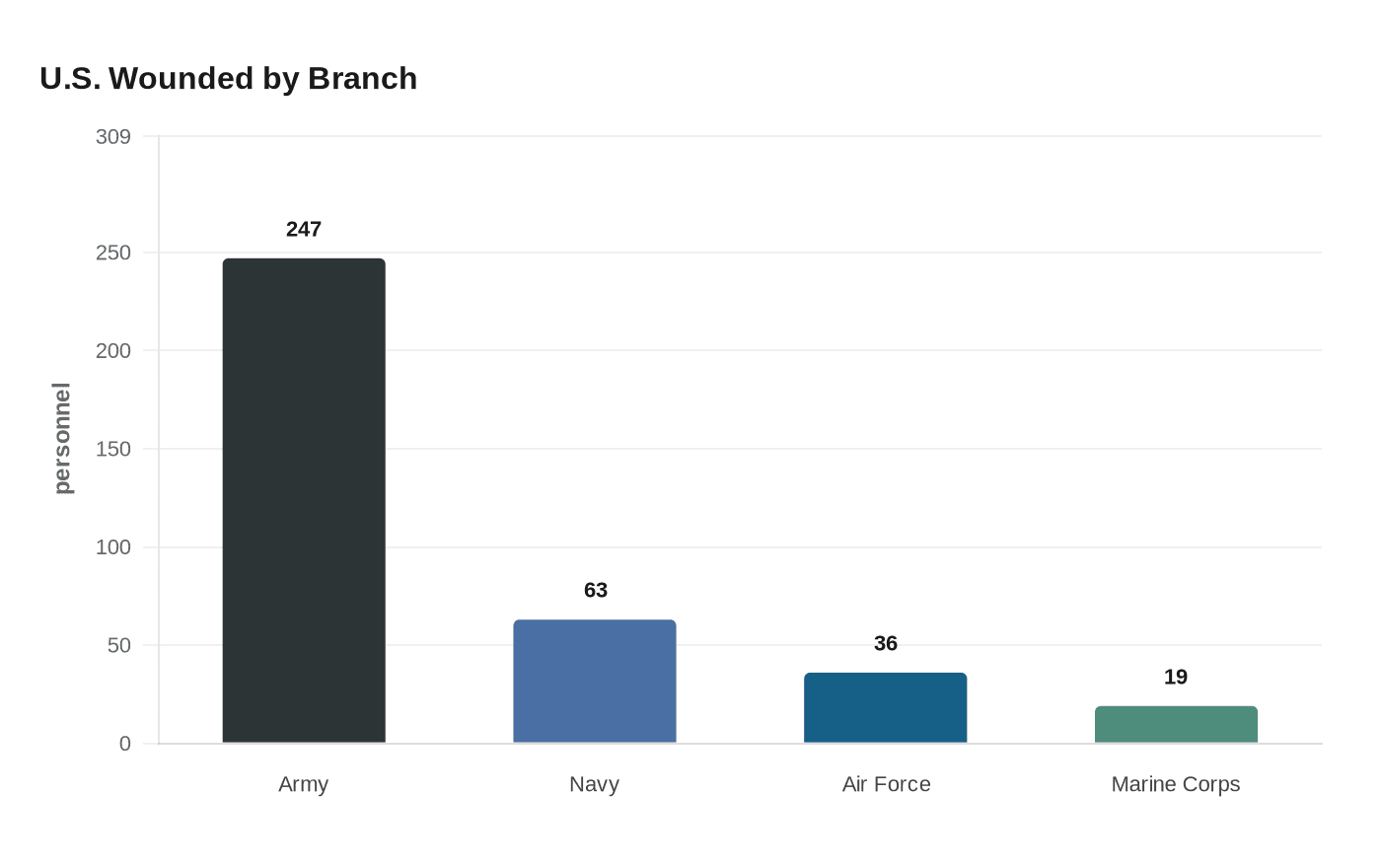
The Pentagon confirmed as of April 3 that Operation Epic Fury had claimed 13 American lives and wounded 365 others, broken down across the Army at 247 wounded, the Navy at 63, the Air Force at 36, and the Marine Corps at 19. The White House confirmed Trump had been briefed on the downed aircraft and the ongoing search for the missing crew member.
Trump has suggested U.S. forces could complete their mission in Iran within two to three weeks. With a missing airman unaccounted for, Iran blocking one of the world's most critical shipping corridors, and a new Supreme Leader consolidating power in Tehran, the timeline faces its first serious test.
This article was produced by Prism’s automated news system from verified source data, official records, and press releases, then run through automated quality and moderation checks before publishing. The system is built and supervised by the people who set the standards it runs under. Read our full AI policy.
Did this article answer your question?


