U.S. Property Tax Bills Rose 3.7% Last Year, Outpacing Inflation
Property taxes on U.S. single-family homes surpassed $396 billion in 2025, even as the average home lost value for the first time in years.

American homeowners absorbed another year of climbing property tax bills in 2025, with the total levy on single-family homes reaching $396.8 billion across more than 89.6 million properties, up 3.7% from 2024, according to an annual analysis released by ATTOM on Wednesday.
The average home, valued at $494,231, generated $4,427 in property taxes, a 3% increase from $4,300 the year prior. The increase landed above general inflation even as the housing market pulled back: home values fell 1.7% from $502,831 in 2024.
The effective tax rate, which measures taxes relative to home value, rose to 0.9% in 2025, up from 0.86% in 2024 and the highest mark since 2020, when the national effective tax rate stood at 1.1%. That combination, rising bills against shrinking home prices, is what pushed the effective rate to a five-year high. The pace of total tax growth did moderate, however, easing from 5.3% in 2024 to 3.7% last year.
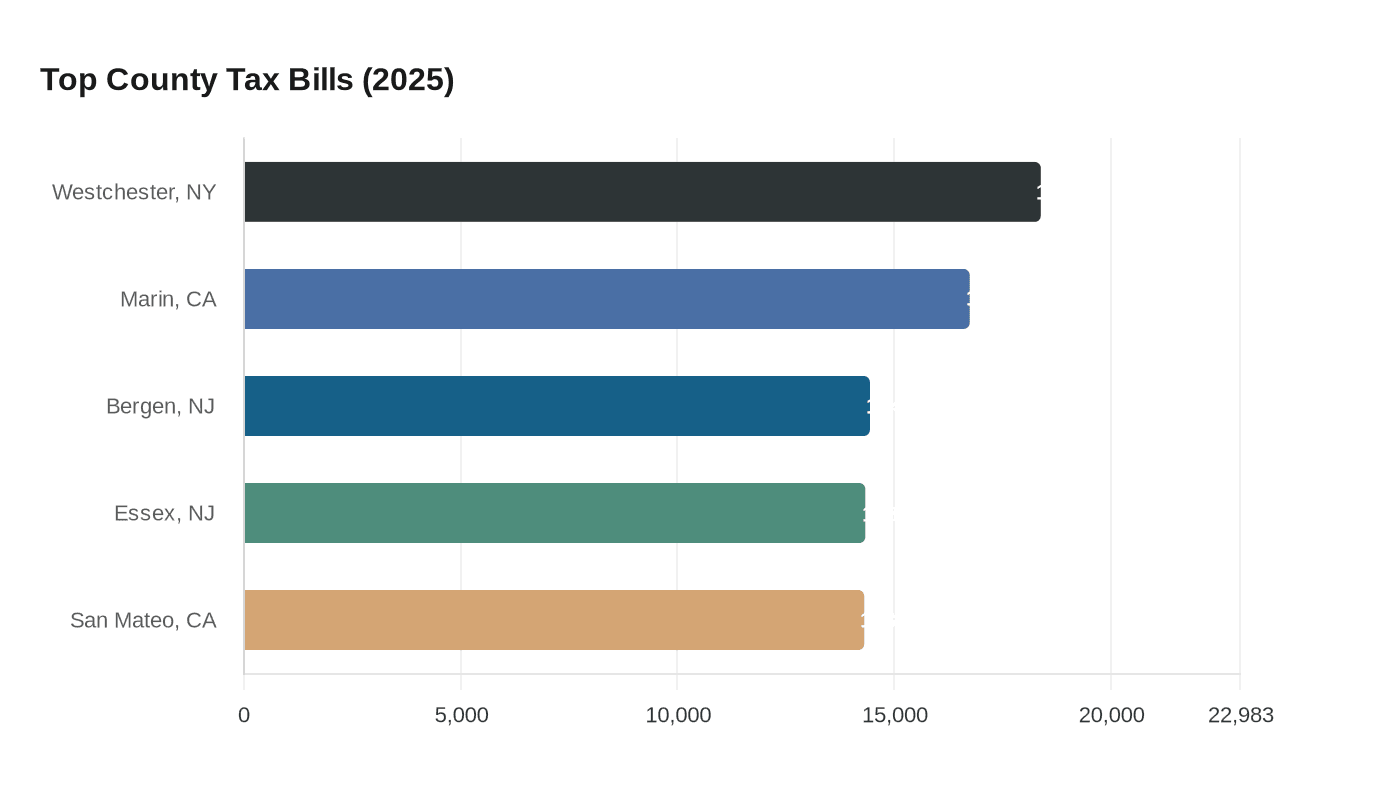
The geographic divide in tax burdens remained stark. The combination of high tax rates and home values in the Northeast generated the nation's highest average tax bills, led by New Jersey ($10,499), Connecticut ($8,901), New Hampshire ($8,174), Massachusetts ($7,904), and New York ($7,732). At the county level, the disparities were even sharper: of the 1,500 counties analyzed with at least 10,000 single-family homes, 26 posted average bills exceeding $10,000, with 10 of those in New Jersey, five in California, and three in New York. Westchester County, New York led all counties at $18,386, followed by Marin County, California at $16,745, Bergen County, New Jersey at $14,443, Essex County, New Jersey at $14,337, and San Mateo County, California at $14,312.
In terms of effective rates, Illinois led the country at 1.84%, followed by New Jersey at 1.58% and Vermont at 1.4%. Rounding out the top 10 were New Hampshire at 1.29%, Iowa at 1.25%, Pennsylvania at 1.24%, Nebraska at 1.24%, and New York at 1.23%.
At the opposite end of the spectrum, states with the lowest effective tax rates in 2025 were Hawaii at 0.33%, Idaho at 0.39%, and Wyoming at 0.4%.
Among the 221 local markets tracked in the analysis, roughly half saw tax bills rise by more than the 3% national average. The divergence reflects how local government budget cycles, reassessment timelines, and school district funding formulas translate into wildly different outcomes for individual homeowners, even within the same state.
The 2025 data underscores a structural pressure building beneath the surface of the housing market: even as price appreciation cools, the tax infrastructure built on the peak-era valuations of 2022 and 2023 continues to catch up. For millions of homeowners already stretched by elevated mortgage rates and insurance costs, the property tax bill has become yet another line item that does not appear to be retreating anytime soon.
This article was produced by Prism’s automated news system from verified source data, official records, and press releases, then run through automated quality and moderation checks before publishing. The system is built and supervised by the people who set the standards it runs under. Read our full AI policy.
Did this article answer your question?

