When to File a Tax Extension and When It Could Cost You
Filing a tax extension buys you six months to submit paperwork, but it doesn't delay what you owe: miss the April 15 payment deadline and penalties start immediately.
Over 14 million Americans request a federal tax extension every year, and for many of them it is the right call. But the single most expensive misconception in personal finance is also the most common one attached to that form: that an extension gives you more time to pay. It does not. Understanding exactly what an extension does and does not buy you is the difference between a smart financial decision and an avoidable penalty.
What a tax extension actually covers
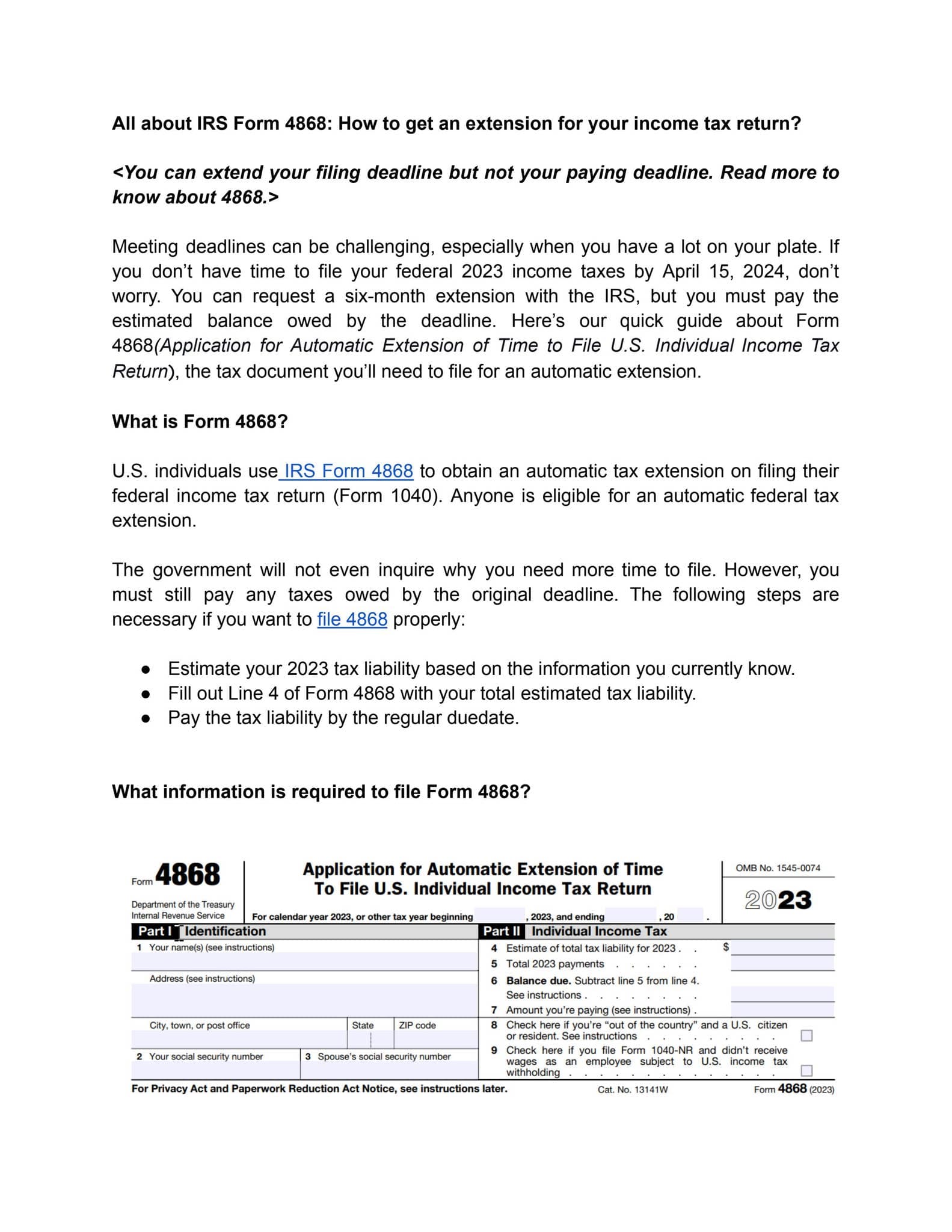
Filing IRS Form 4868, formally titled the Application for Automatic Extension of Time to File U.S. Individual Income Tax Return, moves your filing deadline from April 15 to October 15, a full six additional months. For the 2025 tax year, that means returns due April 15, 2026, can be submitted as late as October 15, 2026. The extension is automatic: the IRS does not require you to explain why you need more time, and receiving one does not flag your account for extra scrutiny or increase audit risk.
You can submit Form 4868 online through an IRS e-filing partner, by mail, or through a tax professional. IRS Free File also accepts extension requests at no cost. The key requirement is that you file the form by April 15, 2026 - the same day as the original return deadline.
What an extension does not cover: the payment deadline
This is where many filers go wrong. An extension to file is not an extension to pay. Any taxes owed for the 2025 tax year are still legally due on April 15, 2026. The IRS begins charging interest and penalties the day after that date, regardless of whether you filed an extension.
The failure-to-pay penalty runs at 0.5% of unpaid taxes per month, or part of a month, with a maximum cap of 25% of the total balance owed. That rate escalates to 1% per month if the IRS issues a formal notice of intent to levy property. Contrast that with the failure-to-file penalty, which applies when no extension is requested and no return is filed: that penalty is 5% of unpaid taxes per month, with a minimum penalty of $510 for returns more than 60 days overdue. Filing an extension eliminates the failure-to-file penalty entirely; it does not eliminate the failure-to-pay penalty.
The practical implication: when you file Form 4868, estimate your tax liability as accurately as possible and pay at least that amount by April 15. Overpaying results in a refund when you eventually file; underpaying triggers penalties on the difference.
When filing an extension makes clear sense
There are well-established situations where requesting more time is the financially sound choice:
- Missing documents: K-1 forms from partnerships, trusts, and S-corporations are notorious for arriving late in tax season. If you're a partner in a business or hold certain investments, your K-1 may not arrive until March or even April. Filing without it risks errors that can prompt an amended return later.
- Complex returns: Rental properties, self-employment income, foreign assets, stock option exercises, and significant capital gains all add layers of complexity. Rushing a complicated return to meet the April deadline increases the chance of errors, which can cost more in the long run than taking the time to file correctly.
- Life events: A divorce finalized in 2025, a death in the family, a major job change, or a home sale can dramatically alter your tax situation. These events often require additional documentation and planning before you can file accurately.
- Working with a tax professional: Qualified CPAs and enrolled agents are under enormous demand in March and April. If your preparer needs additional time to handle your return properly, an extension protects you both.
When an extension could cost you
Extensions become financially damaging in a few specific scenarios. If you owe a meaningful balance and cannot pay it by April 15, penalties and interest begin accumulating immediately. On a $5,000 balance, the 0.5% monthly penalty adds $25 per month, and interest charges compound on top of that. Over six months, the cost of delaying payment adds up in ways that make an extension counterproductive unless paired with at least a partial payment.
Filers who expect a refund face no financial penalty for filing an extension - but they do delay receiving their money. There's no late-payment risk when the government owes you, but there's also no benefit to waiting.
It's also worth noting that an extension applies to your federal return. State income tax rules vary significantly. Some states automatically accept the federal extension and require no separate filing; others require their own extension form submitted by the state's deadline. Checking your specific state's requirements before assuming the federal extension covers everything is essential.
Penalty relief: when it's available
The IRS does provide a first-time penalty abatement program for taxpayers with a clean compliance history. If you've filed and paid on time for the prior three years, you may qualify to have failure-to-pay penalties waived, provided you pay or arrange to pay the outstanding balance. This relief is not automatic - it must be requested - and it does not waive interest charges, only penalties.
The bottom line on timing
An extension is a legitimate and widely used tool, not an admission of failure or a financial risk in itself. The risk comes from conflating the filing deadline with the payment deadline. File Form 4868 by April 15, pay your best estimate of what you owe on the same date, and use the additional six months to file the most accurate return possible. That combination gives you the full benefit of the extension without triggering the penalties that make it costly.
This article was produced by Prism’s automated news system from verified source data, official records, and press releases, then run through automated quality and moderation checks before publishing. The system is built and supervised by the people who set the standards it runs under. Read our full AI policy.
Did this article answer your question?

