Venice Biennale opens amid protests, jury resignations and war tensions
Jury resignations over Israel and Russia turned the Venice Biennale’s preview week into a political showdown, with smoke, flags and protest chants at the pavilions.

The Venice Biennale opened its 61st edition under unusually sharp political strain, with war and diplomacy spilling directly into the Giardini della Biennale. The preview week began just days after all six members of the international jury resigned on April 30, after a dispute over whether Israel and Russia should remain eligible for prizes while their leaders face International Criminal Court arrest warrants.
The resignation forced organizers to change the competition calendar, pushing the prize ceremony from May 9 to November 22, the closing day of the Biennale. That reversal underscored how the exhibition’s old rules are being tested by conflicts that have become impossible to keep outside the art world, especially at an event long described as the world’s oldest contemporary art exhibition.
The protests were visible at the pavilions themselves. On May 6, more than 200 people gathered outside the Israeli pavilion, where activists from Art Not Genocide Alliance blocked the entrance and waved Palestinian flags. At the Russian pavilion, Pussy Riot and FEMEN staged a separate demonstration, releasing colored smoke and denouncing Russia’s return to the Biennale for the first time since its 2022 invasion of Ukraine. Inside and around the grounds, the political messaging was as prominent as the art.
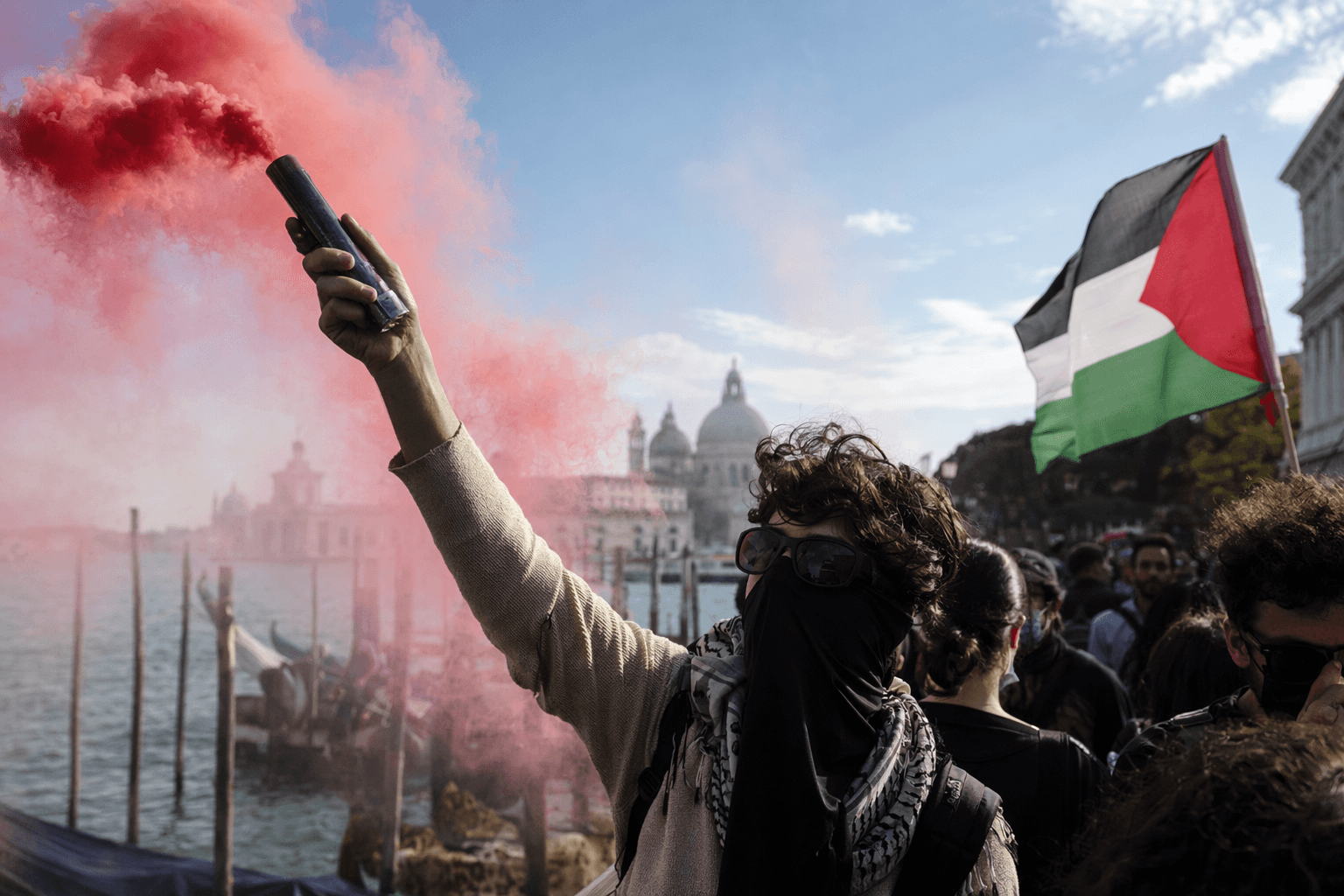
Artists and delegations arrived with work that reflected the war in direct, physical terms. Ukrainian participants brought an origami deer sculpture from the war-ravaged eastern front. Palestinian marchers moved through the Giardini wearing the names of artists killed in Gaza. At the Russian pavilion, participants danced to house music, a scene that sat in stark contrast to the protests outside and to the broader question hanging over the exhibition: whether the national pavilion system still makes sense in a global art world shaped by military conflict and state pressure.
That question matters because the Biennale’s structure still rests on national representation. The Giardini contains 29 permanent national pavilions, including Israel’s pavilion, which opened in 1952. Russia’s pavilion was back in the Giardini for the first time since 2022, adding another layer to a Biennale that has become less a neutral showcase than a stress test for whether major cultural institutions can remain above politics when war is impossible to ignore.
This article was produced by Prism’s automated news system from verified source data, official records, and press releases, then run through automated quality and moderation checks before publishing. The system is built and supervised by the people who set the standards it runs under. Read our full AI policy.
Did this article answer your question?


