Vietnam's New President To Lam Plans State Visit to China
To Lam, elected Vietnam's president just one day ago while retaining his party chief role, plans his first overseas trip to Beijing to meet Xi Jinping next week.
The speed and destination of To Lam's first major diplomatic move answers, at least provisionally, a question that has shadowed Vietnamese foreign policy for decades: when Hanoi must choose a first signal, which direction does it face?
One day after being unanimously elected president by Vietnam's National Assembly on April 7, To Lam is planning a state visit to China next week, where he is expected to meet President Xi Jinping, people briefed on the matter told Reuters. The trip will mark To Lam's first overseas engagement since consolidating an unprecedented concentration of authority, holding both the presidency and his existing role as general secretary of the Communist Party of Vietnam. That dual-role arrangement echoes the governing structure Xi himself operates under in China and departs from Vietnam's traditional model of collective, distributed leadership.
The structural parallel may help explain the pace of the outreach. Beijing tends to reward early engagement with ceremony; the fact that both sides have moved quickly to arrange the visit suggests mutual interest in projecting a stable, high-level relationship. China is Vietnam's largest source of foreign direct investment, while Vietnam is China's top trading partner within ASEAN, making the bilateral economic relationship foundational to both governments' domestic narratives.
The expected agenda will test whether To Lam can secure concrete economic gains without ceding ground on sovereignty. Trade facilitation, cross-border infrastructure, and connectivity projects are all likely on the table, alongside the perennial and considerably thornier issue of maritime boundaries in the South China Sea. Vietnam and China share overlapping claims in those waters, and any joint statement language on the maritime question will be parsed carefully across Southeast Asian capitals.
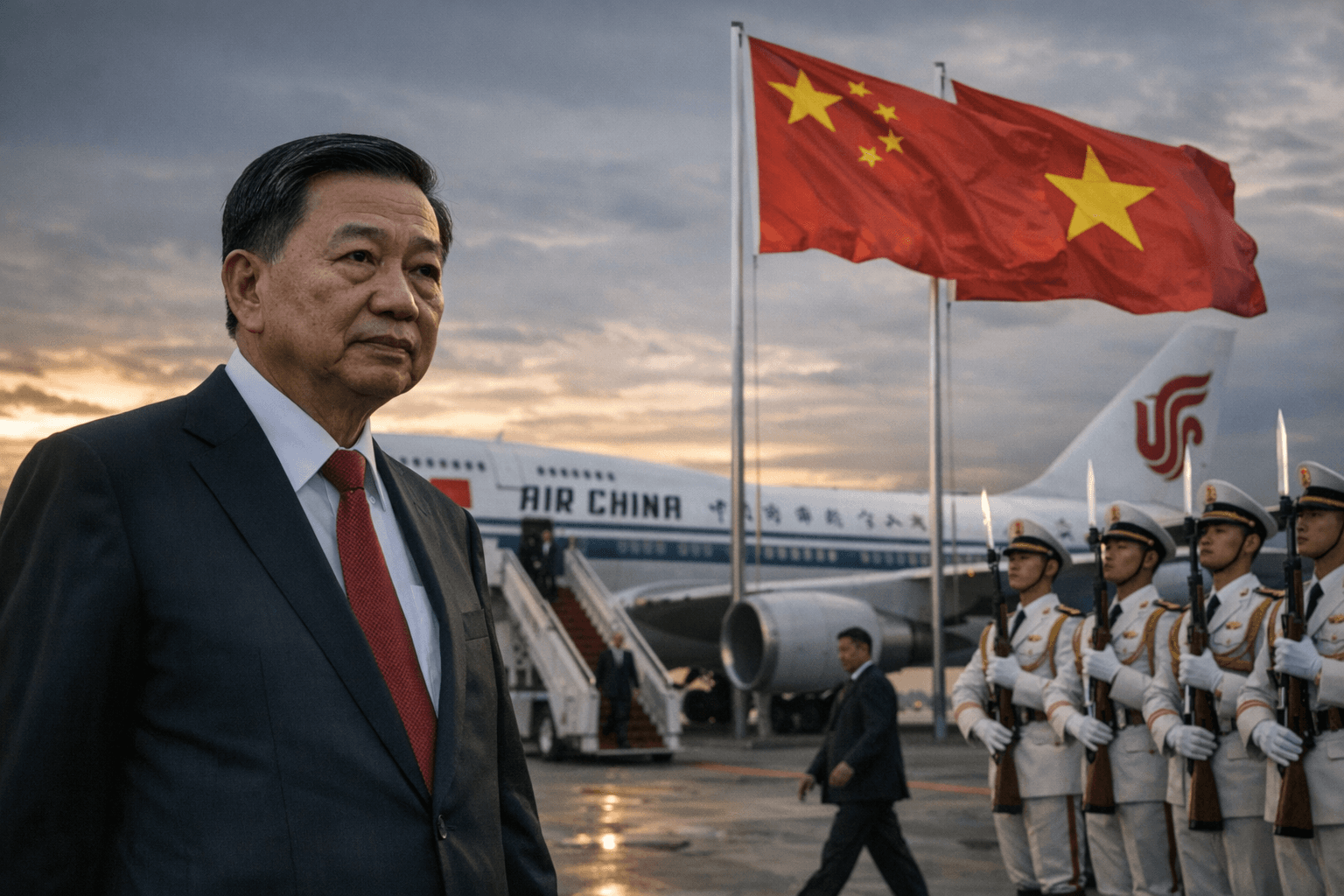
The visit arrives against a backdrop of intensifying U.S.-China strategic competition and global trade disruptions that have made regional alignment decisions more consequential than at any point in recent memory. Khang Vu, a visiting scholar at Boston College, said "Lam's double-hat would not signal any changes in Vietnam's foreign policy, even if there are concerns that Vietnam is concentrating more power in a single individual." That continuity is precisely what Hanoi's bamboo diplomacy doctrine prescribes: bend, but do not break, toward any single power.
The practical test will be what the Beijing trip actually produces. Infrastructure agreements, preferential trade arrangements, or joint language that softens South China Sea frictions would each signal a tilt toward Beijing at a sensitive moment. A visit that yields warm communiques but little structural change would be more consistent with a hedge. A full itinerary has not been published, with details remaining contingent on scheduling and logistics.
Whatever emerges from the meetings, the choice to make Beijing the first foreign capital on the agenda leaves little ambiguity about which relationship To Lam considers most urgently in need of personal management.
This article was produced by Prism’s automated news system from verified source data, official records, and press releases, then run through automated quality and moderation checks before publishing. The system is built and supervised by the people who set the standards it runs under. Read our full AI policy.
Did this article answer your question?