White-Label Services Help Agencies Scale Content Without Sacrificing Quality
White-label content lets agencies deliver blogs, SEO copy, and full strategies under their own brand, scaling output without the overhead of hiring in-house writers.
White-label services let one company produce work that another company sells under its own brand. For agencies, that means delivering blogs, SEO copy, whitepapers, social media content, and full content strategies to clients, without a single in-house writer on payroll. Done right, the client never knows the difference, and the agency keeps its margin.
What Are White-Label Content Services?
White-label content marketing is when a provider creates branded content on behalf of an agency's clients, functioning as an invisible extension of the agency's team. The content, whether blog posts, website copy, email sequences, or content calendars, is delivered under the agency's brand with no mention of the fulfillment partner. According to Boostability, a Utah-based white-label SEO and content provider, this approach helps agencies "build your business brand as industry experts next to your competitors in SEO rankings." The core promise is simple: quality output at scale, without the overhead of building an internal editorial operation.
Why Agencies Outsource Content Instead of Hiring In-House
The math on in-house hiring is brutal for most agencies. Thrive Agency breaks it down clearly: short-term costs include recruitment, onboarding, and training; long-term costs stack up through salaries, benefits, and overhead. For a growing agency adding three or four new content clients in a quarter, spinning up a full writing team fast enough to serve them is rarely practical.
White-label partnerships solve the capacity problem immediately. They also provide flexibility that a salaried team cannot. If a client churns or a campaign winds down, you're not carrying fixed headcount. If demand spikes, the provider scales with you.
What Types of Content Do White-Label Providers Deliver?
The scope has expanded well beyond basic blog posts. The Breezy Company describes modern white-label content services as covering:
- SEO-optimized blog writing and website copy
- Social media content and scheduling
- Whitepapers and long-form guides
- Content calendars and editorial strategy
- Email marketing copy
SEO Vendor adds that providers handle research, writing, and optimization as a bundled service, ensuring the content aligns with each client's target audience and keyword strategy. The key differentiator from a freelance hire is that the provider integrates into the agency's existing workflow, maintaining client confidentiality throughout.
How White-Label Content Marketing Actually Works
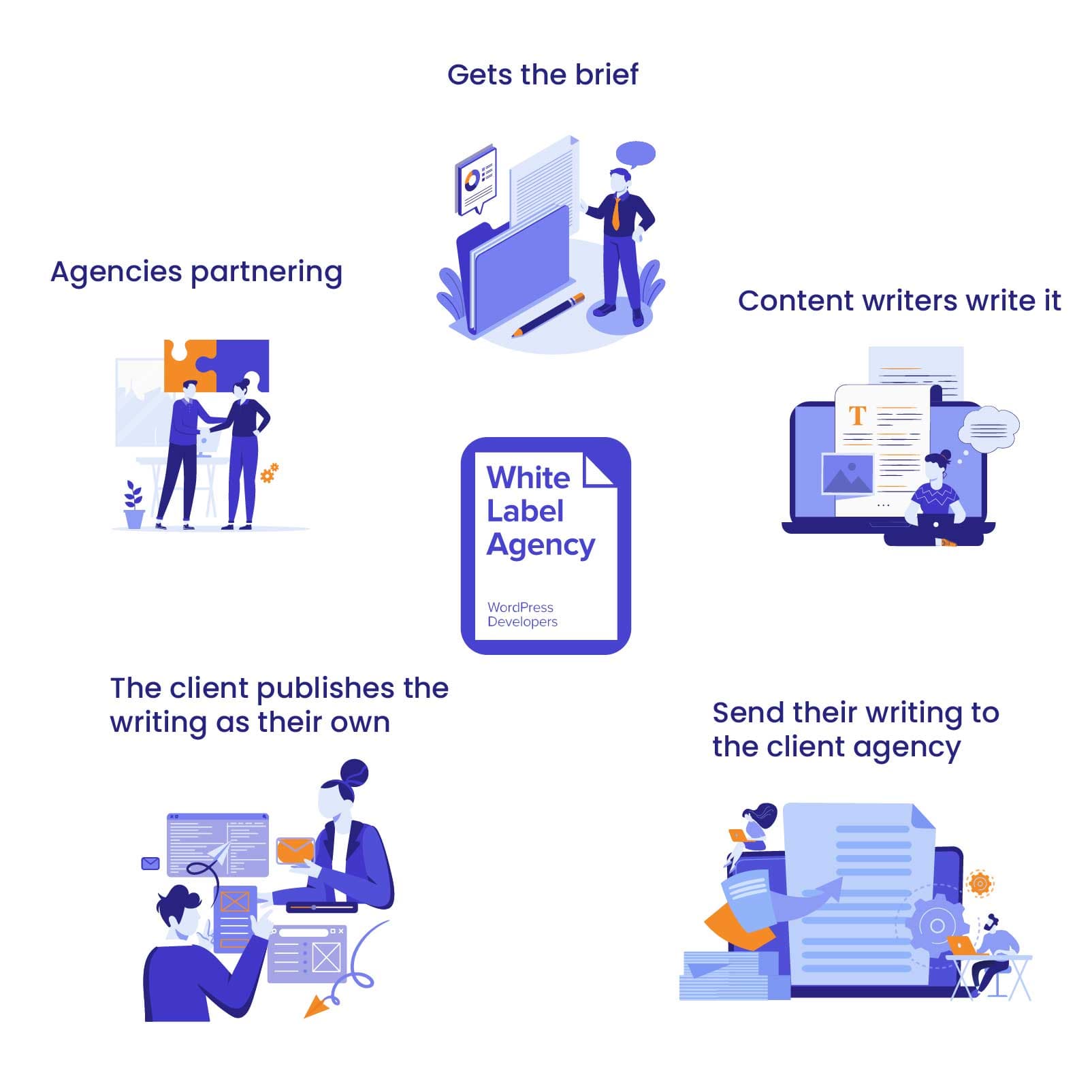
The operational flow is straightforward once a partnership is established. An agency signs on a new content client, gathers the brand brief, target keywords, and audience details, then passes that intake to the white-label provider. The provider produces the content, often within a defined turnaround window, and delivers it under the agency's brand or directly into the client's CMS. The agency reviews, approves, and delivers to the client as its own work.
Symphonic Digital notes that providers handle the full research and optimization process, which means the agency doesn't need to manage individual writers or maintain style guides internally. The quality control burden shifts to the provider, though agencies should still build in a review step before final client delivery.
The Providers Shaping This Market
Several platforms have built significant infrastructure around white-label fulfillment. DashClicks offers white-label content through its fulfillment marketplace, positioning it as a plug-in solution for agencies that want streamlined delivery with minimal operational friction. Vendasta is widely cited for agencies looking to scale quickly, offering white-label marketing services bundled with CRM and client management tools. PixelCrayons serves agencies across the US, UK, India, Dubai, and Australia with full-suite white-label digital marketing including SEO, PPC, content, and social media. Boostability focuses specifically on SEO-driven content and has built its model around serving small-to-midsize agency partners. For agencies that need AI-powered content at volume, WhiteLabelSEO.ai (founded 2025, plans from $199.99/mo) combines multi-model AI content generation with branded client portals and direct publishing integrations to WordPress, Shopify, and HubSpot.
Pricing Models Across the Industry
White-label content pricing typically follows one of three structures:
- Per-word or per-piece rates: Common with content-focused providers; pricing scales with volume and content type.
- Monthly retainer packages: Agencies commit to a fixed content volume each month, often at a lower per-unit cost. WhiteLabelSEO.ai's tiered model, for example, ranges from 50 articles per month at $199.99 to 200 articles at $499.99.
- Platform-based subscriptions: Providers like Vendasta and DashClicks bundle content fulfillment inside broader agency platforms, where content is one service among many.
The right model depends on how predictable your client content volume is. Retainers work well for agencies with stable, recurring content clients. Per-piece pricing gives flexibility for project-based work.
Emerging Trends: AI Integration and Vertical Specialization
The white-label content market in 2026 is being reshaped by two forces: AI-assisted production and tighter vertical specialization. Providers are increasingly using AI to handle first drafts, research, and topic clustering, then applying human editorial oversight to ensure accuracy and voice consistency. WhiteLabelSEO.ai's model, for instance, runs content through YoastSEO scoring with an automatic rewrite loop and verifies against ZeroGPT for human-content scores in the 85 to 90 percent range.
Vertical specialization is the other major shift. Rather than serving every industry generically, providers are carving out expertise in specific sectors, healthcare, legal, e-commerce, SaaS, so that the content they produce reflects genuine subject matter depth, not just keyword-optimized filler.
How to Choose the Right White-Label Content Partner
Symphonic Digital frames partner selection around a few non-negotiable criteria. You need a provider that matches your quality bar, not just your price point. Transparency matters too: can you see the workflow, track delivery timelines, and escalate quality issues quickly? Client confidentiality is table stakes; every serious provider in this space operates under non-disclosure by default.
Operationally, look for:
- Direct CMS publishing integrations that reduce manual handoff steps
- A clear revision and approval process
- Demonstrated experience in your clients' industries
- Scalable pricing that doesn't penalize you for growth
Dintellects emphasizes the value of choosing a partner with years of operational experience working on behalf of digital marketing agencies specifically, since the white-label workflow is different from direct client work and requires a provider that understands agency dynamics.
The agencies that scale content successfully in 2026 are not the ones that try to hire their way there. They're the ones that find a fulfillment partner capable of matching their quality standards, then build repeatable intake and delivery processes around that partnership.
Frequently Asked Questions
What are white-label services?
White-label services are products or work produced by one company and rebranded by another for resale under their own name. In digital marketing, this typically means an agency outsources content creation, SEO, PPC, or web design to a fulfillment provider, delivers the work to its own clients as if produced in-house, and maintains full brand ownership of the client relationship throughout the engagement.
What is the white-label services market size in 2026?
The white-label digital marketing market is growing rapidly, driven by agency demand for scalable service delivery without proportional headcount increases. Adoption is accelerating as AI-assisted production lowers fulfillment costs and platforms like Vendasta, DashClicks, and WhiteLabelSEO.ai make white-label services easier to integrate into existing agency workflows. Vertical specialization and bundled platform models are further expanding the addressable market for providers.
What types of white-label services exist beyond SEO?
White-label services extend across nearly every digital marketing function: PPC campaign management, web design and development, social media management, email marketing, reputation management, and full content strategy. Providers like PixelCrayons and Vendasta offer multi-service packages. DashClicks structures its fulfillment marketplace so agencies can add or remove service categories, such as content, ads, or listings, based on client demand without building internal capacity for each.
Know something we missed? Have a correction or additional information?
Submit a Tip