Women drive India’s chile harvest amid land ownership gaps
Women harvest most of India’s chiles, but land titles still sit in men’s names, limiting pay, credit, and recognition.
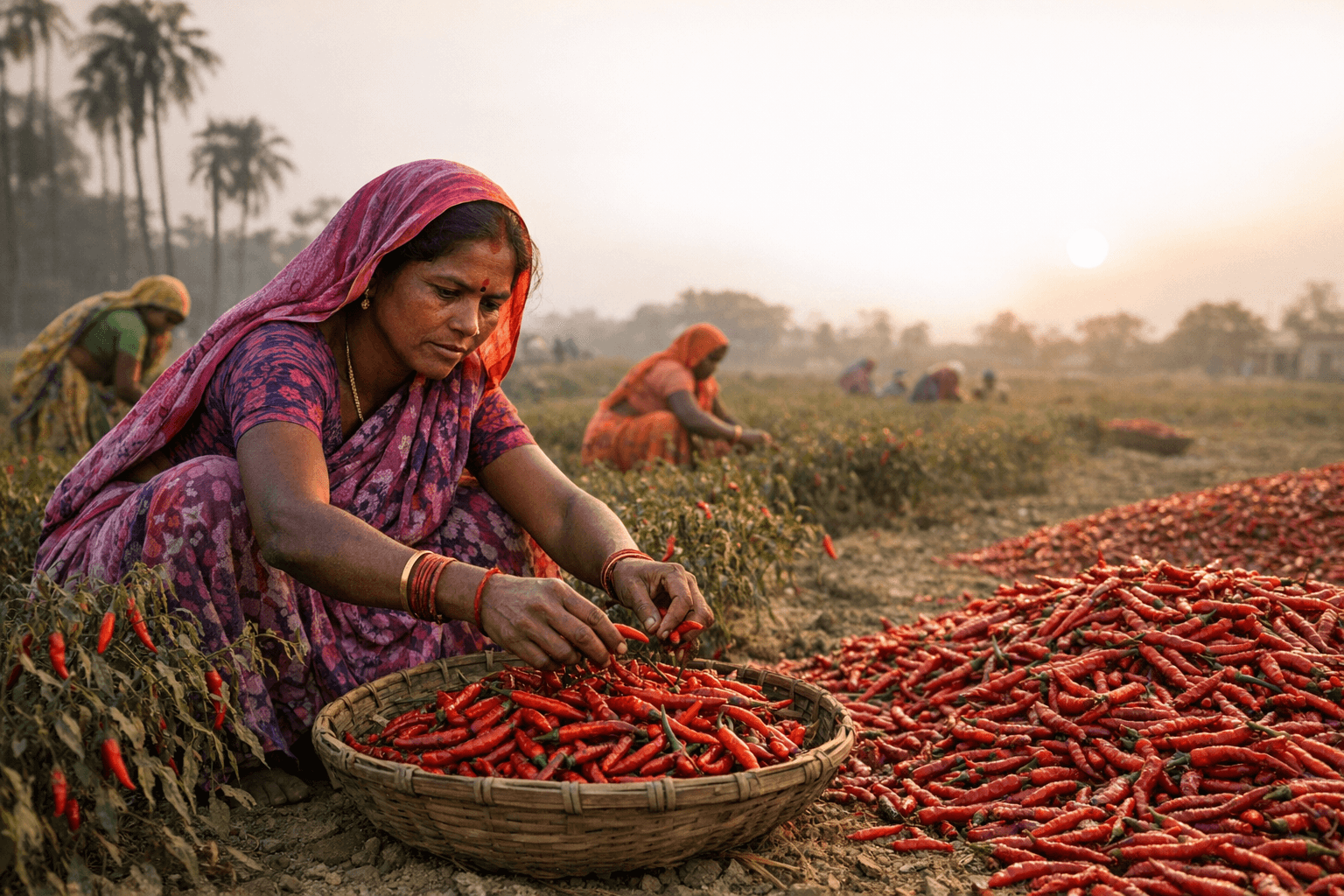
In India’s chile fields, women do much of the work that keeps a signature crop moving from farm to kitchen, even as formal ownership and recognition lag behind their labor. India is the world’s largest producer of chilies, and Andhra Pradesh led production in fiscal 2024 with more than 1 million metric tons, underscoring how much of the country’s food economy depends on a crop handled largely by women.
The scale of women’s involvement in agriculture is visible in official counts. The Ministry of Agriculture and Farmers Welfare’s Agriculture Census 2015-16 recorded 20,439,148 female operational holdings out of 146,453,741 total operational holdings. An official government press note said women operated 11.72% of the country’s total operated area. The census was the tenth in India’s quinquennial series, a reminder that women’s role in farming is tracked, but still often not translated into ownership or power.
That gap starts with land. World Bank-linked research says women constitute barely 14% of landowners and own about 11% of agricultural land in rural landowning households. Without land titles, women cultivators can be left out of the legal definition of “farmer,” which can block access to credit, subsidies, and other government benefits. In practice, that means many women shoulder the labor and the risk without getting the paperwork that unlocks support.
The chile story shows how agricultural labor has shifted under pressure. Analysts say women’s growing share of farm work reflects not just empowerment, but also agrarian distress and male migration into non-farm jobs. Agriculture remains the sector with the highest concentration of female workers in India, and multiple recent analyses show women’s participation has continued to rise even as they remain underpaid or unpaid in many cases. In chile production, that labor substitution is especially visible: women are often the ones harvesting, sorting, and managing the crop, even when men are more likely to be formally recorded as farmers.
The result is a food system built on invisible expertise. Women’s labor sustains a crop that is central to regional Indian cuisines and to national production totals, yet their contribution is frequently measured in hectares operated rather than ownership secured. As India continues its latest Agriculture Census work, the chile fields are already telling a larger story about land rights, labor vulnerability, and the uneven value assigned to the people who make the harvest possible.
This article was produced by Prism’s automated news system from verified source data, official records, and press releases, then run through automated quality and moderation checks before publishing. The system is built and supervised by the people who set the standards it runs under. Read our full AI policy.
Did this article answer your question?


