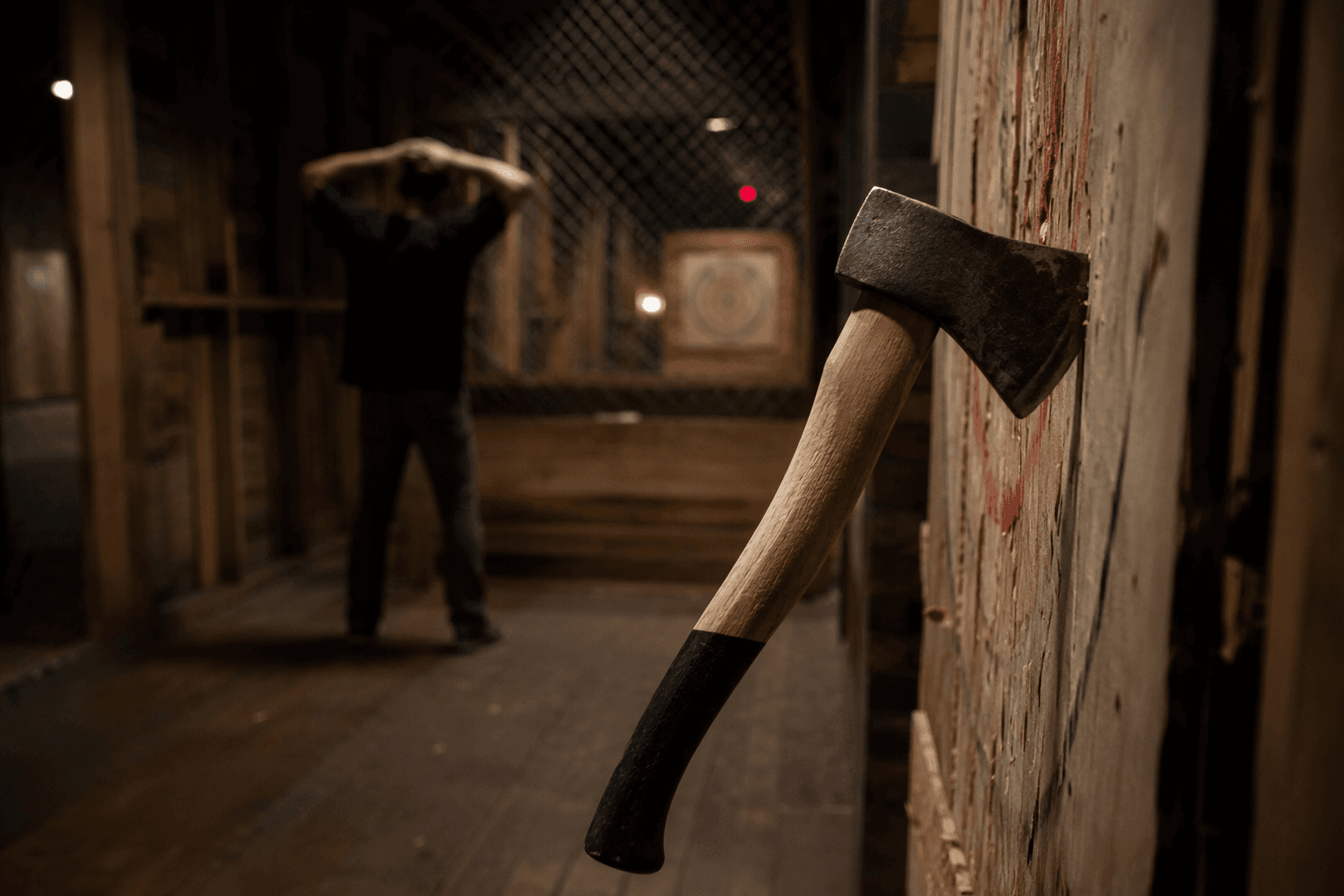
EuroThrowers standardizes axe throwing rules for international competition
EuroThrowers gave axe throwing a common language, so a score in one club can stand up in another. That makes cross-border events easier to trust, and easier to join.

EuroThrowers turned axe throwing from a patchwork of house rules into a sport where a score in one country can be compared with a score in another. Its European Standard Rules are built for big international competitions, and that matters because the difference between a fair result and a local curiosity often comes down to inches, lines, and scoring calls. For throwers who travel, and for clubs that want their event to mean something beyond their own walls, the rulebook is the bridge.
Why shared rules matter on the floor
The simplest way to understand the value of standardization is to picture two clubs with two different ideas of what a good throw looks like. One venue might favor a larger target, another a different throwing distance, and a third might judge borderline hits more generously. Under those conditions, a winning score can look impressive inside one room and meaningless outside it.
EuroThrowers answered that problem by building a common target language. The archived 2010 rulebook set the target at a 50 cm diameter circle with five concentric scoring rings, awarding 5 points for the bullseye and 4, 3, 2, and 1 points outward. It also fixed target height at 1.30 m to 1.60 m, measured from the bullseye to the ground. That kind of precision is what lets a thrower carry one result into another venue without relearning the basics every weekend.
The practical benefits run through the whole lane, not just the target face:
- target dimensions stay the same, so the scoring surface feels familiar from club to club
- lane layout and throwing-line markings can be judged against a shared benchmark
- valid release rules reduce arguments over whether a throw counts
- dead-throw calls and boundary scoring become comparable across tournaments
For a local league, that means less confusion. For a traveling competitor, it means a score earned at home can still mean something when the tournament floor is in another city or country.
From club culture to a European standard
The oldest EuroThrowers rule set did not appear out of nowhere. The 2010 version of the European Knife- and Axe Throwing Rules was based on the Chomutov agreement, which gave the sport a named starting point instead of a collection of isolated club customs. That matters because standardization in niche sports usually begins at the grassroots, where clubs agree that a shared rulebook is better than everyone inventing their own.
The scale of that club network was already visible in EuroThrowers’ 2014/2015 report. At that point, the organization had 14 member clubs and exactly 159 members, including 19 women and 126 men. One more club, Salento Throwers, was in the process of joining, which shows the network was still expanding rather than settling into a closed circle. The same report said the 2014 Big Throwers Meeting in Callac, France, was experimentally organized as a World Championship by Lanserien Kontili Breizh, headed by Pierre Cazoulat.
That experiment matters because it shows where legitimacy comes from in this sport. A championship title only carries weight when competitors believe the same throw in one place will be judged the same way somewhere else. EuroThrowers’ rules gave that title more credibility by making results easier to compare and by tying competition to a stable European format rather than to one-off local traditions.
How the rules kept evolving
Standardization did not freeze the sport in place. By August 2022, a World Championship rules document was using the European Knife and Axe Throwing Rules, version 2019, and it made a notable change: all participants would throw the walk-back, not only the top throwers. That is a small wording shift with a big competitive effect, because it spreads the same test across the full field instead of reserving it for the leaders.
The 2022 document also used cumulative scoring to recognize the three countries with the best throwers. The calculation drew from walk-back precision knife and axe events, using the top five throwers per country and combining women and men. That approach turns individual performance into a national comparison without losing the sport’s technical detail, and it gives international meets a way to rank teams on the same scoreboard.
For ordinary throwers, this is where the rulebook becomes more than administration. When a championship uses the same precision format for everyone, the path from a local club session to an international event looks clearer. The standard does not erase variety in style or atmosphere, but it does reduce the chance that one venue’s habits will distort another venue’s results.
What the wider rules landscape looks like
EuroThrowers is part of a broader effort to codify axe throwing, not the only system in the sport. The World Axe Throwing League described itself in 2026 as the global governing body of axe throwing and said it had 300+ affiliated venues across 20 countries. That footprint shows how far the sport has spread, but it also shows why rule clarity matters: once venues cross borders, a common standard becomes a business asset as much as a sporting one.
The International Axe Throwing Federation runs a different structure again, with separate rules pages for axe throwing, knife throwing, big axe, doubles, and ambidextrous formats. That variety is healthy for growth, but it can also make the sport harder to explain to newcomers unless a competition clearly states which rule set is in force. A first-time visitor wants to know whether a bullseye means 5 points, whether the walk-back is mandatory, and whether the event is using a European standard or a different league format.
That is why EuroThrowers’ standardization matters beyond governance. Traveling competitors gain a fairer comparison of results, venue operators gain a cleaner blueprint for hosting, and readers deciding whether axe throwing is becoming a legitimate sport get something concrete to look at: a common target, a common scoring system, and a rulebook that turns local pastime into international competition.
This article was produced by Prism’s automated news system from verified source data, official records, and press releases, then run through automated quality and moderation checks before publishing. The system is built and supervised by the people who set the standards it runs under. Read our full AI policy.
Did this article answer your question?