How the Collins Rating System shapes global axe throwing rankings
A league-night score in axe throwing can echo all the way to Toronto, where CRS, tournament points, and app rankings shape the sport’s global ladder.
A thrower’s night at a local lane is not just about one match anymore. In the International Axe Throwing Federation’s system, that result feeds the Collins Rating System, the number that tracks play history and helps place one competitor against another across venues and countries.
How the Collins Rating System works
The Collins Rating System is built to do more than count wins and losses. The International Axe Throwing Federation says it is based on Elo-style systems used in chess and other head-to-head sports, but adapted so the rating reflects both opponent strength and match context.
That matters because a player’s Collins Rating is not a generic leaderboard spot. The IATF’s FAQ says the number is determined by play history, and a higher number generally means better past results. Just as important, the federation says ratings are a measurement and do not affect normal league play, which keeps the system separate from match-day enforcement or eligibility to compete in ordinary league nights.
The IATF also says the number shown on player profiles is the Standard Rating. That detail helps make sense of what fans see when they look up a thrower, because the sport now uses multiple competitive layers and a single profile can otherwise feel crowded with data.
Why one league night can matter beyond one venue
The biggest practical value of CRS is that it connects local results to a wider competitive ladder. The IATF’s global rankings page uses the system to compare performance across different venues and countries, so a player is not just measured against the group in one room but against the broader field.
That global frame changes the meaning of an ordinary league night. A thrower who beats a strong opponent in one city can improve a rating that travels with them, and that number becomes part of a longer competitive record rather than a one-night snapshot. For players trying to track progress, that is the difference between casual participation and a sport with a measurable path upward.
The rating system also sits inside the federation’s larger tournament ecosystem. The IATF ties CRS to its integrated tournament circuit and tournament points system, giving the sport a structure that can reward both consistency and event-day performance over time.
Tournament points and the seasonal rhythm
CRS is only part of the picture. The IATF says tournament points are awarded based on finishing position in circuit events, and those points remain in a player’s tally until that same tournament is run again, usually the following year.
That creates a rhythm familiar to fans of structured sports: one event can change the immediate standings, but the record does not disappear when the bracket ends. A strong finish can hold value for months, while the next edition of the event resets the opportunity to defend or improve that position.
The distinction between ratings and tournament points is one reason the system works for players who care about more than trophies. A thrower can build a rating through repeated play history and also accumulate points through specific circuit finishes, so the sport tracks both long-term strength and event-specific success. That separation gives local players a clearer way to see whether they are climbing the ladder, and it gives traveling competitors a way to compare themselves against opponents they may never have faced before.
How the championship field is filled
The clearest example of how all of this turns into real stakes came with the 2024 International Axe Throwing Championships in Toronto, held June 12-16. The IATC FAQ says every IATF Member Organization is guaranteed at least one spot, which ensures the championship field has broad representation across the federation.
The rest of the places are not handed out randomly. The remaining IATC spots are divided by proportional league participation during the 2023-2024 League Qualification Season, so membership alone is not the whole story. League activity during that qualification window helps determine who gets in, which ties local participation directly to the championship stage.
That structure makes the system tangible for everyday throwers. A league player does not need to be a full-time pro to see how the ladder works: league participation feeds qualification, qualification feeds championship access, and the championship sits inside a ranking model that keeps score across the season and beyond.
From a stump outside Toronto to a global sport
The ranking system makes more sense when set against the sport’s own origin story. BATL Axe Throwing says that in 2006, Matt Wilson and friends were bored at a cottage outside Toronto and started throwing an axe at a stump. BATL frames that moment as part of the sport’s origin story, a reminder that a pastime now tied to global rankings began as a simple social activity.
That arc helps explain why the sport’s competitive structure has grown so quickly. What started as a backyard-style challenge now needs systems for ratings, tournament points, and qualification, because players want a way to measure themselves outside a single venue. The ladder gives that recreational energy a formal path without stripping away the social, local feel that brought many people into the sport in the first place.
A sport with more than one ranking conversation
The IATF is not the only name in the conversation. World Axe Throwing League material says it has 300-plus affiliated venues across 20 countries worldwide, showing how large the broader axe throwing ecosystem has become. Its rating-system page asks, “Who is the best thrower in the world?” and notes that season rankings can change week to week, a reminder that global comparison is a shared obsession across the sport.
Inside the IATF community, the Collins system has also been something to explain and defend. A federation forum post said the organization was preparing FAQs for CRS to “demystify the oft-maligned rating,” which captures how rankings can be both useful and controversial when throwers care deeply about what the numbers mean.
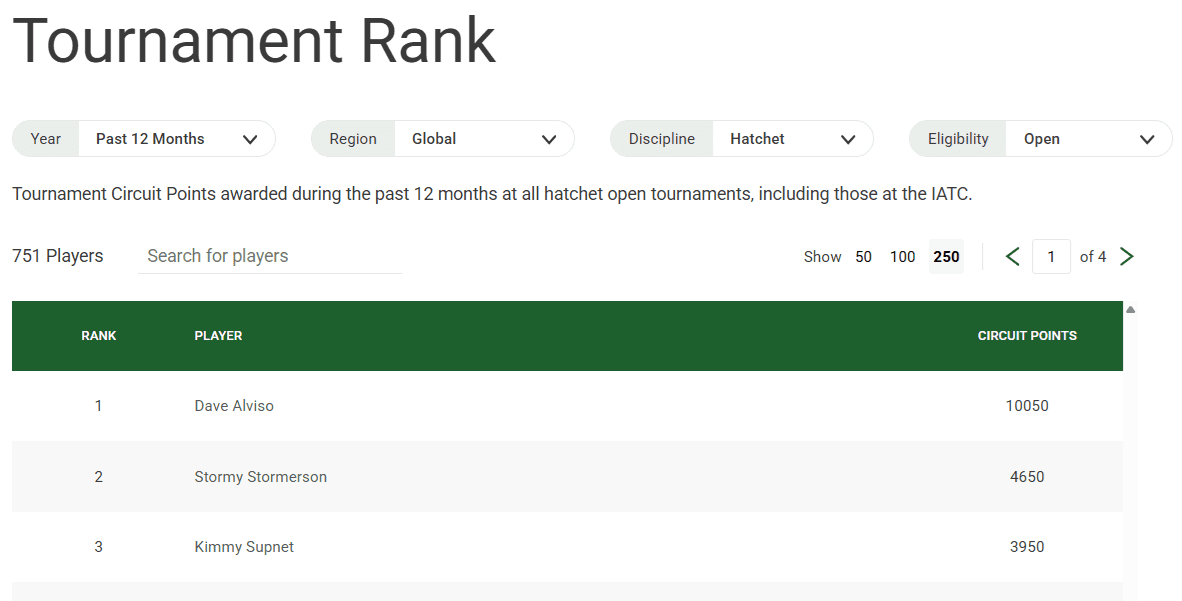
The federation has also pushed the system into mobile-first territory. The IATF announced that its Tournament Rank was live and said IATF mobile app subscribers were eligible to appear on global and regional Tournament Rank leaderboards. That adds another layer for players who want immediate feedback, because the ranking conversation now lives not only in tournament brackets and league tables but also in an app that travels with the thrower.
What the system changes for players
CRS gives axe throwing something many emerging sports struggle to build: a clear path from local participation to international relevance. A player can throw in a league night, see a Standard Rating shift, chase tournament points, and then follow that progress into qualification for events like IATC in Toronto.
That is why the Collins Rating System matters. It turns one night at one venue into part of a larger story, and it gives amateur players a practical way to track progress, compare themselves across borders, and understand why every match can carry weight well beyond the lane.
This article was produced by Prism’s automated news system from verified source data, official records, and press releases, then run through automated quality and moderation checks before publishing. The system is built and supervised by the people who set the standards it runs under. Read our full AI policy.
Did this article answer your question?