After Surviving Attack and Amputation, Diana Jordan Finds CrossFit Community
Diana Jordan’s CrossFit story is not about podiums. It is about how training, scaling, and an affiliate community helped her turn survival into a daily routine.
What CrossFit means when the leaderboard is not the point
Diana Jordan’s story lands harder than any Open score. She was attacked on Feb. 15, 2018, shot in the femoral artery, and spent the next stretch of her life fighting through five hospital deaths, a ventilator, multiorgan failure, dialysis, sepsis twice, and 30 operations in just six weeks before losing her left leg at the hip joint.
That kind of trauma can shrink a life down to the next breath. Jordan came home four months later weighing just 74 pounds. What happened next is the part competitive coverage often misses: CrossFit did not show up as a shortcut to elite fitness. It showed up as a framework for rebuilding ordinary life, one controlled rep at a time.
From survival to the gym floor
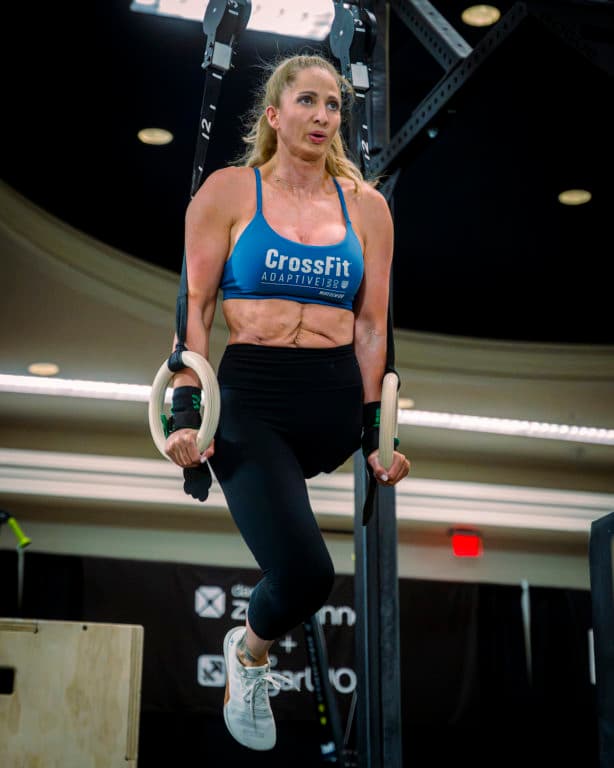
Jordan found CrossFit at the end of 2020 at CrossFit Citadel in Longview, Texas, and the appeal was immediate: the work could be adapted to her body instead of forcing her body to fit someone else’s template. She trained by removing her prosthetic for many movements and using a box behind her for stability when she moved away from the rig. That is the real story here. CrossFit’s value is not just in the intensity; it is in the ability to scale intensity without stripping away purpose.
She built a routine that sounds simple only if you ignore how difficult consistency becomes after catastrophe. Jordan went to classes five times a week and added strength work three days a week. That volume mattered because it gave her repetition, and repetition is where confidence starts to outgrow fear. Over time, that consistency improved her balance, strength, and flexibility, the basic physical ingredients that let a person move through a day without thinking about every step.
Why the affiliate matters
Jordan eventually moved to CrossFit Lindale in 2023, and the gym became more than a place to train. It became a community that understood grief because it was living through its own. Owners Nate and Jodi McCollum lost their son in a car accident that same year, and Jordan said the gym supported both her and the owners through major trauma.
That detail matters because it gets to the sport’s true social infrastructure. The affiliate is not just a box with barbells and ropes. It is where people show up injured, scared, embarrassed, or rebuilding, and are still expected to keep moving. In Jordan’s case, that meant a place where the staff and members understood that progress was not linear and that some days the win was just walking in.
The adaptive lane CrossFit built around athletes like Jordan
Jordan’s progression also runs straight into CrossFit’s adaptive structure. Her athlete profile identifies her as a hip disarticulation amputee and a domestic violence survivor, and it says she is new to CrossFit and preparing to compete in the Open for the first time. That is not a side note. It is the competitive door opening after the work of getting life back in order.
CrossFit’s lower-extremity adaptive division is built for significant, permanent impairments affecting the legs, including the hip joint. In other words, the sport has a lane for athletes whose limitations are not temporary and not cosmetic. That framework exists because the sport eventually had to answer a basic question: if the methodology can be scaled, why should competition stop at one body type?
How the adaptive season changed
The adaptive pathway did not appear overnight. CrossFit introduced an adaptive Open in 2021, then the system kept expanding. In 2023, CrossFit announced that WheelWOD would host the adaptive Open, Semifinals, and Games for the 2024 season. CrossFit said the change would nearly double the number of divisions for adaptive athletes and give every adaptive division a place at the in-person championship.
That is a meaningful shift. It takes adaptive athletes from the margins of the season into a clearer championship structure, and it makes the pathway easier to understand for the people watching at home. The 2024 Adaptive CrossFit Games were held Sept. 19-22, 2024, in San Antonio, Texas, giving the adaptive field a visible stage rather than a separate afterthought.
Why Jordan’s example resonates beyond one division
Jordan’s arc is powerful because it does not rely on a miracle ending. She did not return to fitness by pretending the injury never happened. She returned by working around it, on purpose, every week, until movement became normal again. That is what makes her story bigger than a personal comeback: it shows how CrossFit’s actual identity lives in adaptation, not just competition.
The sport loves its stars, its qualification lines, and its final-cut drama. Fine. But the harder truth is that CrossFit’s most durable feature is the one most competitive coverage leaves in the background: it gives people a way back into their bodies and into other people’s company. Jordan found that at CrossFit Citadel, carried it to CrossFit Lindale, and now stands as proof that the box can be a place where survival becomes routine, then routine becomes purpose.
That is the version of CrossFit worth protecting.
This article was produced by Prism’s automated news system from verified source data, official records, and press releases, then run through automated quality and moderation checks before publishing. The system is built and supervised by the people who set the standards it runs under. Read our full AI policy.
Did this article answer your question?