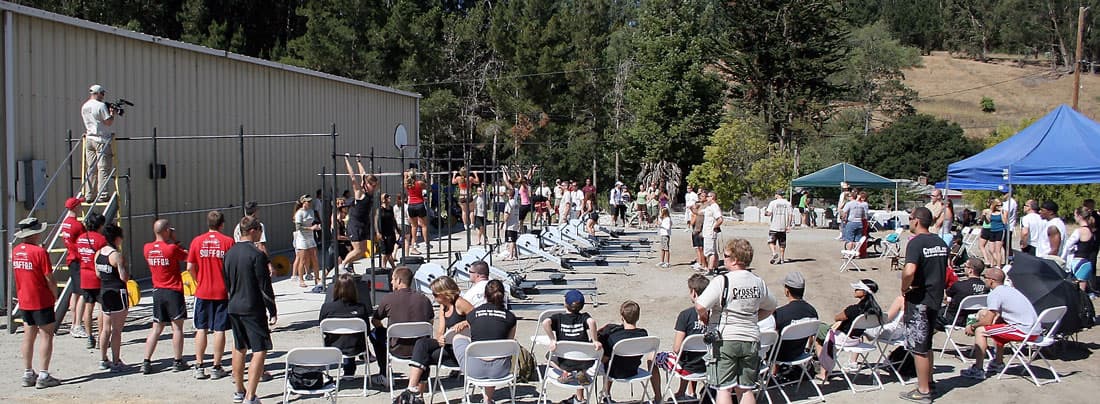
CrossFit explains why judging is central to fair competition
CrossFit judging is not background noise, it is the mechanism that turns effort into a real score. The Open, video review and no-reps all show how one call can reshape a leaderboard.

In CrossFit, the judge is part of the performance. A rep that looks clean in the moment can disappear on the leaderboard, and the difference between a score that stands and a score that gets erased often comes down to a movement standard, a split-second count, or a video review that catches what the eye missed.
Why judging sits at the center of CrossFit
CrossFit treats judging as a core competitive skill because the sport asks officials to compare efforts that are often over in less than a second.
Athletes can feel like they are moving correctly in regular class work and still miss range of motion when a judge is watching closely. Like referees in other sports, a judge has to make a fast call on whether the rep meets the standard, and in CrossFit that call can change the result of a workout, a workout win, or an entire season placement.
How the 2026 Open makes judging formal
The 2026 CrossFit Games Open begins Thursday, Feb. 26, 2026 at 12 p.m. PT, and each week score submission closes Monday at 5 p.m. PT. In the rulebook, Open performances are judged, validated and ranked on the official leaderboard, which means the leaderboard is not just a raw log of times or reps. It is a filtered record of what held up under review.
That system puts real responsibility on judges and affiliate managers. Completing the current-year Judges Course, or holding a current Advanced Judges Course certificate, is required for all CrossFit Games Affiliate Managers. Those managers also have 48 hours after an Open workout closes to reject scores before results are finalized.
Once scores are validated, they feed the leaderboard that determines who keeps moving and who does not.
No-reps are not small mistakes
The biggest misconception about judging is that no-reps are just technical nitpicks. In reality, they are the mechanism that keeps a result honest. Judges can reveal faults athletes did not know they had, especially when range of motion is the issue and the athlete is moving too fast to self-audit in real time.
That is why borderline calls can be so volatile. A squat that looks deep from the athlete’s angle may not meet the standard from the judge’s line of sight. A rep that feels complete can fall short if the movement ends before the required range of motion is reached. In a sport built on speed and fatigue, those margins are not abstract, they are the difference between a rep being counted and being erased.
The 2025 Games also showed how much a single counting error can matter. CrossFit logged an appeal involving a double-under crossover miscount that produced a new time for multiple athletes.

Video review is the second line of defense
CrossFit’s video review process makes the stakes even clearer. If an athlete cannot provide a required video for an online test, the athlete receives a zero score for that test.
Once a video is submitted, the work does not stop with the on-site judge. Videos that receive penalties are reviewed by multiple judges. Performances that affect prize money or progression to the next stage of the season are prioritized first.
The review process begins with the top scores in a test and the top athletes in the overall standings. That creates a practical funnel: the more likely a performance is to affect the leaderboard in a meaningful way, the more likely it is to receive close scrutiny.
Judging also changes strategy and pacing
CrossFit scoring is not just about whether a rep counts, it shapes how athletes attack a workout. Some events use tiebreaks to separate athletes who finish with the same rep total, and in a workout with a time cap, finishing under the cap may still leave the athlete without a tiebreak score. When tied reps are broken by a split or checkpoint time, pacing affects placement.
The Judges Course exists partly to improve understanding of movement standards, range of motion and movement evaluation, and that knowledge is useful to athletes as well as officials. Athletes who know where the judge is going to be strict can pace differently, set up cleaner reps and avoid burning energy on a movement that is doomed to be no-repped.
The judge has become part of the sport’s infrastructure
CrossFit’s judging system has also become a recruiting and credentialing pipeline. Judges are vetted well in advance for the Games, and CrossFit turns down hundreds of potential volunteers every year because they do not yet have the required credentials. Prior experience judging virtual competitions and local Open workouts can raise a volunteer’s standing.
That evolution tracks with the sport itself. The CrossFit Games began in 2007 on a ranch in Aromas, California, and the field has grown into something far more technical and far deeper than the early days. CrossFit says the average Semifinals athlete in 2023 would be dramatically more capable than the world’s best in 2007.
Live competition still leaves room for appeal, but even there the line is firm. Athletes can challenge a score, yet on-field judgment calls are final.
This article was produced by Prism’s automated news system from verified source data, official records, and press releases, then run through automated quality and moderation checks before publishing. The system is built and supervised by the people who set the standards it runs under. Read our full AI policy.
Did this article answer your question?