DJI Dominates Consumer Drones as Oregon Proposes Test Corridors
DJI still owns the consumer drone lane, but Oregon's test corridors and FCC spectrum rules are reshaping where the next FPV gear gets built and proven.
The market is narrowing while the testing map expands
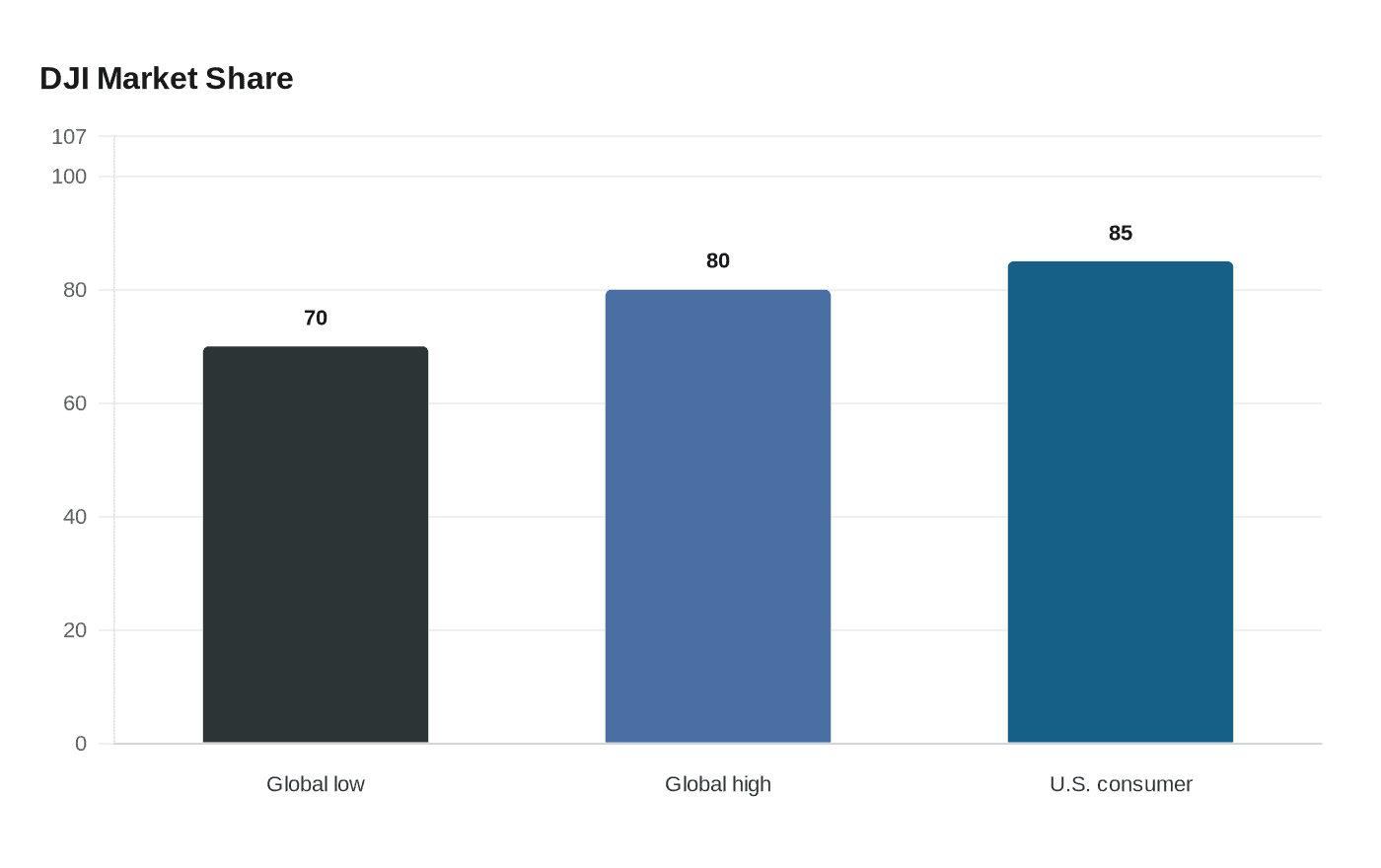
DJI still sits at the center of the civilian drone world, and that dominance matters far beyond retail shelves. Industry sources continue to place DJI around 70% to 80% of the global civilian market, with U.S. consumer share cited as high as 85% when the product is available, a level of control that shapes prices, accessories, training gear, and the video systems FPV pilots actually fly with. At the same time, American rivals are being pulled toward defense work, leaving the hobbyist and consumer end of the market thinner than it used to be.
That squeeze is not abstract. When one ecosystem becomes the default, compatibility becomes power, and every shift in supply affects daily flying habits. For racers and freestyle pilots, the result is a tighter hardware funnel, fewer alternative platforms, and greater dependence on the few consumer systems that can still scale.
Skydio’s defense pivot is the clearest sign of where U.S. drone money is flowing
Skydio’s trajectory shows how sharply the market has tilted. In March 2026, the company said the U.S. Army placed an order worth more than $52 million for more than 2,500 X10D drones, and Skydio described it as the Army’s largest single-vendor tactical sUAS order in history. The company also said the bid-to-award process took under 72 hours, a reminder that defense procurement can move fast when the platform fits the mission.
That order did not appear out of nowhere. Skydio said it entered the final phase of the Army’s Short Range Reconnaissance Tranche 2 program in January 2024, and that its X10D was the only system delivered to date in that tranche. Put together, those details show a company leaning hard into military work while the consumer lane grows less certain. For FPV pilots, the implications are practical: fewer American companies fighting over hobbyist share means less pressure to build cheaper, broader consumer ecosystems.
FCC spectrum policy is no longer theoretical
The policy fight around drone spectrum has already moved past the comment stage. The Federal Communications Commission adopted UAS spectrum rules on August 21, 2024, and the Federal Register published them on January 8, 2025. Under new Part 88 rules, operators can obtain direct frequency assignments in part of the 5030-5091 MHz band for non-networked operations.
That matters because the FCC’s own documents say the rules are meant to support control-related communications with the reliability those operations require, using dynamic frequency management systems. In plain language, that means regulators are trying to make the control link more dependable in a crowded spectrum environment. For drone racers and FPV pilots, the downstream effect could be cleaner video links, steadier control signals, and fewer headaches on race day when interference can ruin a lap before the gate even opens.
Oregon has pushed that conversation in a particularly concrete direction, arguing for movement toward the 5030 and 5091 MHz bands for critical operations because the unlicensed bands are too crowded for safety-critical flights. That is not just a policy preference. It is a recognition that the sport and the wider drone industry depend on radios that hold up under pressure, especially as more pilots crowd into the same frequencies.
Oregon’s test ranges turn geography into an advantage
If spectrum is the invisible infrastructure, Oregon’s test sites are the physical one. The State of Oregon Department of Aviation has identified three proposed drone test corridors: one in the Cascades near Oakridge, one along the Columbia River Gorge, and one in Southeast Oregon. Each offers the kind of real-world terrain that academic labs cannot reproduce, from mountain conditions to broad corridors and open desert.
Oregon already has a more formal testing footprint through the Pan-Pacific UAS Test Range Complex. Its locations are in Pendleton, McMinnville, and Tillamook, with fixed test ranges at Pendleton Airport, Tillamook Municipal Airport, and the Warm Springs Reservation. The Alaska Center for UAS Integration also lists the locations as Pendleton Airport; Tillamook uncontrolled public airport, managed by NearSpace, Inc.; and Warm Springs Reservation, which underlines how established the framework already is.
The appeal is not just access, but variety. Pendleton’s UAS test range says it offers 14,000 square miles of FAA-approved airspace, backed by expert support and a legacy of aviation leadership. Tillamook describes itself as the only UAS test range in a maritime environment, with a setting useful for COA development. Between high desert, coastal airspace, mountain terrain, and reservation-based testing, Oregon gives developers a place to prove hardware in conditions that look a lot more like the field than the lab.
Why FPV and racing pilots should care even if they never file a test plan
The connection between these policy and infrastructure changes and the racing scene is indirect, but it is real. Better spectrum policy can make race-day video feeds more stable and reduce the sort of interference that turns a clean run into a frozen image. New test corridors and innovation zones can accelerate the development of hardware that eventually trickles down to the gear pilots use every weekend.
There is also a supply-chain angle that is easy to miss. Foreign drone restrictions and the shrinking consumer market could push pilots toward a smaller number of available ecosystems, which raises the stakes on compatibility. When fewer platforms dominate, every choice in goggles, receivers, flight controllers, and radio systems becomes more consequential. That is why the headline is not really just about DJI’s market power or Oregon’s testing map; it is about who gets to define the next generation of flight equipment.
The bigger picture is control
Taken together, the story is about power moving to the places that can shape the future fastest: the company with the dominant consumer footprint, the defense buyer with the biggest checks, the regulator writing spectrum rules, and the state building places to test in the real world. DJI remains the standard in civilian drones, Skydio is increasingly a defense contractor, and Oregon is turning terrain and airspace into an advantage. The pilots who fly for fun or for competition will feel that shift in the gear on their workbenches long before they see it in a policy memo.
Know something we missed? Have a correction or additional information?
Submit a Tip