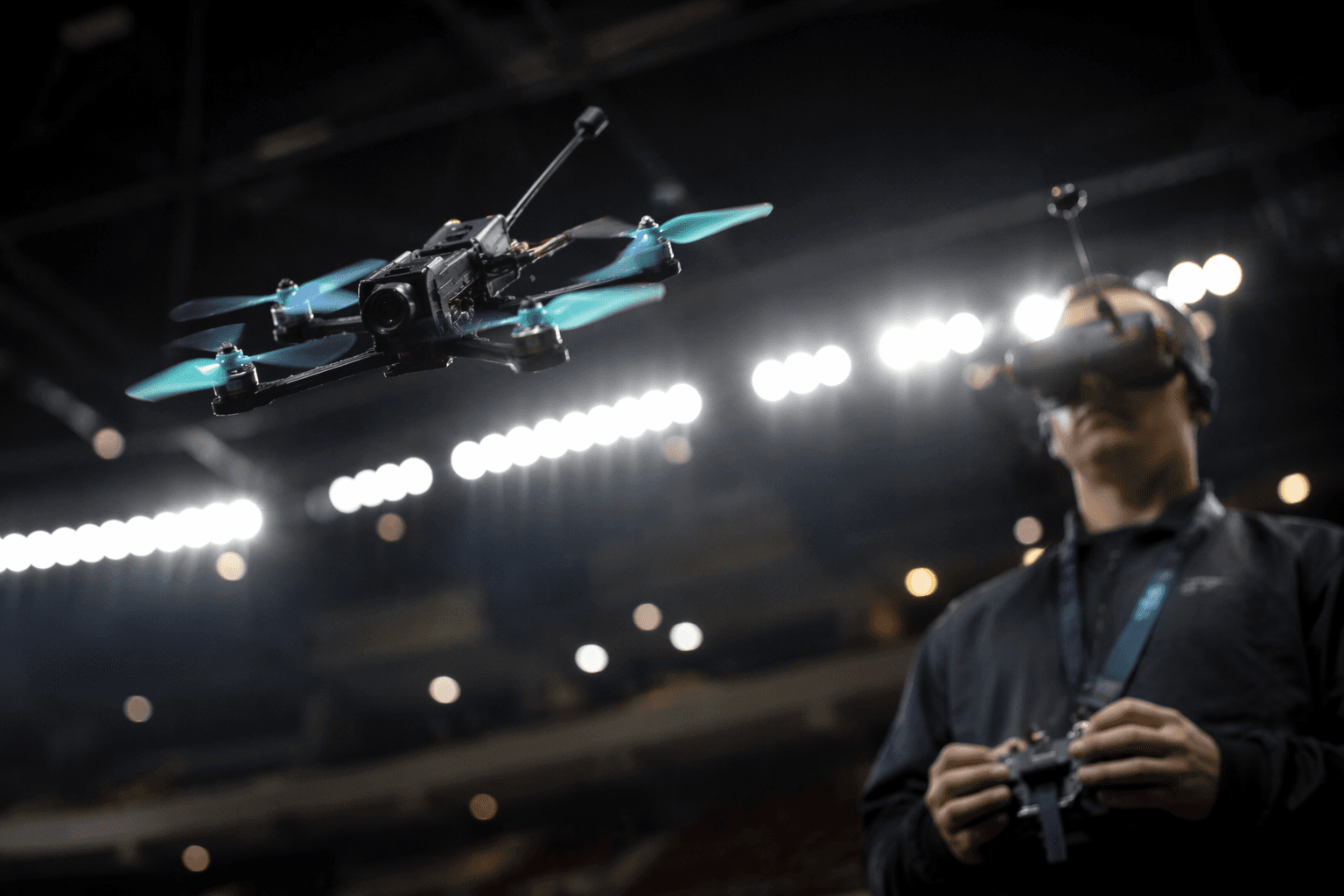
Drone racing is won by mastering the track itself
Drone racing is decided by the course: gate size, elevation, and chokepoints shape who advances, who crashes, and who wastes speed.

Pilots race on a specially built course, threading gates and obstacles to the finish in the fastest time after three laps. The best lap often belongs to the pilot who reads the layout fastest, because every turn changes line choice, momentum, and crash risk before the clock ever does.
The track is the test
The current World Games format turns that idea into structure. Qualification is built around five rounds, with eight races per round, four pilots in each race, and up to three minutes to complete three consecutive laps. Rankings come from the average of each athlete’s three fastest single-lap times, which means one reckless blast rarely beats a pilot who can repeat a clean, legal line three times over.
A pilot who carries speed through the wrong gate angle loses more than a fraction of a second. The mistake compounds at the next obstacle, then the next, until the race is no longer about pace but recovery.
Gate size changes the whole race
MultiGP’s obstacle standards make the geometry of the sport easy to see. Its standard chapter gate is 5 by 5 feet, while championship racing uses a larger 7 by 6 opening. The wider championship gate is meant to create better racing and fewer crashes. The opening itself dictates how aggressive a pilot can be at top speed.
A tight gate punishes hesitation. A larger gate invites a straighter attack and gives pilots more room to stay full throttle without clipping a frame or losing the line into the next corner. For fans, this is where a race gets decided before the photo finish: if the field enters a gate at different heights or angles, the pilot who exits cleanly often gets the only usable lane into the next obstacle.
These dimensions matter beyond a single series. MultiGP has more than 30,000 registered pilots and 500 active chapters worldwide, so its obstacle language has become a de facto standard at the grassroots level. When a 5 by 5 gate or 7 by 6 championship opening shows up on a course map, it signals how much speed the track will allow.
Every obstacle has a job
The course vocabulary is where drone racing becomes a real tactical sport. Towers and double gate towers force altitude shifts that break rhythm and reward pilots who can hold a stable line while changing height. Ladders and topless ladders ask for careful vertical management, because the drone has to climb or descend without over-rotating into the next sector.
Dive gates do something different: they demand commitment and punish half-measures. Launch gates reward a hard throttle punch, while hurdles and super hurdles compress acceleration and braking into a tiny window where the pilot has almost no time to correct a bad setup. Split-S gates may be the clearest example of course control, because the pilot has to go up and over the obstacle rather than cheat around it, and flags can be used to enforce that line. Offset-90 gates add another layer by forcing a quick change of direction without giving the pilot a clean straightaway to reset.
What fans should watch on race day
The course is the best watching guide. Once you know what each obstacle does, the race starts to read like a series of forced decisions rather than a blur of motion.
- Watch the first gate after the start. If the field is crowded into a tight opening, the pilot who exits with the cleanest angle usually gets the cleanest air for the next turn.
- Watch any split-S or ladder section. Those are the places where altitude management separates a smooth lap from a messy one, and they often expose who is flying on instinct versus who is flying on plan.
- Watch the chokepoints. Hurdles, dive gates, and narrow offsets are where speed has to be converted into precision, and they are also where a bad entry can trigger contact.
- Watch for line changes after a mistake. In drone racing, the fastest recovery is often not the flashiest move, but the one that gets the drone back into the intended rhythm without burning time.
Why venue and video quality matter
A circuit can be indoor or outdoor, but organizers have to choose a location that supports good video reception. FPV racing depends on what the pilot sees through the live feed, so the quality of the video path becomes part of the competitive environment itself.
That requirement also helps explain why track design is inseparable from venue design. A course can look brilliant on paper and still fail if the reception is unreliable, because the pilot’s ability to judge a gate entry or a split-S line depends on a stable image.
How the sport’s rules have hardened
Drone racing entered the Sporting Code as provisional class F3U on January 1, 2016, became F9U on January 1, 2019, and became an official class on January 1, 2025.
FAI also launched the first E-Drone Racing World Cup in 2024 as a series of four or five events on different circuits.
Big stages have already shown what matters
The 2024 FAI World Drone Racing Championship in Hangzhou ran from October 31 to November 3 on a triple-level, 650-meter track with 55 obstacles. More than 100 pilots from 33 nations were in the field, which is exactly the kind of pressure cooker that exposes whether a design produces real racing or just expensive chaos. Triple levels and a long obstacle count force pilots to manage both vertical rhythm and mental fatigue over a course that leaves little room to improvise.
The 2025 World Games course in Chengdu pushed the idea further with 44 gates and obstacles along a developed trajectory of about 590 meters. The track was shaped like a panda, a tribute to Chengdu that also had to work as a legal racing line, and 32 athletes qualified for the event inside the broader World Games air-sports competition held from August 7 to 17, 2025.
By FAI’s count, around 40% of championship entrants are juniors, and juniors make up the majority of female pilots.
This article was produced by Prism’s automated news system from verified source data, official records, and press releases, then run through automated quality and moderation checks before publishing. The system is built and supervised by the people who set the standards it runs under. Read our full AI policy.
Did this article answer your question?