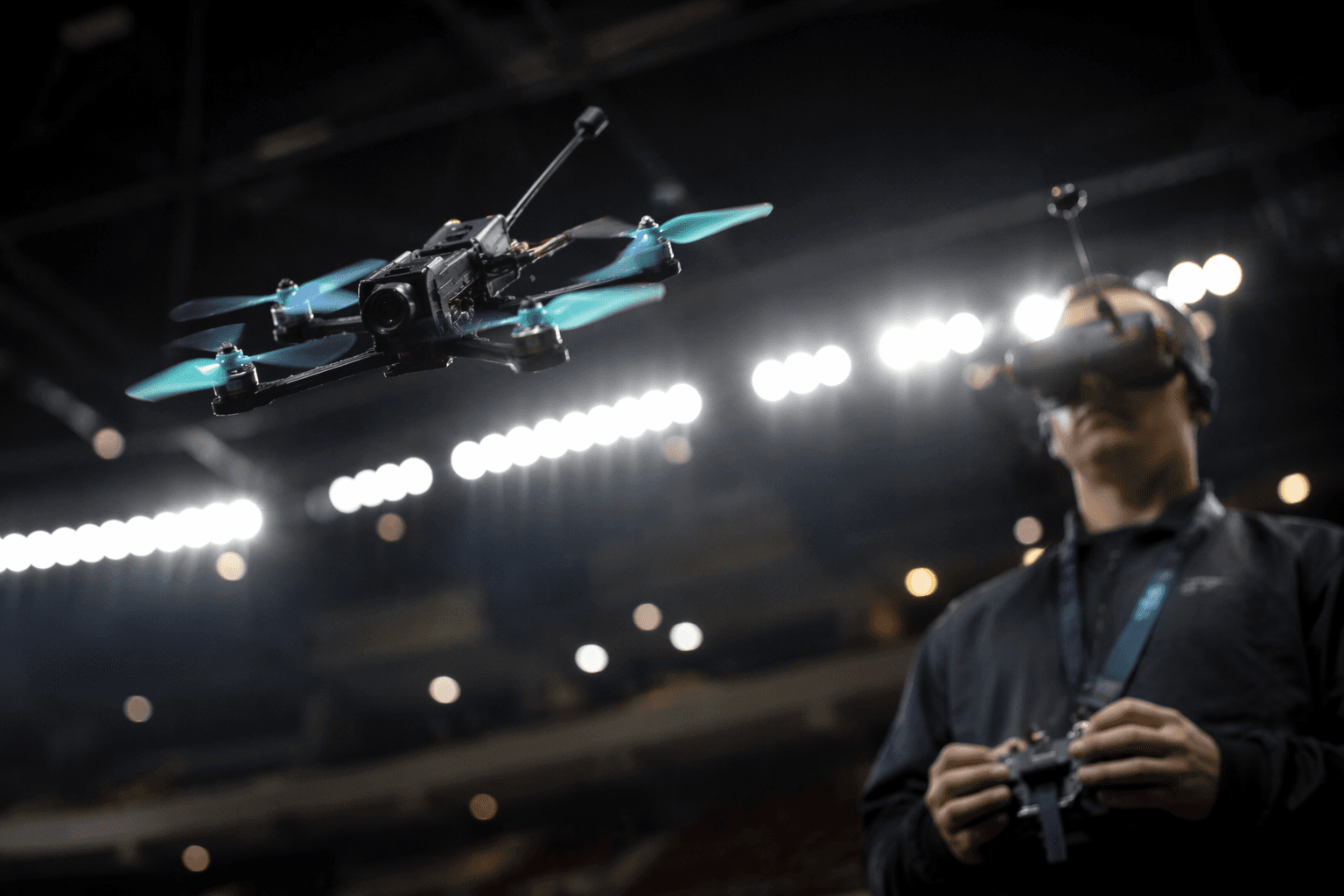
Drone racing rises from hobby to World Games sport
From Karlsruhe hobbyists to a World Games debut, drone racing scaled into a mixed, global sport in a decade. Hangzhou's 100-plus-pilot championship proved the leap.

A sport that began with hobbyists in Germany became a World Games event in little more than a decade, and the size of its next step made the trajectory impossible to miss. In Birmingham, 32 pilots from 25 nations raced in a mixed field at Protective Stadium, then the discipline moved on to a 100-plus-pilot world championship in Hangzhou with a course built for speed, obstacles and elimination pressure.
From Karlsruhe to the World stage
Drone racing’s modern origin story is compact and unusually clean. The FAI traces the first organized hobbyist races to Germany, with early pilots gathering in Karlsruhe in 2011, a starting point that gives the sport a fixed place and date instead of the vague folklore that often surrounds new competitions. Just over a decade later, drone racing had a place at The World Games 2022 in Birmingham, Alabama, a leap that turned a niche FPV pastime into a formally recognized air sport.
That World Games appearance mattered because The World Games sit just below the Olympic Games in multi-sport scale. Once drone racing reached that platform, it was no longer being judged only as a tech hobby or a social-media spectacle; it had entered the same legitimacy conversation that has lifted other fringe sports into mainstream consideration.
How the race works when it is official
At its core, drone racing is simple to describe and hard to master: pilots try to beat one another around a specially built course. The FAI classifies the discipline as F9U, and its World Cup rules sit in the FAI Sporting Code Volume F9 Drone Sports, which is the structure that turns a fast-moving pastime into an administered competition.
The Birmingham documents show how much organization sits behind the velocity. The World Games 2022 competition used selection rankings, qualifying lists approved by CIAM, the FAI Aeromodelling Air Sport Commission, and instructions for a race simulation. That kind of paper trail is what separates a demo from a sport, because it defines who gets in, how they advance, and how the event is judged before the first propeller spins.
Why the sport spread so quickly
Drone racing’s rise has been powered by more than novelty. The FAI says the wider drone sports community now stretches across the globe and attracts e-sports fans who follow races online, which helps explain why the sport has traveled so quickly through digital-native audiences. It also sits at the intersection of technology, gaming culture and motorsport-style competition, a combination that gives it a different growth path from traditional air sports.
The technology itself widened the lane. The FAI says easily available drones have brought tens of thousands of new people into air sports very quickly, and the category has expanded beyond pure racing into combat and team-based events. That broader ecosystem matters because it gives organizers more than one format to build around, more than one kind of participant to recruit, and more than one kind of fan to keep engaged between championships.
The sport’s audience profile has also helped it travel. The FAI describes drone racing as one of the fastest-growing air sports and says it has built a large following among young fans, particularly in Asia. That matters because the sport’s visual grammar, glowing gates, split-screen feeds and onboard FPV views, is built for a generation that already consumes competition through phones, streams and game-like interfaces.

Birmingham’s mixed field gave the sport its first major showcase
The Birmingham event made the case for drone racing’s scale in a way no exhibition could. The competition ran on July 9 and 10, 2022, at the 45,000-capacity Protective Stadium in downtown Birmingham, with 32 pilots from 25 nations competing in a mixed event. Of those pilots, 20 were men and 12 were women, all competing under a single individual classification.
That mixed format gave the sport an identity distinct from many legacy disciplines. The FAI says disabled athletes can compete in drone racing, and wheelchair users are often among the competitors, which makes the field more inclusive than many traditional sports and gives it a different human texture when it is staged in front of a large crowd. The Birmingham crowd also revealed the sport’s presentation problem: the FAI says audiences sometimes struggled to follow the action, a reminder that drone racing has had to learn how to stage itself as it grows.
That learning carried into The World Games 2025 in Chengdu, where the FAI said numerous changes had been made after Birmingham to make the racing easier to track. The adjustment shows a sport that is not just expanding, but refining the way it presents speed to spectators who are still learning the visual language of FPV competition.
Hangzhou showed the next level of scale
By the time the FAI World Drone Racing Championship landed in Hangzhou, China, from October 31 to November 3, 2024, the sport was operating on a different tier. The championship drew more than 100 pilots from 33 nations, and the track itself was built as a triple-level, 650-meter course with 55 obstacles. That is not the layout of a novelty event. It is a championship engine designed to test precision, nerves and consistency across multiple stages.
The event structure matched the scale. The FAI’s schedule included qualifying rounds, additional sequence rounds, elimination stages, finals and a prize-giving ceremony, which gave the championship the same competitive arc seen in bigger mainstream properties. The FAI calls the World Drone Racing Championship the biggest competition of its kind, and by Hangzhou it had the field size, course complexity and round structure to support that claim.
What made the rise stick
Drone racing’s path to legitimacy happened fast, but not accidentally. It began with a small German hobby scene, gained structure through FAI rules and CIAM selection systems, reached its first world-stage proof point at The World Games 2022, and then scaled into a truly international championship with triple-digit fields and course design that demanded more than speed alone.
That is the pattern that makes the sport durable. It has the accessibility of modern tech, the audience behavior of e-sports, the competition logic of motorsport and enough formal structure to keep moving from showcase to championship without losing its identity.
This article was produced by Prism’s automated news system from verified source data, official records, and press releases, then run through automated quality and moderation checks before publishing. The system is built and supervised by the people who set the standards it runs under. Read our full AI policy.
Did this article answer your question?